

70 Rule Calculator for House Flipping: How to Use It in South Florida
June 9, 2026 · 6 min read · By Onias Derilus, Broker
The 70 rule calculator is the fastest way to filter out bad flip deals before you waste time on due diligence. Here's how it works, and how to apply it in Palm Beach, Broward, and Miami-Dade.
Every flipper who has done more than a couple of deals runs the 70 rule calculator before anything else. You do it before you tour the property, before you call a contractor, and definitely before you let yourself get excited. The math takes about 30 seconds, and it tells you whether a deal is worth another minute of your attention.
What is the 70 rule calculator?
The 70 rule calculator gives you the most you should pay for a property you plan to flip. The formula is short:
- Maximum Offer = (ARV x 0.70) - Estimated Repair Costs
ARV is After Repair Value, meaning what the property will sell for once it is fully renovated and back on the market. That 30 percent gap is there to cover your profit, holding costs, closing costs, and agent commissions. It is not padding. It is the part of the deal that keeps you out of trouble when something goes sideways.
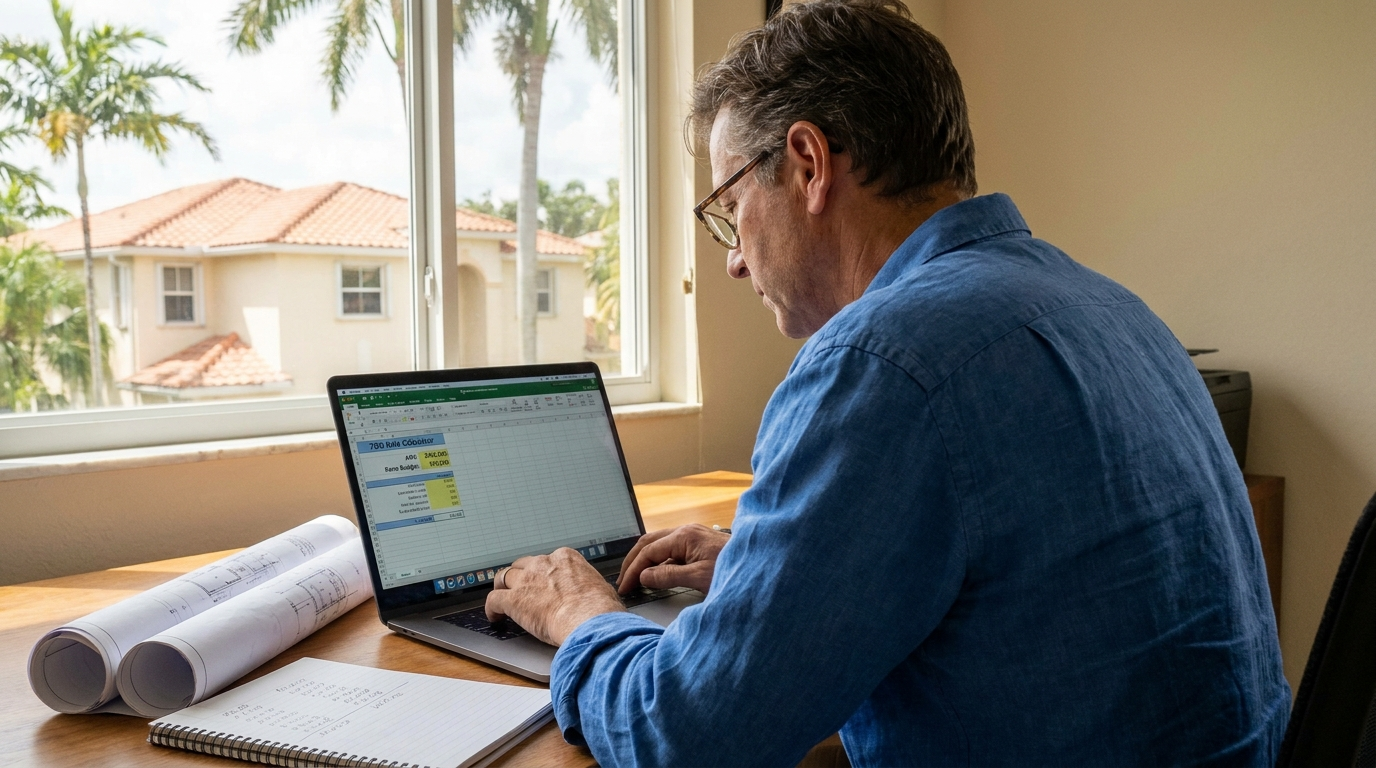
70 rule calculator example in south florida
Say you find a dated 3/2 in Delray Beach. Renovated homes on the same street are selling for $420,000, so that is your ARV. A contractor walks the property and quotes $65,000 for a full renovation. Here is how the math runs:
- ARV: $420,000
- 70% of ARV: $294,000
- Minus repairs: $65,000
- Maximum offer: $229,000
If the seller wants $265,000, the deal does not work at those renovation numbers. Your options are to negotiate the price down, find a cheaper way to do the rehab, or move on to the next one.
When the 70 rule is a starting point, not a hard ceiling
In the tightest South Florida submarkets (Coconut Grove, Pinecrest, parts of Boca Raton) you will almost never see a deal clear 70 percent at list price. That does not mean flipping there is off the table. It means you have to work harder to make the numbers fit. A few ways flippers do that:
- Source off-market through wholesalers, direct mail, or agent relationships
- Find properties where your renovation estimate comes in well below what other buyers are budgeting, which comes down to controlling scope
- Use a higher ARV only when the comps are tight and confirmed by an agent, never a guess
Some seasoned flippers shift to an 80 percent rule in the hottest zip codes, where holding times are short and the rehab is mostly cosmetic. If you are still early in this, stay at 70 percent. It protects you from the surprises that turn up once the renovation is underway, and there are always a few.
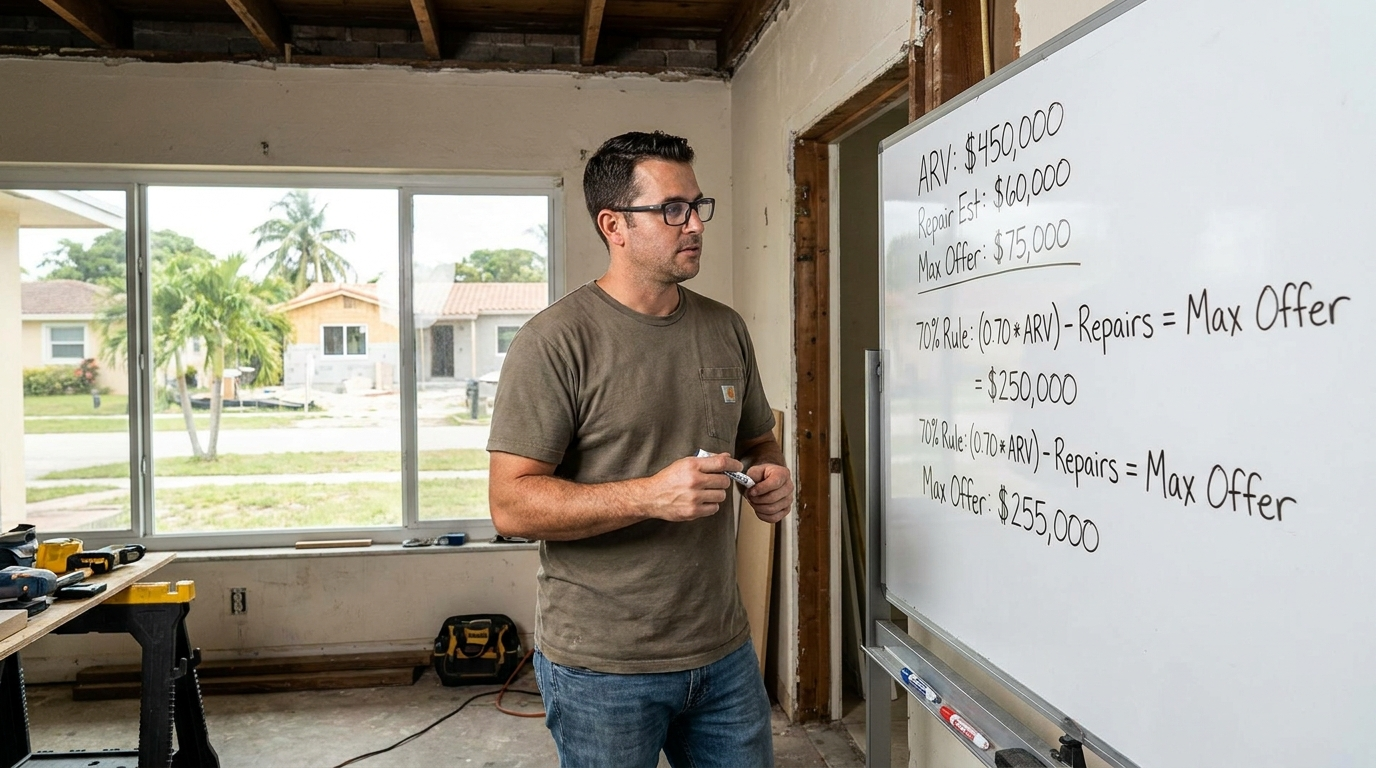
How to find the ARV accurately
Your 70 rule calculator is only as good as the ARV you feed it. Bad number in, bad answer out. Here is how to get the ARV right in South Florida:
- Pull sold comps within a quarter-mile, same bed and bath count, sold in the last 90 days
- Adjust for square footage differences, which run roughly $80 to $120 per square foot in most South Florida markets
- Run it by a local agent who has MLS access and can flag a comp that does not belong
- Lean conservative and use the median comp rather than the one high outlier
Our Fix & Flip / BRRRR Calculator lets you stress-test a deal across different ARV and repair scenarios before you put in an offer.
Common mistakes with the 70 rule
Most new flippers who lose money break the 70 rule in one of two ways. The first is inflating the ARV to make a deal pencil out, often by leaning on a top-of-market sale from two years ago instead of current comps. The second is lowballing the repair estimate, usually off a quick phone quote that balloons the moment a contractor opens up the walls.
The fix is to be hard on both inputs. A deal that still works on conservative estimates will work in real life. A deal that only works if everything breaks your way almost never does.
Want flip opportunities in South Florida that actually clear the 70 rule? Tell us your criteria and we will send you off-market deals that pencil out. We source across all six counties: Palm Beach, Broward, Miami-Dade, St. Lucie, Martin, and Highlands. For broader market context, see Florida Realtors market data.
Frequently asked questions
What does the 70 rule actually account for?
The 30 percent you hold back below ARV is meant to cover your profit plus every cost that is not the purchase or the rehab. That includes holding costs like taxes and insurance, closing costs on both ends, agent commissions when you sell, and a buffer for the repairs you did not see coming. It is one number doing a lot of work, which is why staying disciplined on it matters.
Is the 70 rule too strict for South Florida?
In the hottest pockets, yes, you will struggle to find list-price deals that clear it. That is a signal to change how you source, not a reason to abandon the rule. Off-market deals, tighter rehab scopes, and confirmed comps are how flippers keep buying in those areas. Loosening to 75 or 80 percent is something you earn with experience, not something you start with.
Can I use the 70 rule for a BRRRR deal?
You can use it as a quick screen, but BRRRR has a refinance step that changes the math. What you care about there is whether the appraised value supports pulling most of your capital back out after the rehab. Run it through our Fix & Flip / BRRRR Calculator to see how the numbers hold up across both strategies.
The calculator is fine, the inputs are where deals die
Arithmetic this simple cannot be got wrong. What goes wrong is what you feed it, and two inputs carry almost all of the risk.
After repair value and repair cost are both estimates, and the output inherits every error in them at full size. A calculator returning a confident number from two guesses produces a confident guess, which is more dangerous than no number at all because it feels like analysis.
So the useful work is not running the formula. It is establishing how wrong each input could be and what that does to your maximum bid.
Test the sensitivity before you trust the answer
Run the calculation three times rather than once, and the discipline takes about five minutes.
First with your base assumptions. Then with the after repair value reduced by ten percent, which is well within the range of an optimistic comparable set. Then with the repair budget increased by thirty percent, which is an ordinary overrun on an older house rather than a disaster.
Compare the three maximum bids. The gap between them is your actual margin for error, and if the deal only works at the first number it does not work. Investors who do this stop chasing deals that were never viable, which is the main benefit.
Which wrong input hurts most
They are not symmetrical, and knowing which to guard is worth more than precision on both.
An inflated after repair value is the more damaging error because it is multiplied. The formula takes a percentage of it, so overstating the exit by fifty thousand overstates your maximum bid by tens of thousands before repairs are even considered. Using active listings rather than closed sales is the usual cause, since listings show hope rather than outcomes.
An understated repair budget is subtracted rather than multiplied, so it hurts one for one. It is still the more common error, because estimates produced without a contractor walking the property are guesses and guesses run low far more often than high.
Guard the after repair value with tight closed comparables in finished condition. Guard the repair figure with an actual contractor quote before you commit.
What the formula silently assumes
The seventy percent is doing work that is invisible in the arithmetic, and it assumes conditions that may not be yours.
It assumes a short holding period, roughly a few months. It assumes normal financing costs. It assumes ordinary selling costs including commission and Florida documentary stamps. And it assumes you require a conventional profit margin.
Change any of those and the percentage should move. A deal in a county where absorption is slow carries more months of interest and holding, so the percentage has to fall for the same profit. Highlands currently averages about 206 days on market against 107 in Palm Beach, which is not a rounding difference.
Use it to reject, then underwrite properly
The calculator earns its place as a filter. It lets you discard obviously unworkable listings in seconds, which matters when screening volume.
What it cannot do is approve. Anything that survives the filter should then be underwritten from the bottom up: actual purchase costs, financing for your real holding period, carrying costs, selling costs, and the profit that remains. A deal that clears seventy percent on paper and fails on that build up is still a bad deal.
More common questions
Which input should I be most careful with?
After repair value, because the formula multiplies it. Use closed sales in finished condition rather than active listings.
Should the percentage change by county?
Yes. Slower markets carry more months of interest and holding, so the same profit requires a lower percentage.
Can I use it for a BRRRR deal?
Only loosely, since the exit is a refinance rather than a sale. Model the lender's advance rate and the rent instead.


