

The Best Places to Invest in Real Estate in South Florida (2026)
June 9, 2026 · 7 min read · By Onias Derilus, Broker
The best place to invest in real estate isn't one-size-fits-all. Here's how South Florida's six counties stack up for cash flow, appreciation, and 2026 upside.
Choosing the best place to invest in real estate comes down to one question: what is your goal? Some investors chase monthly cash flow, while others want long-term appreciation. South Florida offers both, but the right county depends on your strategy. Let's compare the markets we know best, from Palm Beach down to Miami-Dade and inland to Highlands County.
What makes a place good for real estate investing?
Before naming markets, it helps to know the ingredients. Strong investment areas share population growth, job creation, landlord-friendly rules, and reasonable entry prices relative to rents. Florida checks every box. The state has no income tax, steady in-migration, and year-round rental demand.
Given that backdrop, even an average South Florida property can perform well. Still, some areas clearly outperform others.
The best place to invest in real estate by county
Here is how the six counties we serve compare for 2026 investors.
- Palm Beach County: Premium appreciation and strong rents in Boca Raton, Delray Beach, and Wellington. Entry prices are higher, so cash flow is tighter.
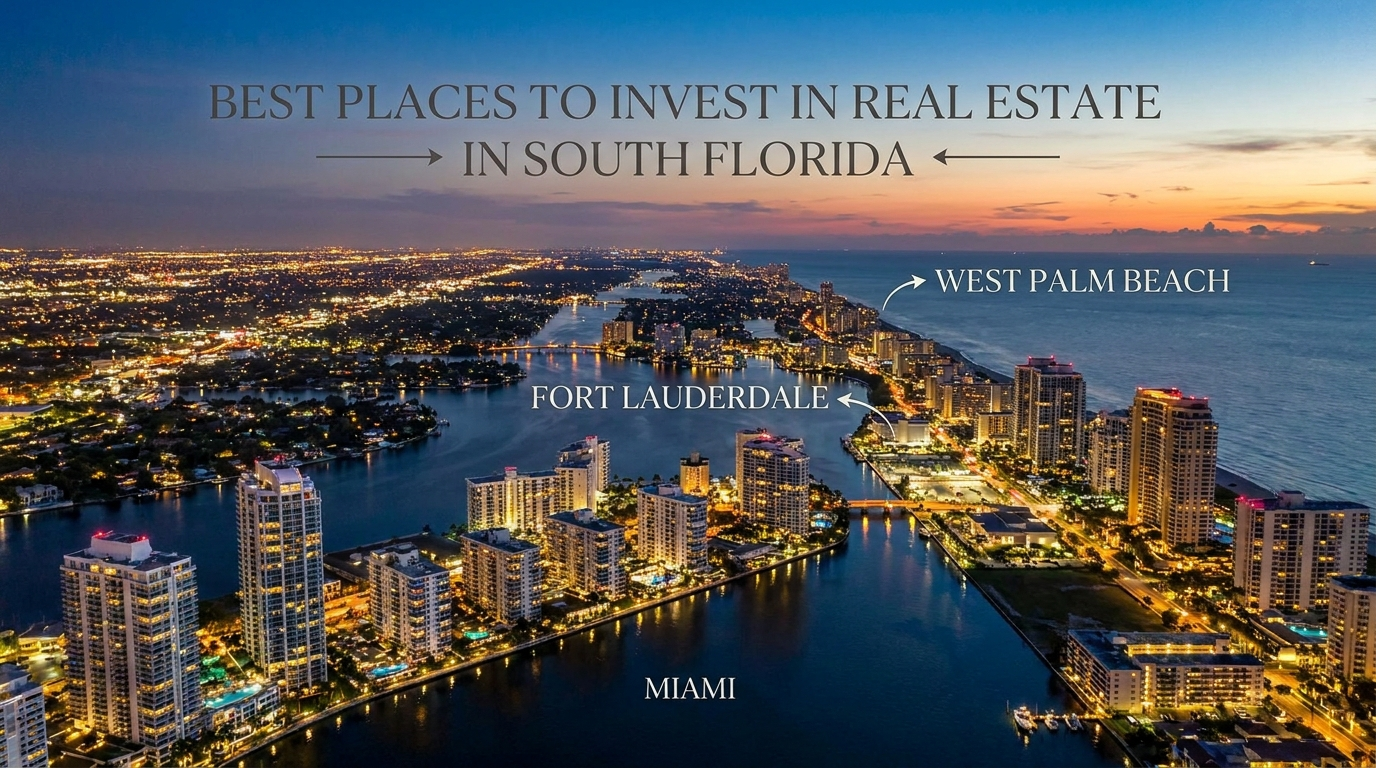
- Broward County: A balanced pick. Fort Lauderdale, Pembroke Pines, and Coral Springs blend solid rents with steady demand.
- Miami-Dade County: The appreciation leader. International capital and tourism keep demand high, especially for condos and short-term rentals.
- St. Lucie County: One of Florida's fastest-growing areas. Port St. Lucie offers lower entry prices and genuine cash-flow potential.
- Martin County: Stuart and Palm City attract stable, higher-income tenants and waterfront upside.
- Highlands County: The value play. Sebring and Lake Placid deliver the highest cap rates for buy-and-hold investors.
Cash flow vs. appreciation: which should you pick?
If you want income now, look inland. Highlands and St. Lucie counties carry higher cap rates because prices stay modest while rents hold firm. If long-term wealth is the priority, the coastal counties reward patience with stronger appreciation.
To compare any specific deal, run it through our rental property ROI calculator. It shows cap rate, cash-on-cash return, and monthly cash flow in seconds.
Don't forget financing and the numbers
Even the best market fails if the math does not work. Secure financing early and model your returns before you make an offer. Investors using the BRRRR strategy should also check the refinance numbers with our Fix & Flip / BRRRR calculator.
For broader context on Florida's market, the Florida Realtors association publishes monthly data worth bookmarking.
Ready to invest in South Florida?
The best place to invest in real estate is the one that fits your goals, budget, and timeline. Our team helps investors find the right county, analyze the numbers, and source off-market deals across the region. Explore our area guides or tell us your investment criteria to get started.
There is no single best market, only a trade
Every "best place to invest" list hides the same trade: yield against liquidity. Cheaper inland markets produce better rent-to-price ratios and take longer to sell. Coastal markets cost more, yield less on paper, and convert to cash faster. Neither is superior. They answer different questions, and the right one depends on your holding period and your tolerance for a slow exit.
What our own inventory shows across the eight counties
Median list prices currently run roughly $599,000 in Miami-Dade, $549,894 in Martin, $480,000 in Palm Beach County, $410,000 in St. Lucie, $399,900 in Indian River, $389,000 in Broward, $309,500 in Highlands, and $265,000 in Okeechobee.
Average days on market tells the other half: about 107 in Palm Beach County, 108 in St. Lucie, 110 in Martin, 117 in Indian River, 125 in Broward, 139 in Miami-Dade, 145 in Okeechobee, and 214 in Highlands.
Read those together. Okeechobee and Highlands offer the lowest entry prices and the slowest resale. Palm Beach and St. Lucie combine mid-range pricing with the fastest absorption. Miami-Dade has the deepest inventory and the highest prices with a moderate pace. That is the actual decision, stripped of marketing.
Match the market to the strategy
- Long-term rental for yield. Inland counties give more rent per dollar invested. Accept that selling will take longer and underwrite a longer exit.
- Appreciation and liquidity. Coastal Palm Beach, Broward, and Miami-Dade have deeper buyer pools. Current yield is thinner, and you are partly buying the ability to sell.
- Flipping. Needs a wide spread between distressed and renovated pricing plus a fast exit. Slow markets punish flips twice, through holding cost and through the wait.
- Land. Okeechobee, Highlands, and St. Lucie carry large vacant-lot inventories. Land has no income, so the whole return depends on the exit, and the homework is zoning, access, and utilities.
The costs that decide returns here regardless of county
Insurance is the first thing to verify anywhere in South Florida. Windstorm and flood coverage can consume a large share of projected cash flow, and it varies enormously by location, roof age, and construction. Get a written quote before you are committed.
Property taxes reset on sale in Florida, so the seller's bill is not yours. On a long-held property the increase can be substantial and it lands in your first full year.
Association dues and pending assessments matter most on condominiums. Reserve funding and milestone inspection findings can produce a bill that exceeds a year of net income, and none of it appears on the listing.
Why sub-market beats market
County-level figures are a starting point and nothing more. Within any county here, individual communities diverge sharply on price, rentability, association health, and flood exposure. An investor who picks a county and then buys carelessly inside it usually does worse than one who picks a specific community and knows it well.
The practical approach is to choose two or three communities that fit your strategy, learn what actually closes there and what units genuinely rent for, and buy when something fits. That beats scanning eight counties indefinitely.
Common questions
Which county has the best rental yield?
Generally the lower-priced inland counties, because rents do not fall proportionally with purchase prices. The trade is a slower resale, which the days-on-market figures above make concrete.
Is Miami-Dade too expensive to invest in?
Not inherently. It has the deepest inventory and buyer pool in the region, which supports liquidity and appreciation. It simply produces less current yield per dollar than inland alternatives.
Should I buy where I live?
There is real value in knowing an area first-hand, particularly for self-managing owners. Just confirm the numbers work rather than assuming familiarity substitutes for underwriting.
Can you help me compare two specific areas?
Yes. We can pull closed sales, current competition, and realistic rents for any communities you are weighing, which is a far better basis than a regional ranking.
Property type matters as much as location
Choosing a county is only half the decision. Within any of them, single-family homes, condominiums, small multi-family buildings, and land behave very differently.
Single-family rentals avoid association risk and appeal to both investors and owner occupants on exit, which widens the buyer pool. Condominiums often show better yield on paper until association dues, reserve requirements, and assessments are counted, and their resale now depends heavily on the building's financial health. Small multi-family spreads vacancy risk across units and can qualify for owner-occupied financing if you live in one. Land produces nothing while held and depends entirely on the exit.
A common mistake is picking the market carefully and then buying whatever is cheapest inside it. The property type should follow the same reasoning as the county: what are you optimising for, and over what period?
Building a shortlist you can actually act on
Pick two or three communities rather than eight counties. Learn what has genuinely closed there over the last six months, what comparable units rent for, how the associations are funded where relevant, and how long listings sit. That knowledge is what lets you recognise a good deal quickly when it appears, which is the real advantage over investors scanning everything.
We can help with that groundwork for any communities you are weighing, and it costs you nothing to ask before you commit capital.
Revisiting the decision as conditions move
The figures above describe today. Inventory, pace, and pricing all shift, and the county that suits a strategy this year may not next year. That is an argument for tracking a shortlist continuously rather than researching once and buying on year-old conclusions.
The underlying trade, though, is durable. Cheaper markets will keep offering better yield and slower exits, and coastal markets will keep offering liquidity at a price. Whatever the numbers do, the question to answer first is which of those two things your money actually needs, because that determines the market long before any individual property does.
A note on advice you read online
Most national "best places to invest" content is written without reference to any specific market, and Florida attracts more of it than almost anywhere. Treat any list that does not cite current inventory, actual closed sales, and local carrying costs as entertainment rather than research. The figures in this article come from our own listing data, which refreshes nightly, and we would rather you check them than take them on trust.


