

Best States to Be a Landlord in 2026, And Why Florida Ranks Near the Top
June 9, 2026 · 6 min read · By Onias Derilus, Broker
Not all states treat landlords equally. Tenant protections, eviction timelines, rent control laws, and property taxes vary dramatically. Here's where Florida stands, and what it means for South Florida investors.
Picking among the best states to be a landlord matters as much as picking the right property. Take two identical houses. Put one in a landlord-friendly state and the other in a tenant-friendly state, and the investment outcomes can look completely different. Here is how to weigh where to put your money, and why Florida keeps landing near the top for rental property owners.
What makes a state landlord-friendly?
A landlord-friendly state usually gives you several things at once. Non-payment evictions move through the courts in 30 to 60 days instead of dragging on for 6 to 18 months the way they do in tenant-heavy states. There is no rent control, so you can price units at market and raise rents at renewal. You can charge a security deposit large enough to actually cover damage. The courts enforce the lease you signed without stacking on delays or leaning toward the tenant. And property taxes stay reasonable, which keeps your carrying costs in check.
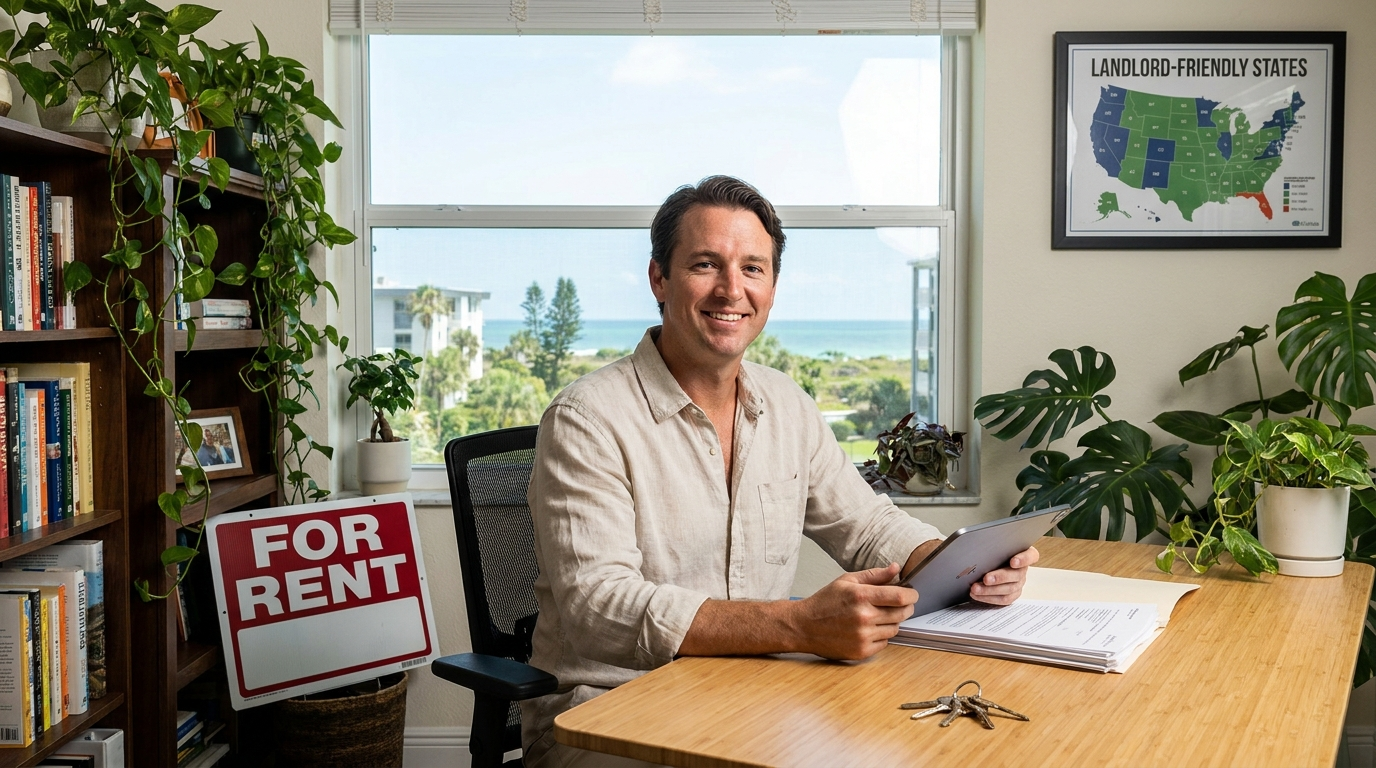
Why Florida ranks among the best states to be a landlord
Florida lands in the top five landlord-friendly states year after year. The reasons are practical, not theoretical.
- No rent control statewide. Florida law preempts local rent control ordinances, so no city or county can cap your rents. That alone separates it from California, New York, Oregon, and Massachusetts.
- Efficient eviction process. Florida lets you serve a 3-day notice for non-payment of rent. When the case is uncontested, eviction usually wraps up in 3 to 5 weeks across most South Florida counties. That is fast by national standards.
- No state income tax. Your rental income gets taxed only at the federal level. Compare that to California, where the state tax tops out at 13.3%, or New York at up to 10.9%, and the difference in net cash flow adds up quickly.
- Strong rental demand. Population growth, year-round tourism, and a steady stream of out-of-state transplants keep South Florida rentals full across every price point.
- Homestead exemption protection. Florida's homestead exemption caps how fast property tax assessments can rise on primary residences. Investment properties do not get the homestead cap, but they still benefit from Florida's overall low property tax rate compared with many Northern states.
The best states to be a landlord: a comparison
If you are deciding where to buy rental property, here is how the leading landlord-friendly states line up.
- Florida. No rent control, fast evictions, no state income tax, and strong rental demand. The mild climate keeps occupancy steady all year.
- Texas. No state income tax and landlord-friendly courts on the back of solid job growth. Property taxes run higher than Florida's, though.
- Indiana. Very low property taxes, fast evictions, and a low cost of entry. Appreciation tends to lag the Sun Belt markets.
- Georgia. A strong Atlanta market, a fast eviction process, and no rent control. It strikes a good balance between cash flow and growth.
- North Carolina. Growing population, landlord-friendly laws, and prices that are still affordable, though investor competition keeps climbing.
For most investors who want both cash flow and long-term appreciation, Florida, and South Florida in particular, offers the strongest combination in 2026.

What to watch as a South Florida landlord
Florida is landlord-friendly, but it is not risk-free. Insurance has climbed sharply in recent years, especially wind and flood coverage along the coast. On condos, association fees and special assessments can eat into returns in a hurry, so factor them in before you buy a unit. Short-term rental rules also change from one municipality to the next, so check the local STR ordinance before you bank on that strategy.
Run the numbers with our Rental Property ROI Calculator before you commit. Then look at the South Florida counties we serve, since each one carries its own risk and return profile for rental investors. For the legal details, Florida Statutes Chapter 83 spells out landlord-tenant law in full.
What landlord friendly does not protect you from
State rankings measure the legal and tax environment, and investors routinely read them as a proxy for profitability. They are not the same thing, and in Florida the gap between the two is unusually wide.
A favourable eviction process does not reduce your insurance premium, which in coastal Florida has risen substantially and is now one of the largest line items in a rental model. It does not reduce property tax, which resets to your purchase price on the January 1 after you buy rather than continuing at the seller's capped assessment. It does not reduce association fees or condominium reserve contributions, which are rising under the current reserve funding rules. And it does not create cash flow where the rent to price ratio does not support it.
So use the ranking for what it measures. Florida's legal environment is genuinely favourable to owners. The economics of a specific property are a separate question and they are the one that decides your return.
The Florida advantages that are real
- No state income tax. Rental income is not taxed at state level, which is a permanent structural advantage over high tax states and compounds over a long hold.
- No statewide rent control. Florida law preempts local rent control in the ordinary case, so you are not exposed to a municipality capping increases.
- A defined eviction procedure. Florida provides a statutory process that is comparatively quick when followed exactly, which is the important qualifier.
- Population growth. Sustained in migration supports rental demand independently of any particular year's market.
Note the qualifier on eviction. The process is unforgiving of procedural error, and a defective notice can restart it. This is the part of landlording where doing it yourself to save a few hundred dollars regularly costs months, and where a Florida attorney earns their fee.
Do not treat homestead protections as landlord protections
Florida's homestead exemption and the Save Our Homes assessment cap apply to a permanent primary residence. A rental property is not homesteaded, so it gets neither.
The consequence is direct. Your investment property is assessed differently from your own home, and the assessment increase limits that protect owner occupants do not apply in the same way. Investors who budget a rental's taxes by looking at what a neighbouring homesteaded house pays will be wrong, usually by a lot.
Where the economics differ inside Florida
Treating the state as one market is the second common error. Median asking prices currently run about $599,000 in Miami-Dade, $545,000 in Martin, $480,000 in Palm Beach, $410,000 in St. Lucie, $399,900 in Indian River, $390,000 in Broward, $309,000 in Highlands and $274,900 in Okeechobee.
Rents do not vary by anything like that ratio, which is why cash flow generally improves as you move inland and away from the coast, while appreciation and liquidity generally improve as you move toward it. Liquidity matters more than investors expect: Highlands averages around 206 days on market against 107 in Palm Beach, so an inland exit takes roughly twice as long.
The choice is therefore between yield and liquidity rather than between good and bad counties, and it should follow your own need for access to the money.
Running it properly wherever you buy
Screen tenants consistently and document the criteria you apply, both because it produces better outcomes and because fair housing obligations apply to how you select. Handle deposits according to Florida's requirements on holding and notice. Put everything in writing, including permission for anything that varies the lease.
Budget the items that are easy to omit. Those are vacancy, turnover and make ready costs, plus management at roughly eight to twelve percent if you use it. Add a genuine capital reserve for the roof and air conditioning rather than a hope that they last.
The insurance question to settle before you buy
For a Florida landlord this is the line most likely to break a model, so treat it as diligence rather than admin.
Get an actual quote on the specific address during your inspection period, not an area estimate. Ask whether the property has a current wind mitigation report, since roof age, roof to wall connections and opening protection drive the wind portion directly. Establish the flood zone and quote flood separately, because standard coverage excludes it.
Then ask what a landlord policy costs rather than an owner occupant one, since the coverage differs and so does the price. A model built on an owner occupant quote understates the real figure and will look profitable right up to the first renewal.
More common questions
How long does an eviction take in Florida?
It varies by county and by whether the process is followed exactly. Procedural mistakes are the main cause of delay, which is why counsel is worth it.
Can a Florida city impose rent control?
State law preempts it in the ordinary case. Verify current law before relying on any general statement, since preemption provisions do get revisited.
Does out of state ownership work?
It can, with a manager you trust and a realistic budget for their fee. Self managing from another state is where most remote landlord problems begin.


