

Can You Flip Houses Without a Real Estate License in Florida?
June 9, 2026 · 6 min read · By Onias Derilus, Broker
You don't need a real estate license to flip houses in Florida, but there are important rules about what you can and can't do without one. Here's what the law actually says.
One of the most common questions from new real estate investors in South Florida is: "Do I need a real estate license to flip houses?" The short answer is no. You can flip houses in Florida without a real estate license, and many investors do it successfully every year. That said, there are clear distinctions between what activities require a license and what falls outside its scope. Getting this wrong has serious legal and financial consequences, so it is worth understanding exactly where the line sits. The question of whether you can flip houses without a license comes down to one thing: are you acting for yourself or for someone else?
What you can do without a license
Florida law allows you to buy, renovate, and sell real estate you personally own without a real estate license. When you are acting as a principal (the actual buyer or seller), you are transacting for your own account, not representing someone else. That is the legal foundation of every legitimate house flipping operation in Florida.
Specifically, a non-licensed Florida real estate investor can:
- Purchase properties in their own name or through a business entity they own
- Hire contractors, supervise renovations, and resell the property
- Use a licensed agent to list and sell the renovated property, paying their commission as part of closing costs
- Execute purchase contracts and sale contracts as a principal
What requires a license
Florida real estate license law applies when you are being compensated for representing or facilitating transactions on behalf of others. Activities that require a license include:
- Listing someone else's property for sale and receiving compensation
- Representing buyers or sellers in a transaction for a fee
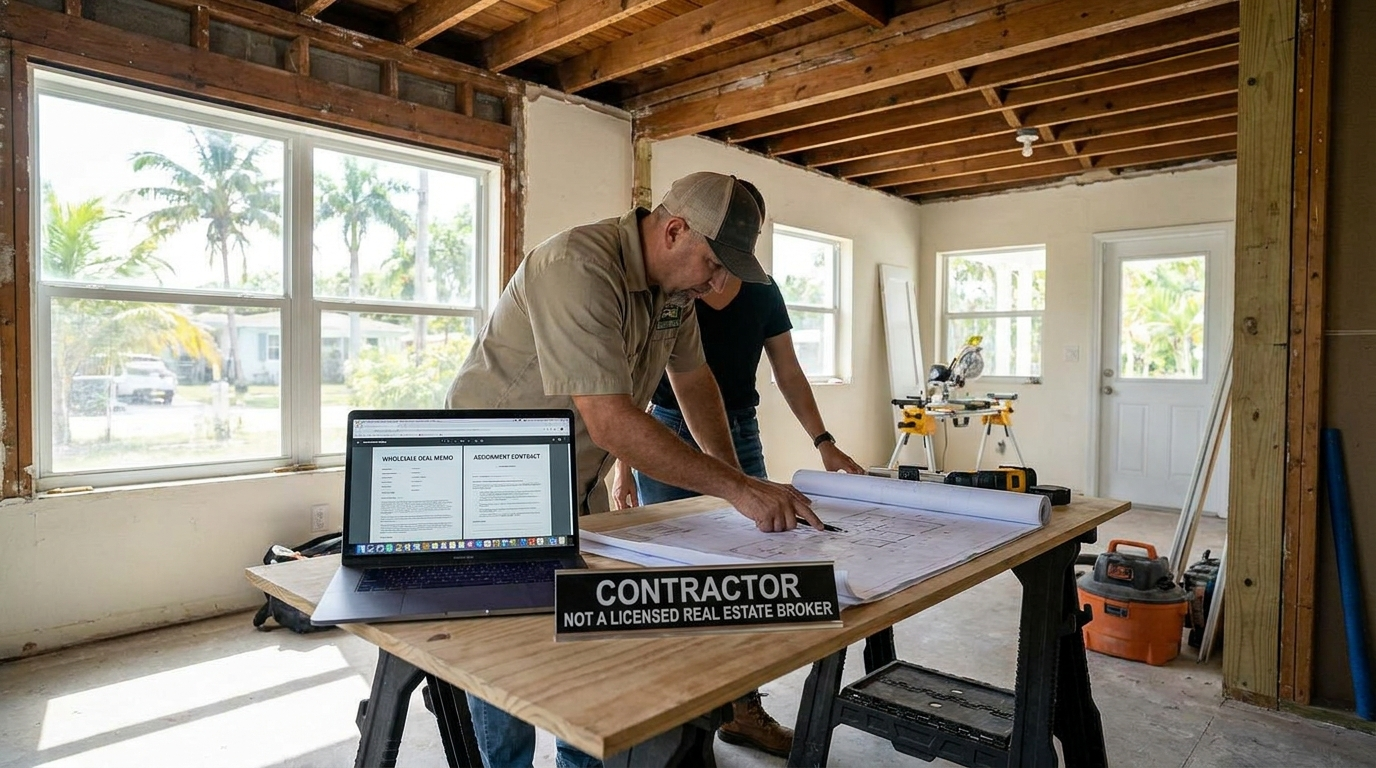
- Assigning contracts for compensation in a way that constitutes brokerage activity (the critical gray area for wholesalers)
- Managing rental properties for others for a fee, which requires a broker's license in Florida

The wholesaling gray area
Real estate wholesaling (getting properties under contract and assigning those contracts to investors for a fee) is a legal gray area in Florida. If you are assigning your own purchase contract where you are named as the buyer, there is a reasonable legal argument that you are transacting as a principal. If you are repeatedly marketing other people's properties for sale or charging fees for facilitating transactions without being a party to the deal, the Florida Real Estate Commission (FREC) may view that as unlicensed brokerage activity.
Florida has issued guidance on wholesaling, and there is active debate about where exactly the line sits. If you plan to wholesale regularly in South Florida, consult a Florida real estate attorney to structure your operation correctly before you scale up.
Should you get a license anyway?
Many South Florida investors get their real estate license even when they are primarily investing for their own account. As we covered in our post on being a real estate agent and investor, the MLS access, market knowledge, and commission savings can improve investment returns significantly. For a flipper doing six to ten deals per year, commission savings on purchases alone can easily cover the cost of getting licensed.
Whether you operate licensed or unlicensed, our team at Pure Equity works with investors at every level. Contact us to discuss acquisition opportunities, or use our Fix and Flip Calculator to run the numbers on your next deal.
Analyzing a potential flip in South Florida? Use our Fix and Flip / BRRRR Calculator to model your purchase price, rehab budget, ARV, and projected profit before you make an offer. Already have a property in mind? Talk to a local investor-friendly agent about current market conditions in Palm Beach, Broward, or Miami-Dade.
Frequently asked questions
Can I flip houses in Florida without any real estate license?
Yes. Florida law does not require a license to buy, renovate, and resell property you own. You are acting as a principal in that transaction, not as an agent or broker representing someone else.
Do I need a license to wholesale houses in Florida?
It depends on how you structure the deal. Assigning a purchase contract you hold as a buyer is generally treated as a principal transaction. Repeatedly marketing or brokering deals for others without being a named party may cross into unlicensed brokerage activity. Consult a Florida real estate attorney before building a wholesale business.
What happens if I act as an unlicensed real estate broker in Florida?
Practicing brokerage without a license in Florida is a third-degree felony under Chapter 475 of the Florida Statutes. Penalties include fines and potential imprisonment. FREC also has the authority to void transactions and pursue civil remedies.
Is getting a real estate license worth it for house flippers in Florida?
For high-volume investors, the MLS access and commission savings often justify the time and cost. A license also gives you direct access to off-market networking and the ability to write your own offers without waiting on an agent. Whether it makes sense depends on your deal volume and how you prefer to work.
Can my LLC flip houses without a license in Florida?
Yes. A properly structured LLC can buy and sell real estate it owns without a license, just as an individual can. The key is that the LLC must be the actual buyer or seller, not a middleman acting on behalf of a third party.
The line is acting for another party, not the money involved
The whole question resolves to one principle, and once you have it the edge cases mostly answer themselves.
Florida regulates real estate services performed for another person for compensation. Buying, renovating and selling property you own is dealing with your own asset, which is why flipping is not licensed activity no matter how many times you do it or how much you make.
What requires a licence is acting on someone else's behalf: marketing their property, negotiating on their account, or being compensated for bringing parties together. The trigger is agency and compensation, not scale.
Where flippers actually stray across it
The risk is rarely the flip itself. It is the adjacent activity people drift into once they are active in the market.
- Marketing a property you do not own. Advertising a house under contract as though it were yours to sell is where wholesaling attracts scrutiny, because you are marketing someone else's property.
- Taking a fee for finding a deal. Being paid to introduce a buyer to a seller is compensation for a real estate service, whatever it is called.
- Selling a friend's house for them. Doing it once, as a favour, with payment attached, is still acting for another party.
- Managing rentals for other owners. Property management for third parties is separately regulated, and flippers who keep a few units for others sometimes miss this.
Note the pattern: each of these involves someone else's property and a payment. That is the test to apply.
Entities do not change the answer
Buying through an LLC or a land trust does not create or remove a licensing requirement, and people occasionally believe it does.
If the entity owns the property, the entity is dealing with its own asset, exactly as an individual owner would. If the entity is performing services for another party for compensation, the requirement applies exactly as it would to a person. The structure affects liability and tax, which are good reasons to use one, and it is not a licensing workaround.
What a licence would actually get you
Worth weighing honestly rather than assuming either way, because it carries real annual cost.
The benefits are direct multiple listing service access, the ability to represent yourself and earn the commission on your own purchases and sales, and credibility with agents. The costs are pre licensing education, examination and application fees, board or association dues, multiple listing service fees, errors and omissions insurance, continuing education, and registration under a broker who will take a share of any commission you earn.
Do the arithmetic on your own volume. At one or two flips a year the annual carrying cost of a licence frequently exceeds the commission you would save, and a good relationship with an investor friendly agent gets you most of the benefit for none of the overhead. At higher volume the calculation flips.
Why the consequences are worth avoiding
Unlicensed real estate activity is taken seriously in Florida and can carry both regulatory and criminal exposure, alongside the practical risk that a transaction or a fee becomes unenforceable.
This section deliberately does not tell you where the line sits in your specific situation, because that is a legal judgement rather than an article's. If any part of what you plan involves someone else's property and a payment, get advice from a Florida real estate attorney before you do it rather than after somebody complains.
More common questions
How many houses can I flip before I need a licence?
There is no count that triggers it. Dealing in your own property is not licensed activity regardless of frequency, though frequency can affect your tax treatment, which is a separate question for an accountant.
Can I pay someone a finder's fee?
Paying an unlicensed person for a real estate service can create exposure for both of you. Take advice before agreeing to any such arrangement.
Do I need a licence to buy at a tax deed or foreclosure sale?
No. You are buying for yourself, which is the same principle. The diligence burden at those sales is the real issue rather than licensing.


