

Cash Flow Rental Property Calculator: How to Use It and What to Look For
June 9, 2026 · 6 min read · By Onias Derilus, Broker
A cash flow rental property calculator is the most important tool in a rental investor's arsenal. Here's how to use one correctly, what inputs matter most, and what the South Florida numbers actually look like.
A cash flow rental property calculator is the first thing you should run on any investment property before you make an offer. It tells you whether a property will put money in your pocket every month or quietly drain it. In South Florida's market, where insurance costs and HOA fees can dramatically affect returns, using a reliable calculator with accurate inputs is not optional.
What a cash flow rental property calculator actually measures
Net cash flow is the money remaining after all expenses are paid, including the mortgage. It is the truest measure of a rental property's performance because it accounts for your actual financing structure, not just the property's theoretical value. Two investors buying the same property at the same price can have dramatically different cash flows based on their down payment and loan terms.
The basic formula:
- Gross rental income
- Minus vacancy (typically 5-8% in South Florida)
- Minus operating expenses (taxes, insurance, maintenance, management, HOA)
- Minus debt service (mortgage principal + interest)
- Equals net cash flow
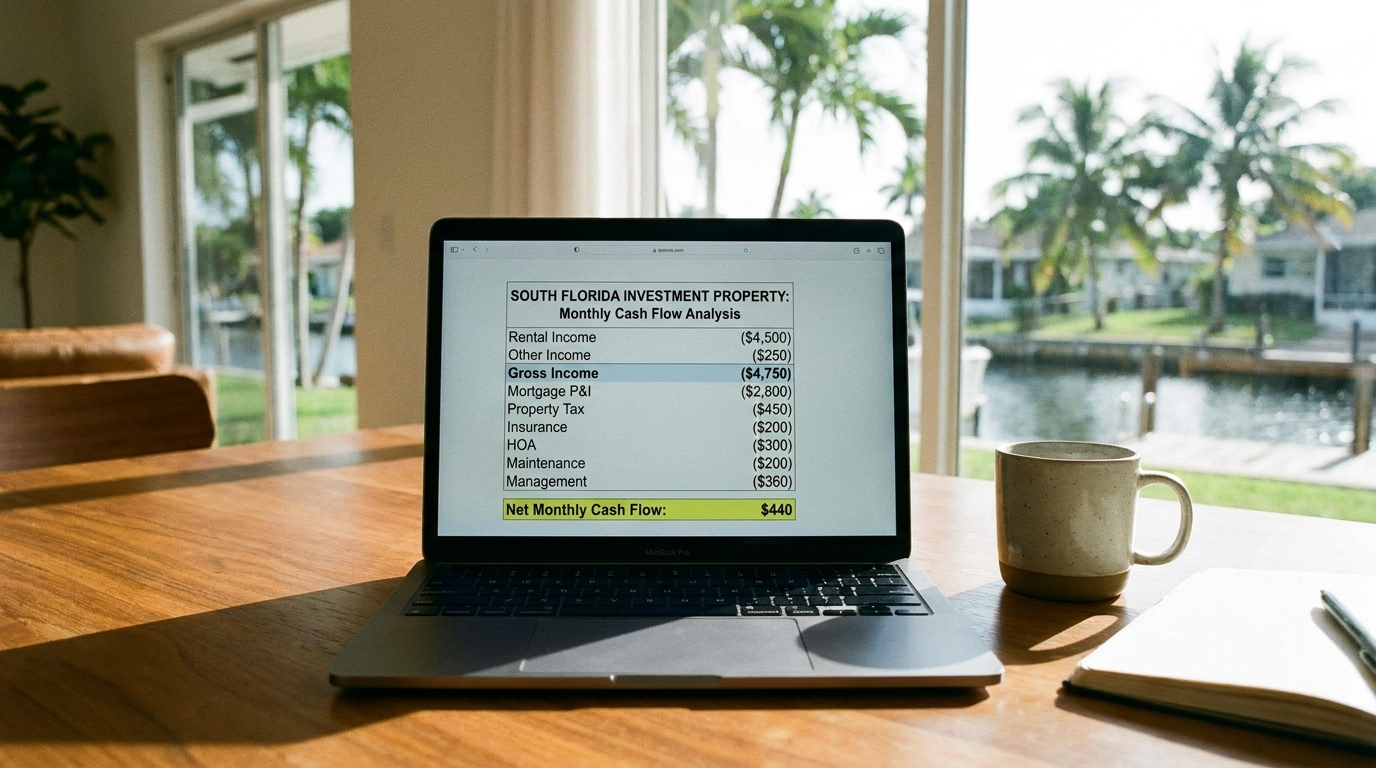
The inputs that most investors get wrong
Running a cash flow calculator with bad inputs gives you a false sense of security. These are the numbers South Florida investors most commonly underestimate:
- Insurance. Florida homeowner's insurance, especially in coastal Palm Beach, Broward, and Miami-Dade counties, has increased 30-60% in recent years. Get an actual insurance quote before you close. Do not use the current owner's premium as your estimate.
- Property taxes. When a South Florida property sells, it gets reassessed at the new purchase price. The previous owner's tax bill (often protected by homestead exemption) can be dramatically lower than what you will pay. Check the county property appraiser's website for estimated post-sale taxes.
- Maintenance reserve. Budget 8-10% of annual gross rent for repairs and maintenance. South Florida's climate is hard on HVAC systems, roofing, and exterior paint. Investors who budget 5% routinely come up short.
- Vacancy. Use 7-8% as a baseline. Even in tight rental markets, turnover and lease-up periods mean you will not collect 100% of rent every year.
What good cash flow looks like in South Florida
In South Florida's current market, here is what realistic cash flow looks like by strategy:
- Leveraged single-family (25% down, 7% rate): $150-$500 per month net in most Palm Beach and Broward markets. Tighter than most calculators suggest when insurance is input correctly.
- All-cash single-family: $900-$1,400 per month net. No mortgage payment, but much more capital deployed per property.
- Small multifamily (2-4 units), leveraged: $400-$900 per month total net. The combined rents from multiple units create more cushion.
- Short-term rental (coastal areas): $1,500-$4,000 per month net potential, but management costs are higher and regulatory risk is real.
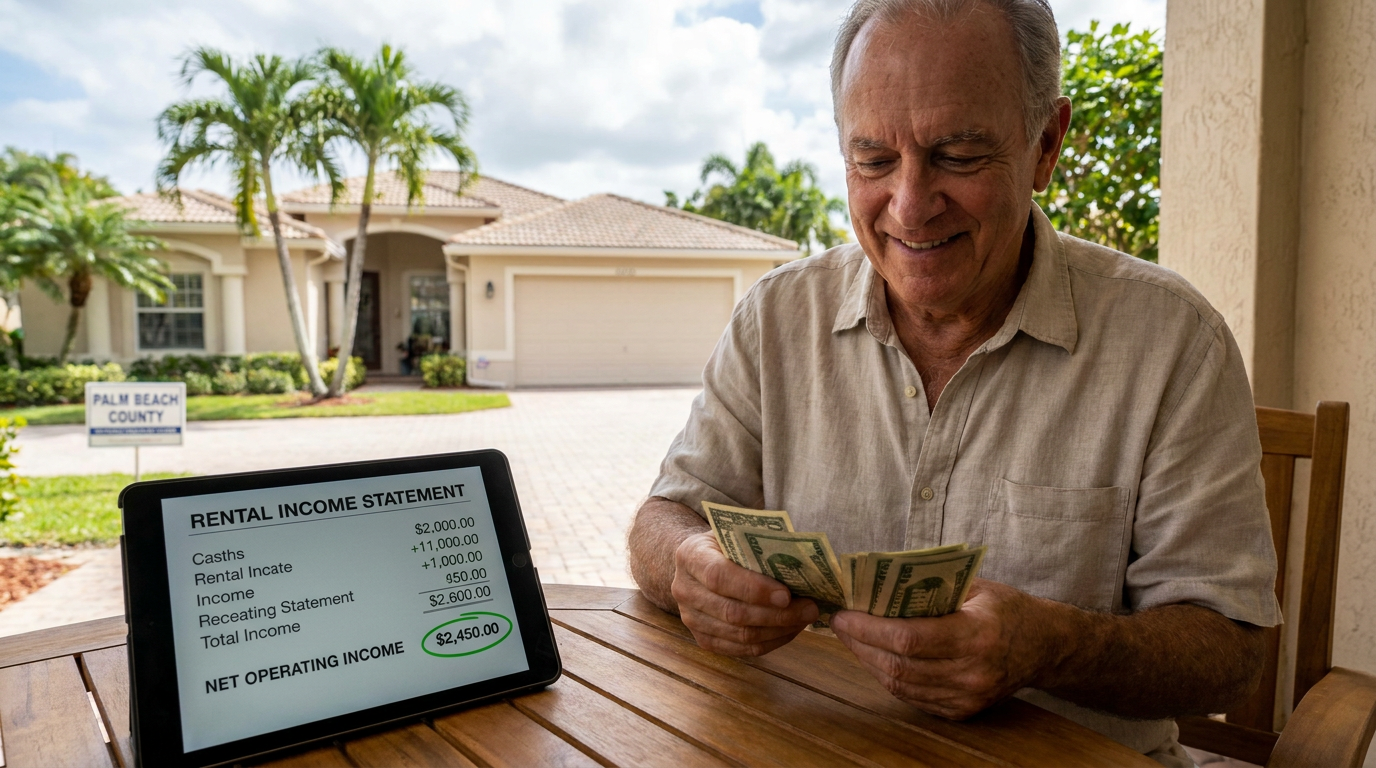
Use our free South Florida rental calculator
Our Rental Property ROI Calculator was built for South Florida investors. It calculates monthly cash flow, annual cash-on-cash return, cap rate, and total 5-year return, all with South Florida-realistic default assumptions you can customize to your specific deal.
Run every property you are considering through the calculator before you make an offer. If the numbers do not work with realistic inputs, walk away regardless of how good the property looks in person. Our team can help you interpret the results and find deals that actually pencil out. Reach out here or explore investment opportunities by county. For more on rental property analysis, see IRS rental income guidelines for tax context.
The inputs that decide the answer
Cash flow is gross rent minus every expense including debt service. The formula is simple; the discipline is in refusing to be optimistic about the inputs. Almost every disappointing South Florida rental traces to one of four numbers being wrong at purchase.
- Insurance. The largest variable here and the one most often carried over from the seller's policy. Their premium reflects their roof age, their claims history, and their carrier. Get a written quote in your own name before removing contingencies.
- Property taxes. Florida reassesses on sale, so the seller's bill is not yours. On a long-held property with a homestead cap, the increase can be substantial and it lands in your first full year.
- Association dues and assessments. On anything attached, request the reserve study, recent minutes, and any milestone inspection findings. A pending structural assessment can exceed a year of net income.
- Realistic rent. Not the asking rents you see advertised, but what comparable units have actually leased for recently.
The expenses beginners leave out
Vacancy is the first. Nobody collects twelve months of rent every year, and five to eight percent is a normal allowance. Maintenance is the second, and it is not optional simply because nothing broke this year. Capital reserves are the third: roofs, air conditioning, and water heaters fail on a schedule, and setting nothing aside does not prevent the cost, it just moves it into a year you had not planned for.
Management belongs in the calculation even if you intend to self-manage. Your time has value, and the day you stop managing, or sell to someone who will not, that expense becomes real and visible.
A worked example
Take a $389,000 Broward property, close to the county median, bought with 25 percent down. Suppose it rents for $2,900 a month, so $34,800 a year gross.
Now subtract: mortgage payment, property taxes at the reassessed value, a real insurance quote, five percent vacancy, maintenance, capital reserves, and management. Those deductions commonly consume 35 to 45 percent of gross rent on a single-family rental, and more on a condominium once dues are included. What remains is your cash flow, and on many South Florida properties at current prices it is thinner than investors expect.
Then change one input. If insurance comes in $250 a month above assumption, annual cash flow drops by $3,000 and nothing else about the property changed. That single sensitivity is why the quote matters more than any other piece of diligence.
Cash flow is not the whole return
A property can produce modest cash flow and still be a sound holding, because three things never appear in the calculation: principal paydown building equity with every payment, appreciation over the holding period, and tax treatment including depreciation.
Equally, strong projected cash flow built on optimistic rent or a stale insurance figure is not cash flow at all. Underwrite the inputs conservatively, then trust the output.
Reviewing what you already own
Run the calculation annually on properties you hold, not just ones you are buying. Rents, insurance, and taxes all move, and a rental that returned well at purchase may be returning very little today without anything dramatic having happened.
Knowing that early gives you options: raise rent at renewal, re-shop insurance, refinance if rates allow, or sell while the market supports it. Discovering it late usually means selling under pressure. If you own a rental in the eight counties we serve and want to know both what it would rent for today and what it would sell for, we can tell you.
Common questions
What is a good monthly cash flow?
There is no universal figure, because it depends on how much cash you have invested and what else that money could earn. Cash on cash return is the more comparable measure.
Should I count appreciation?
Not in cash flow, which is a current-year figure. Count it separately in total return, and never let it be the only reason a deal works.
How do I find realistic rents?
From what comparable units have actually leased for, not from current asking rents. We can pull that for any area we serve.
Does this work for a house hack?
Yes, and the numbers are often strongest there, since owner-occupied financing allows a much smaller down payment. Count the rent from the other units and the market rent of the space you occupy.
Stress-testing before you commit
Run the calculation three times rather than once. First on the seller's figures, then on figures you have verified yourself, then on a pessimistic case: one month of additional vacancy, insurance ten percent higher, and one significant repair.
If the deal still works in the third version, it is a sound purchase. If it only works in the first, you are buying the seller's optimism rather than the property. The gap between run one and run two is also a useful read on how straightforward the seller has been about everything else.
Reserves are part of the purchase
Investors who lose money on South Florida rentals are usually undercapitalised rather than wrong about the property. A cushion is what lets you decline a weak tenant, fix something properly the first time, and hold through a slow patch instead of selling into one.
Treat reserves as part of the acquisition cost rather than something to build later out of cash flow that has not arrived yet. The first year is almost always the most expensive.


