

Cash on Cash Return: How to Calculate It (Free Calculator)
June 9, 2026 · 6 min read · By Onias Derilus, Broker
Cash on cash return is the metric serious investors live by. Here's exactly how to calculate it, what a good number looks like, and a free tool to run yours.
Cash on cash return tells you how hard your actual invested dollars are working. Unlike cap rate, it accounts for financing, which is why most rental investors rely on it. This guide covers the formula, a real South Florida example, and what counts as a strong return in 2026.
What is cash on cash return?
Cash on cash return is the annual pre-tax cash flow divided by the total cash you invested. It answers one question: for every dollar you put in, how much comes back each year?
Because it uses real out-of-pocket cash, it reflects your leveraged return. Two investors can buy the same property and earn very different cash-on-cash returns based on their down payment and loan terms.
The cash on cash return formula
The math is straightforward:
Cash on Cash Return = Annual Pre-Tax Cash Flow / Total Cash Invested
Annual cash flow is your rental income minus all operating expenses and mortgage payments. Total cash invested includes your down payment, closing costs, and any upfront repairs.
A worked example
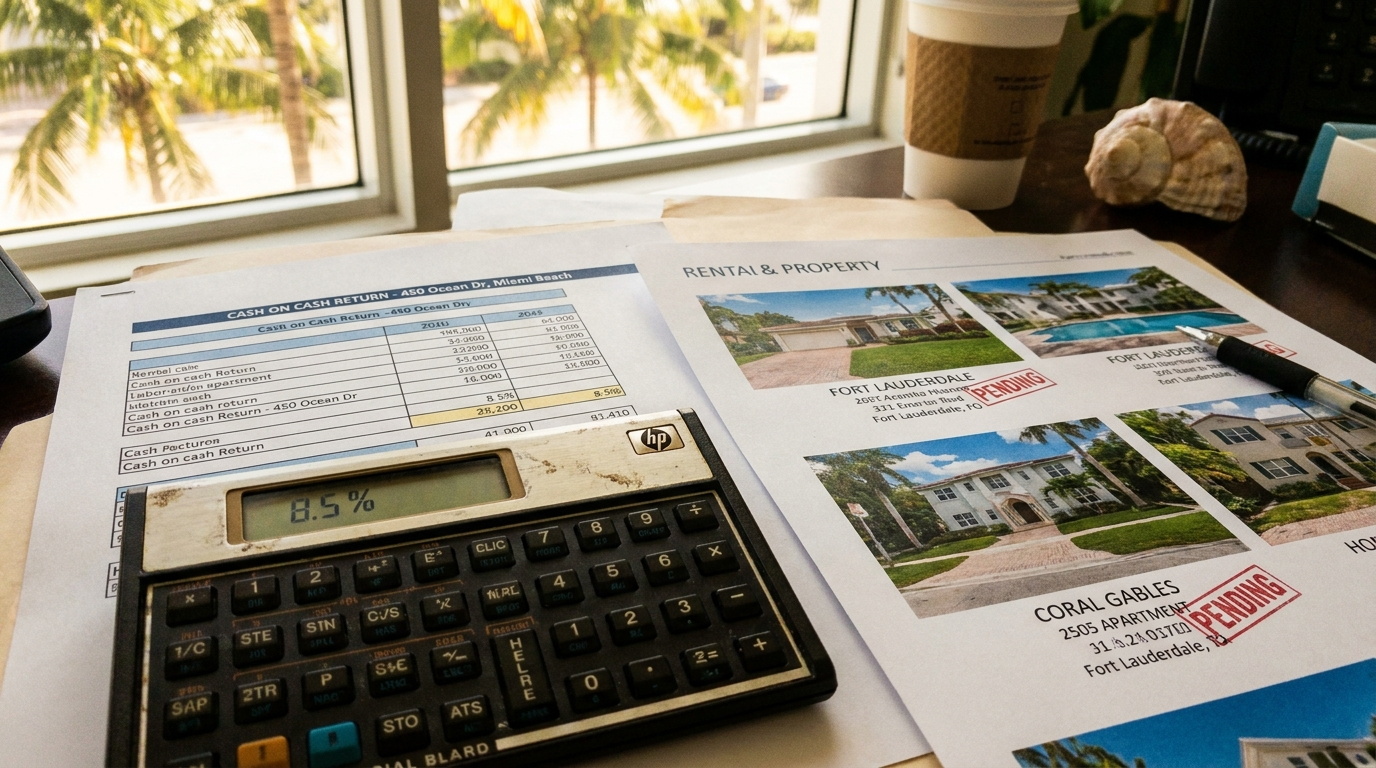
Take a Port St. Lucie rental priced at $320,000. You put down 25 percent ($80,000), plus $12,000 in closing and setup costs, so $92,000 invested total. After all expenses and the mortgage, the property cash-flows $7,400 per year.
That gives a cash on cash return of $7,400 divided by $92,000, which is 8.0 percent. That is a healthy number in this market.
Rather than run this by hand for every deal, use our rental property ROI calculator. It outputs cash-on-cash return automatically alongside cap rate and monthly cash flow.
What is a good cash on cash return?
Most South Florida investors aim for 6 to 10 percent. Coastal markets often land lower because prices are high. Inland counties like Highlands and St. Lucie can push past 10 percent. What counts as "good" depends on your goals. Some investors accept a lower cash-on-cash return in exchange for stronger appreciation.
For a broader view of the return picture, our compound interest calculator shows how reinvested cash flow compounds over time.
Put the number to work
Cash on cash return turns a gut feeling into a clear decision. Run it on every property before you make an offer and you will quickly separate the cash-flowing deals from the money pits. Ready to find a property that pencils out? Share your investment criteria and our team will send matching South Florida properties.
What cash on cash actually measures
Cash on cash return is annual pre-tax cash flow divided by the total cash you invested. It answers a narrower and more personal question than cap rate: of the money that actually left your bank account, what percentage came back this year?
Suppose you buy a $500,000 Palm Beach County property with 25 percent down. Your cash in is $125,000 down plus roughly $12,000 in closing costs plus $8,000 of immediate repairs, so $145,000. If the property produces $1,000 a month after every expense including the mortgage, that is $12,000 a year, and your cash on cash return is 8.3 percent.
Count every dollar of cash in
The most common error is counting only the down payment. Include closing costs, lender fees, inspection and appraisal, any immediate repairs needed to make the unit rentable, and the reserve you must hold. Understating cash in overstates the return, and it is the reason a deal that looked like 10 percent on a spreadsheet delivers 6 percent in reality.
Why leverage cuts both ways
Cash on cash is sensitive to financing in a way cap rate is not. Borrowing more reduces the cash you put in, which can raise the percentage return. It also raises your monthly payment, which reduces the cash flow in the numerator. Whether leverage helps depends on whether the property's yield exceeds your borrowing cost.
When it does, leverage amplifies returns. When it does not, leverage amplifies losses, and the investor is effectively paying for the privilege of owning. That is the situation to model carefully before committing, because it is not obvious from the purchase price alone.
The South Florida numbers that decide the outcome
Two local costs move this calculation more than anything else. Insurance is the first: windstorm and flood premiums have risen sharply, and a policy quoted at last year's rate can consume an entire year of projected cash flow. Get a written quote in your own name before you are under contract, not after.
Association dues are the second, and they matter most on condominiums. Beyond the monthly figure, ask for the reserve study and any milestone inspection findings. A building facing a structural assessment can hand a new owner a five-figure bill that no cash on cash calculation anticipated.
Property taxes are the third trap, because Florida resets assessed value on sale. The seller may be paying under a long-held cap that will not transfer to you.
What return should you target?
That depends on what else you could do with the money and how much work the property demands. A passive, well-located rental at 5 to 7 percent cash on cash with steady appreciation is a different proposition from a 12 percent return that requires constant management in a market where homes take 200 days to sell.
Compare the return against the effort and the risk, not against a number you read somewhere. And remember that cash on cash ignores appreciation, principal paydown, and tax treatment, all of which are real parts of the total return.
Questions we get about cash on cash return
What is the difference between cash on cash and ROI?
Cash on cash counts only cash flow against cash invested for one year. Total return on investment also includes appreciation, principal paydown, and tax benefits, so it is usually the larger number.
Should I use pre-tax or post-tax cash flow?
The standard calculation is pre-tax, because tax treatment varies by investor. Model your own after-tax position separately with an accountant.
Does cash on cash work for a house hack?
Yes, and it is often where the numbers look best, because owner-occupied financing allows a much smaller down payment. Count the rent you collect from the other units and the market rent of the space you occupy.
How do I improve the return on a property I already own?
The realistic levers are raising below-market rents at renewal, reducing insurance through mitigation credits or a re-shopped policy, refinancing if rates allow, and cutting vacancy through faster turnovers. We can tell you what comparable units nearby are actually renting for.
A worked example, start to finish
Assume a $389,000 Broward property, roughly the county median, bought with 25 percent down. Cash in is $97,250 down, about $9,000 in closing costs, and say $6,000 to make it rent-ready, so $112,250 total.
On the income side, suppose it rents for $2,900 a month, or $34,800 a year. Deduct the mortgage payment, taxes at the reassessed value, insurance, a vacancy allowance, maintenance, and reserves. If that leaves $9,000 of annual cash flow, the cash on cash return is about 8 percent on your $112,250.
Now change one input. If insurance comes in $250 a month higher than budgeted, annual cash flow drops to $6,000 and the return falls to 5.3 percent. Nothing else about the property changed. That single sensitivity is the reason we push buyers to get a real quote early rather than using a rule of thumb.
What the number leaves out
Cash on cash counts only this year's cash. It ignores three things that often matter more over a full holding period.
- Principal paydown. Every payment builds equity that never appears in cash flow.
- Appreciation. Real, but not guaranteed, and it should never be the only reason a deal works.
- Tax treatment. Depreciation can shelter a meaningful portion of rental income. Your accountant, not a calculator, should quantify this.
A property showing a modest cash on cash return can still be a sound long-term hold once those are counted. Equally, a strong headline return that depends on optimistic rent or stale insurance figures is not a return at all. Underwrite the inputs, then trust the output.
Using the number to decide, not just to measure
A single cash on cash figure is most useful when compared against something. Run it for two or three candidate properties on identical assumptions, and the comparison will tell you more than any individual percentage does. Keep the assumptions genuinely identical, because it is easy to be generous on the property you already like.
It is also worth running the number twice for the same property: once on the seller supplied figures and once on figures you have verified yourself. The gap between those two runs is a fair measure of how much risk sits in the deal. When verified numbers land close to the pro forma, the seller has been straightforward. When they diverge sharply, that is information about everything else you have been told.
Finally, revisit the calculation annually on properties you own. Rents, insurance, and taxes all move, and a rental that returned eight percent at purchase may be returning four today without anything obvious having happened. That is often the moment owners decide to sell, refinance, or reposition, and knowing it early gives you the choice.


