

Dave Ramsey on REITs: What South Florida Investors Should Actually Know
June 9, 2026 · 7 min read · By Onias Derilus, Broker
Dave Ramsey recommends direct real estate over REITs, but his reasons are more nuanced than most summaries suggest. Here's a balanced look at REITs vs. direct ownership for South Florida investors.
Dave Ramsey has a famously skeptical take on REITs (Real Estate Investment Trusts). He consistently recommends paid-off, directly owned rental properties over paper real estate investments, a position that surprises many investors who view REITs as a simpler, more accessible way to participate in real estate. When people search for "dave ramsey reits," they're usually trying to understand why a personal finance icon seems to dismiss one of the most popular investment vehicles of the past three decades. Here is what Ramsey actually says, where his reasoning holds up, and what it means for South Florida investors specifically.
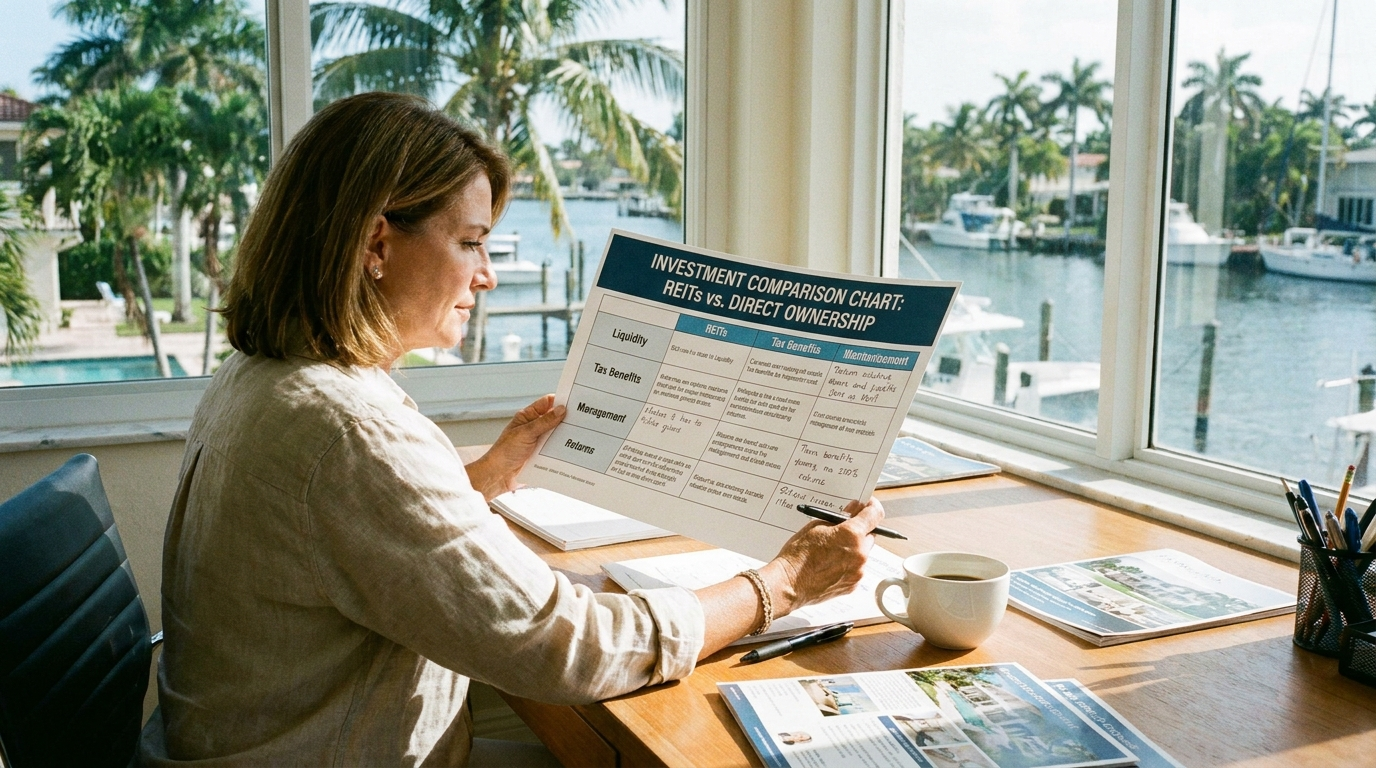
What Dave Ramsey actually says about REITs
Ramsey's position is more nuanced than "REITs are bad." His actual view is that REITs are acceptable as part of a broadly diversified mutual fund portfolio, specifically in growth stock mutual funds that happen to include REIT exposure. What he opposes is treating REITs as a primary real estate investment vehicle, particularly for people who believe they're getting the same benefits as owning physical real estate.
His core objection is that REITs behave like stocks in bear markets, not like real estate. During the 2008 financial crisis and the 2020 COVID crash, publicly traded REIT indices dropped 60% or more. That is far steeper than the underlying real estate values would have fallen in a direct-ownership scenario. For Ramsey's audience (middle-class Americans building wealth conservatively), that tight correlation with stock market volatility makes REITs a weaker substitute for actual real estate ownership.
What REITs actually are
A REIT is a company that owns, operates, or finances income-producing real estate. Publicly traded REITs are bought and sold on stock exchanges like any other equity. By law, they must distribute at least 90% of taxable income to shareholders as dividends, which makes them attractive income vehicles.
There are several types. Equity REITs own physical properties. Mortgage REITs hold mortgage debt. Hybrid REITs do both. For most retail investors, equity REITs are the relevant category. They own portfolios of apartments, commercial properties, industrial facilities, data centers, and cell towers.

REITs vs. direct real estate in South Florida
South Florida real estate has historically outperformed national averages, so the case for direct ownership here is particularly strong. That said, each approach has genuine trade-offs.
- Control: Direct ownership means you decide when to sell, how to finance, and what improvements to make. REIT shareholders have no say in any of that.
- Leverage: You can buy a $500,000 South Florida property with $100,000 down, a 5:1 ratio that amplifies equity gains on the full asset value. A REIT investment amplifies nothing unless you're trading on margin.
- Tax benefits: Direct real estate ownership unlocks depreciation deductions, 1031 exchanges, and the qualified business income deduction. REITs do not replicate those advantages.
- Volatility: Direct real estate values do not update daily. You will not panic-sell a rental property because the market fell 10% last Tuesday.
- Accessibility: REITs win on entry cost. You can invest $1,000 in a diversified REIT portfolio today. A South Florida rental property typically requires $25,000 to $100,000 or more to get started.
Our take for South Florida investors
Ramsey's preference for direct real estate is well-grounded in markets like South Florida, where leveraged long-term ownership has rewarded patient investors. But REITs have a real role for investors who lack the capital for direct acquisition, want diversification outside the local market, or need liquidity that physical property cannot provide.
The real question is not "REITs or direct real estate." A careful investor often holds both: direct ownership for concentrated, leveraged, tax-advantaged local exposure, and REITs for diversification and liquidity. Where that line falls depends on your capital, timeline, and risk tolerance.
If you're ready to move from paper real estate to physical property in South Florida, talk to our team. We can help you model the real returns on direct investment and run the cash flow numbers on specific properties you're considering.
The comparison on the axes that actually differ
Arguments about REITs against direct ownership usually turn on which returns more, which is the least reliable thing to predict. The differences that genuinely matter are structural and knowable in advance.
- Liquidity. A publicly traded REIT sells in seconds. A Florida rental takes months, and in our slower counties considerably longer, with Highlands averaging around 206 days on market.
- Leverage. You can borrow most of the purchase price of a property at long fixed terms. That option does not exist in the same form for a share holding, and it is the main reason property returns amplify.
- Control. You choose the property, the tenant, the rent and the improvements. A REIT gives you a share of decisions made by other people.
- Effort. A REIT requires none. A rental is a small business with tenants, repairs, insurance renewals and vacancy.
- Diversification. One REIT can hold hundreds of properties across regions. One rental is a single asset on a single street exposed to a single local market.
None of these is an argument for one side. They are the trade you are choosing between, and different investors should rationally choose differently.
What concentration means in practice here
Buying one rental in one South Florida county means your outcome depends on that county, that neighbourhood and frequently that single tenant. A vacancy is not a small dip in income, it is all of the income from that property.
Florida adds two specific concentration risks. Insurance costs have risen substantially and land disproportionately on coastal property, and a single hurricane can affect an entire region at once. A diversified holding spreads that. A single house does not.
This argues for reserves rather than against ownership. The investors who struggle are rarely wrong about the asset, they are underfunded when an ordinary problem arrives.
Tax treatment differs and it matters
Direct ownership allows depreciation, deduction of operating expenses and mortgage interest, and potentially a 1031 exchange when reinvesting in other investment property. Those are meaningful and they are also why direct ownership needs an accountant.
REIT distributions are taxed under different rules, and a substantial portion is often ordinary income rather than qualified dividends. The right comparison is after tax rather than headline yield, and it depends on your own position enough that a general answer is not useful. This is a question for a tax professional, not for an article and not for an agent.
The middle ground people ignore
These are not mutually exclusive and treating them as a debate produces worse decisions than treating them as a portfolio question.
A common and sensible pattern is direct ownership where you have genuine local knowledge, which for a South Florida resident means South Florida, plus liquid diversified holdings for everything else. That gives you the leverage and control where your information advantage is real, and the liquidity and diversification where it is not.
An honest test before you buy a rental
Ask three questions. Can you fund the down payment and still hold several months of expenses in reserve. Are you willing to take a call about a failed air conditioning unit on a Sunday, or to pay a manager roughly eight to twelve percent of rent to take it instead. And can you leave the money committed for years without needing it back quickly.
If any answer is no, the passive route suits you better, and choosing it is not a failure of ambition. Far more money has been lost by people who bought a rental they could not carry than by people who stayed liquid.
What a rental actually asks of you
The effort difference is the part most comparisons wave at without describing, so here it is concretely.
A rental means finding and screening tenants, holding deposits according to Florida's requirements, handling repairs including the ones that arrive at inconvenient hours, renewing insurance in a market where premiums have moved sharply, filing a separate schedule at tax time, and dealing with vacancy and turnover between tenants.
You can pay a manager roughly eight to twelve percent of collected rent to absorb most of it, and that fee belongs in your model from the start rather than being treated as optional. A property that only works when you self manage is a job you have bought rather than an investment you have made.
More common questions
Is one strictly safer than the other?
They carry different risks rather than different amounts of risk. A REIT exposes you to market volatility you can see daily. A rental exposes you to vacancy, repairs and illiquidity you cannot sell out of quickly.
Can I hold both?
Yes, and most investors sensibly do. The question is proportion rather than which one wins.
Does leverage make direct ownership better?
It amplifies the outcome in both directions. A twenty percent fall on twenty percent down erases the equity while the loan balance is unchanged, which is what Florida owners saw from 2007 to 2011.


