

The Difference Between Rich and Wealthy, And Why It Matters for South Florida Investors
June 9, 2026 · 6 min read · By Onias Derilus, Broker
Rich means high income. Wealthy means you don't need to work to maintain your lifestyle. Understanding the difference shapes every investment decision, and real estate is the most direct path from one to the other.
The difference between rich and wealthy is one of the most important concepts in personal finance, and one that matters a great deal for South Florida residents operating in one of the country's most expensive real estate markets. You can earn $300,000 per year in Miami or Palm Beach and still be one medical emergency or job loss away from financial distress. Understanding this distinction shapes every investment decision. Real estate, particularly in South Florida's market, is one of the most direct paths from "high earner" to genuinely wealthy.
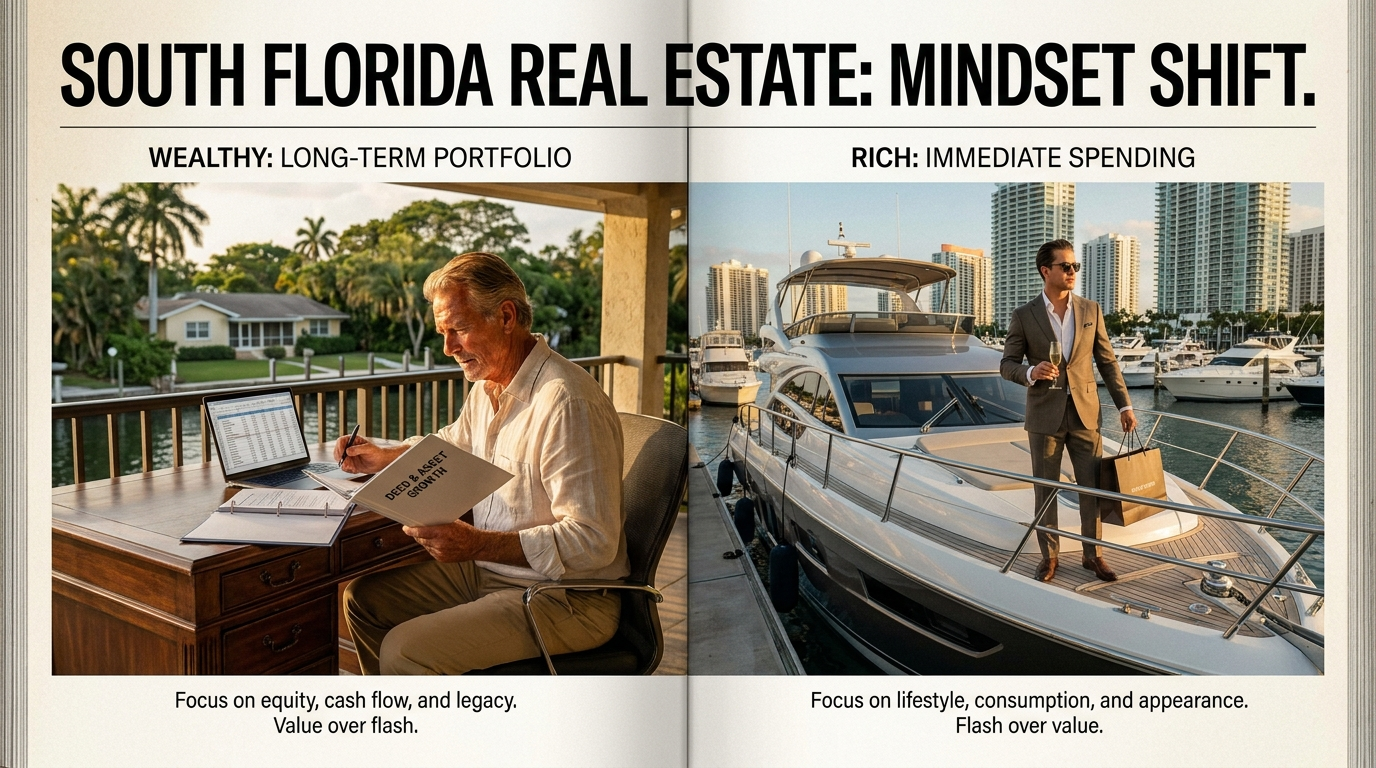
What "rich" actually means
Rich describes cash flow from active work. A rich person earns a high income from a job, a business, or a professional practice. Their lifestyle is funded by their labor. The moment that income stops (job loss, illness, retirement), the lifestyle is threatened.
Many high-income South Florida professionals fall into this category: physicians, attorneys, corporate executives, and highly paid commissioned salespeople who earn substantial incomes but spend accordingly. They accumulate limited assets relative to their expenses and would face significant lifestyle disruption if their income stopped for six to twelve months.
What "wealthy" actually means
Wealthy describes assets that generate income independent of your labor. A wealthy person has accumulated income-producing assets (real estate, businesses, investments) whose cash flows can sustain their lifestyle without them actively working. This is sometimes called passive income, though true passive income is rarely completely passive.
A useful threshold test: if you stopped working today, how long could you maintain your current lifestyle from your existing assets? If the answer is "indefinitely," you are wealthy. If the answer is "six months," you are not, regardless of your income level.
Why real estate is the most direct path
South Florida real estate offers an efficient path from high-earning to genuinely wealthy for several reasons:
- Leverage: You can control a $500,000 asset with $100,000 of capital, amplifying both income and appreciation returns.
- Inflation hedge: Rents and values tend to rise with inflation over time, protecting purchasing power.
- Tax advantages: Depreciation offsets rental income. 1031 exchanges allow tax-deferred growth. Step-up in basis eliminates capital gains tax at death.
- Tangibility: Unlike stocks, a South Florida property is a physical asset with intrinsic utility. Someone always needs housing.
- Income generation: Properly structured rental properties generate cash flow, building the asset-income column that defines wealth.
The practical transition strategy
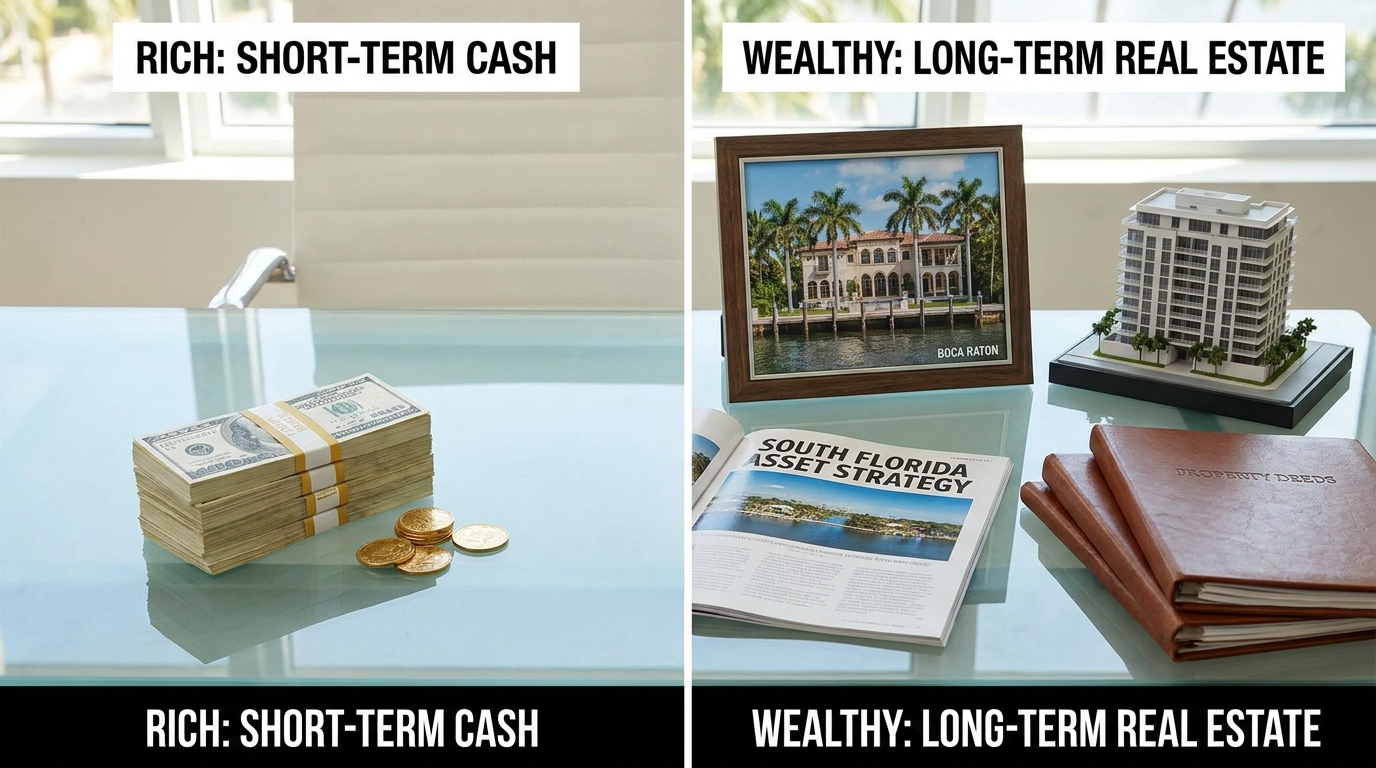
The most common wealth-building path for South Florida professionals: use high earned income to fund down payments on investment properties, let rental income and appreciation compound over 10 to 20 years, and eventually reach a point where passive income from property covers living expenses. This is not a fast strategy. It is a reliable one, especially in South Florida where structural demand keeps rental markets strong.
The key mindset shift is to stop treating high income as a destination and start treating it as a tool. It is a source of capital to be deployed into income-producing assets. Spend less than you earn, invest the surplus in South Florida real estate, and repeat.
If you are a high-income earner in South Florida looking to start building wealth through real estate, talk to our team. We work with investors at every stage, from first rental property to multi-unit portfolio. Use our Rental ROI Calculator to model what an investment might look like for your situation.
Frequently asked questions
Can someone be both rich and wealthy at the same time?
Yes. Many people are both: they earn a high income and hold substantial income-producing assets. The point is that high income alone does not make you wealthy. The goal is to convert earned income into assets over time so that asset income eventually exceeds your expenses.
What income level is considered rich in South Florida?
There is no single number, but household incomes above $200,000 to $250,000 generally place you in the top 5 to 10 percent for the region. In Palm Beach County and Miami-Dade, the cost of living is high enough that even six-figure earners can feel stretched if they carry large mortgages, private school tuition, and other fixed costs without a savings and investment plan.
How much do I need to invest in real estate to become wealthy in South Florida?
It depends on your target lifestyle cost. A rough framework: if you need $10,000 per month in passive income, and a well-run rental property nets $500 to $800 per month after expenses, you would need 13 to 20 properties producing at that level. Most investors build to this over 15 to 25 years, starting with one or two properties and reinvesting cash flow and appreciation into additional acquisitions.
Is South Florida real estate a good investment compared to other markets?
South Florida has structural advantages: no state income tax, strong population growth, limited developable land in desirable coastal areas, and persistent rental demand from domestic and international migration. These factors have supported long-run appreciation above the national average. The trade-off is higher entry prices and, in coastal areas, elevated insurance costs. Inland markets (western Palm Beach County, St. Lucie, Martin, Highlands, Okeechobee) offer lower entry points with decent rental yields for investors focused on cash flow over appreciation.
What is the first step to transition from rich to wealthy?
Track your net worth, not just your income. Most high earners focus on their paycheck. Wealthy people focus on the asset column of their personal balance sheet. Once you know where you stand, identify the gap between current asset income and your target passive income, then set a specific acquisition plan to close it. A single investment property is a concrete first step that most South Florida professionals with high incomes can execute within 12 to 24 months of intentional saving.
Three different things get called the same word
The distinction is usually drawn as two categories, and it works better as three, because the middle one is where most people actually get stuck.
Income is what arrives while you work. It is the most visible and the least durable, since it generally stops when you do. Assets are what you own, and they can be substantial while producing nothing you can spend. Cash flow is what your assets pay you whether or not you work, and it is the only one of the three that replaces income.
High income with no assets is a treadmill. Assets with no cash flow is a paper position that still requires you to work. The combination people describe as wealth is assets that produce cash flow, and the practical question is how one becomes the other.
The conversion is the whole exercise
Income becomes wealth only when it is deliberately converted, and the conversion is uncomfortable because it means spending less than you earn for a sustained period.
That is the entire mechanism, and it explains why high earners frequently have little. Rising income absorbed by rising spending produces no assets at all, and it is the most common pattern rather than an unusual one.
What property offers here is a forced version of the discipline. A mortgage payment converts part of your income into equity every month whether or not you feel like saving, and a tenant does the converting for you on an investment property. That structure is a large part of why property appears so often in wealth statistics, and it is a mechanism rather than magic.
Why property suits this and where it does not
Four things work together: appreciation grows the asset, loan paydown converts payments into equity, cash flow provides income while you hold, and tax treatment on investment property can shelter part of that income.
Leverage amplifies all of it, and it amplifies losses identically. A twenty percent fall on twenty percent down erases the equity while the loan balance is unchanged, which is what Florida owners saw between 2007 and 2011. So the honest version is that property rewards people who can hold through a downturn and punishes those who cannot, and reserves rather than returns decide which group you are in.
Property is also illiquid. Across our counties, average days on market runs about 107 in Palm Beach and St. Lucie, 124 in Broward, 137 in Miami-Dade and 206 in Highlands, with closing on top. This is not where your reserve belongs.
A sequence that generally works
The order matters more than the ambition, and getting it wrong is what produces forced sales.
Build a genuine cash reserve first, because it is what lets you hold everything that follows. Then reduce expensive debt, since paying fifteen percent to carry a balance beats most returns you could earn. Then acquire your first asset at a payment that survives a bad year. Only then consider adding a second, and keep reserves scaled to the number of properties rather than fixed.
People who invert this, buying assets before reserves, do not usually fail because they picked badly. They fail because an ordinary problem arrived and they had to sell into it.
What the transition actually feels like
It is slow and unremarkable, which is why it is rarely written about. Loan balances fall a little each month, rents adjust upward over years, and nothing happens quickly enough to be satisfying.
The people who reach the other side are generally not the cleverest buyers. They are the ones who bought something reasonable, held it through periods when selling would have felt sensible, and kept converting income into assets while their earnings rose. That is unglamorous and it is genuinely the mechanism.
More common questions
Can you be both?
Yes, and high income makes the conversion easier without performing it. Plenty of high earners hold few assets, which is the point of the distinction.
How many properties does it take?
Fewer than people assume, held longer than most manage. Three properties held for twenty five years generally beats ten traded over five.
What is the first step?
A reserve, before any asset. It is what makes every subsequent decision survivable.


