

How to Become a Full-Time Real Estate Investor in South Florida
June 9, 2026 · 6 min read · By Onias Derilus, Broker
Going full-time in real estate investing means replacing your active income with passive or semi-passive real estate income. Here's the South Florida roadmap, the numbers, the strategies, and how long it actually takes.
Becoming a full-time real estate investor is a realistic goal for South Florida investors who build their portfolio systematically. But "full-time" means different things depending on your strategy. Here is what the transition actually looks like, and what you need in place before you can make it work long-term.
Define what "full-time" means for your strategy
There are two very different versions of full-time real estate investing:
- Active full-time (flipping, wholesaling, development): You replace your job income with real estate deal income. This is a business. You are working 40 to 50 hours a week, just on real estate instead of your previous career. Income can be high but is not passive.
- Passive full-time (rental portfolio): You accumulate enough rental income that your portfolio generates more than you need to live on. The work is managing the portfolio, not chasing deals full-time. This is the version most people mean when they say "full-time investor."
These paths require very different timelines and capital structures. Know which one you are building toward before you start planning.

The income number you need to hit first
Before you quit your job to invest full-time, you need a few things in place:
- Monthly passive income at 1.3x your monthly expenses: The buffer accounts for vacancy months, unexpected maintenance, and the reality that passive income fluctuates. If you need $6,000 per month to live, you need $7,800 or more in net rental income before you make the move.
- 12 months of personal expenses in liquid reserves: Even a well-managed portfolio has occasional months with major repairs or vacancies. Liquid reserves keep you from making bad decisions under financial pressure.
- A pipeline of future deals: Going full-time is not the moment to stop building. You should have your next two or three acquisitions identified before you exit employment income.
The South Florida path: what the portfolio needs to look like
In South Florida's current market, a realistic passive income of $8,000 to $10,000 per month net requires roughly one of the following:
- 10 to 14 leveraged single-family rentals generating $600 to $800 per month net each (achievable in inland Broward, West Palm Beach, and Port St. Lucie with 25 to 30 percent down)
- 4 to 6 small multifamily units (2 to 4 unit properties) generating $1,500 to $2,000 per month net each
- A mix of 5 to 6 single-families plus 2 to 3 multifamilies
Building that portfolio takes most investors 8 to 15 years starting from a moderate capital base. Investors who accelerate through BRRRR cycles or equity pulls from appreciation can do it in 5 to 8 years.
The transition moment: when to pull the trigger
Most investors transition to full-time gradually rather than all at once. Common milestone-based approaches:
- Drop to part-time employment when passive income covers 60 to 70 percent of expenses
- Shift to freelance or consulting when passive income covers 80 to 90 percent
- Full exit when passive income exceeds expenses with a buffer
This staged approach reduces risk and keeps income flowing during the building phase. Investors who quit cold-turkey at 50 percent passive income coverage often end up under financial stress that leads to poor investment decisions.
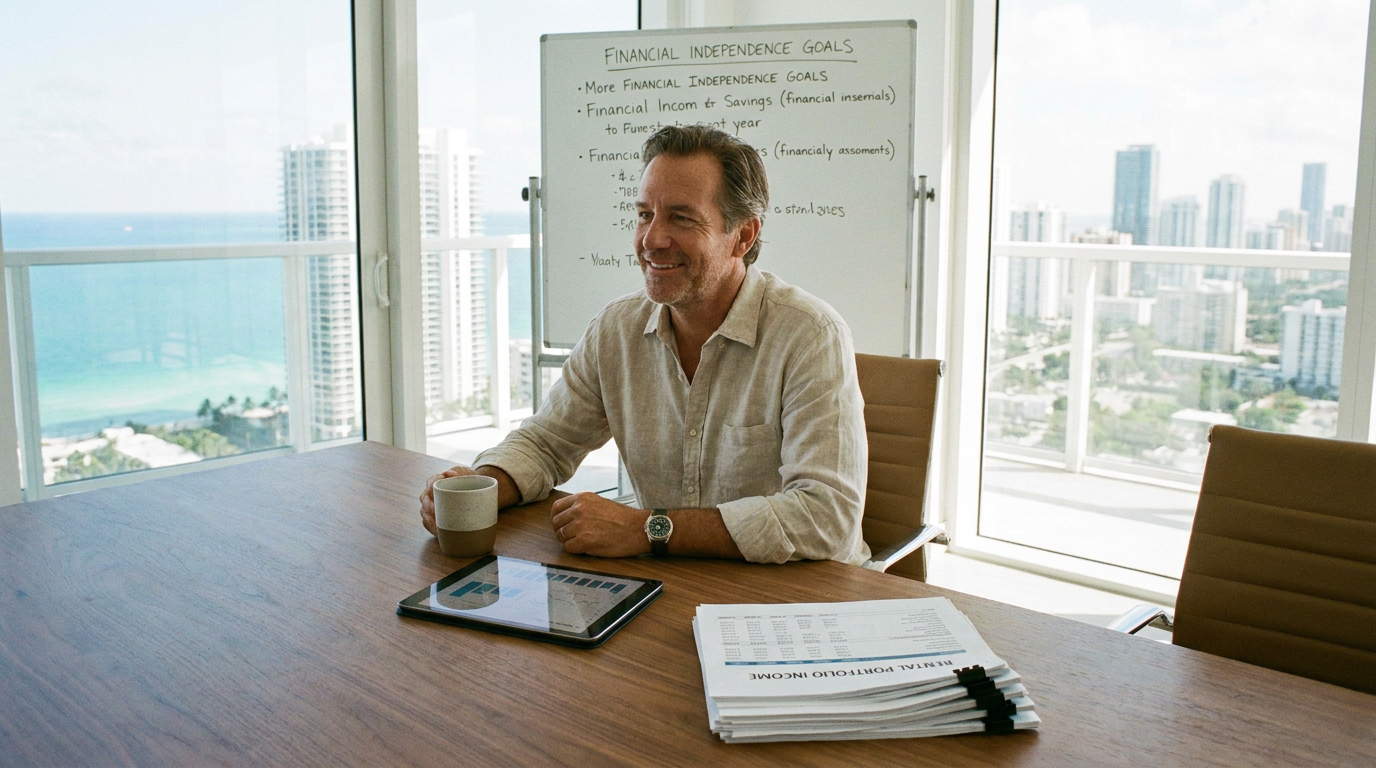
Use our Rental Property ROI Calculator and Compound Interest Calculator to model your portfolio growth trajectory. Ready to accelerate toward full-time investor status? Connect with our investment team and we can help you build a portfolio across all six counties. Also see our guide on what it takes to scale to 100 rental properties.
The question is cash flow replacement, not portfolio size
Going full-time is not about owning a certain number of doors. It is about whether reliable net income, after every expense including reserves, covers your living costs with enough margin to survive a bad year.
The distinction matters because gross rent and net income are far apart. A portfolio producing $10,000 a month in rent may net a fraction of that once mortgages, taxes at reassessed values, insurance, vacancy, maintenance, capital reserves, and management are paid. People who quit on gross figures tend to return to work within eighteen months.
Reserves are what make it survivable
An employed investor with a vacancy has an inconvenience. A full-time investor with a vacancy has a pay cut, and if several coincide with a roof failure, a crisis. The difference between the two is reserves.
Hold enough to cover several months of every property's full carrying cost plus at least one major repair, separately from your personal emergency fund. Investors who lose properties in South Florida are usually undercapitalised rather than wrong about the market, and forced selling is where real losses happen.
What the local costs do to the plan
Three things make South Florida underwriting stricter than the national advice assumes.
Insurance is the largest and most volatile line, and it has moved enough in recent years to turn positive cash flow negative on properties bought before the increases. Model it high and re-shop it annually.
Property taxes reset on sale, so any portfolio built by acquisition carries higher tax bases than long-held comparables suggest.
Association exposure on attached property means a single milestone-inspection assessment can consume a year of net income from that unit. Reserve studies are not optional reading.
Liquidity, and why the exit matters before the entry
Full-time investors need the ability to sell when they choose rather than when a buyer appears. That makes local absorption a strategic input rather than trivia.
Days on market across the counties we serve range from roughly 107 in Palm Beach to about 214 in Highlands. A portfolio concentrated in slow markets can look excellent on yield and still leave you unable to raise cash within a quarter. Mixing markets, or simply knowing which of your holdings is genuinely liquid, is part of the plan.
The unglamorous parts of doing this full-time
- You become an operator. Tenant screening, maintenance coordination, bookkeeping, and compliance are the actual daily work, not deal-hunting.
- Health insurance and retirement are now your responsibility, and both are real line items that salaried investors never price.
- Financing gets harder without W-2 income. Lenders scrutinise self-employed borrowers more closely, which can constrain growth exactly when you want to accelerate.
- Income is lumpy. Rents are steady; capital events are not, and budgeting on the latter is how people get caught out.
A more realistic path
Most people who make this work build the portfolio while employed, prove the numbers across at least one full year including a real vacancy and a real repair, then leave once net income plus reserves clears their living costs with margin.
That is slower and considerably more likely to hold. If you are building toward it in the eight counties we serve, we are glad to be candid about what specific properties would realistically rent for and what they would sell for, which is the arithmetic the whole plan rests on.
Common questions
How many properties do I need?
The wrong question. What matters is net income after all expenses and reserves relative to your living costs, which depends on price point, financing, and local costs rather than door count.
Should I quit before or after the numbers work?
After, and preferably after a full year that included something going wrong. A portfolio that has never faced a vacancy or a capital repair has not been tested.
Is it harder to get loans without a job?
Generally yes. Plan financing before leaving employment rather than discovering the constraint afterwards.
Self-manage or hire?
Either, but cost it honestly. Self-management is real work, and the expense reappears the moment you stop or sell to someone who will not.
Structuring the transition
Two practical steps make the leap far less risky. First, run a full year of accounting as though you were already full-time: every expense, every reserve contribution, every vacancy, with nothing subsidised quietly by your salary. What that year nets is your actual income, and it is usually lower than the mental figure.
Second, secure financing before you leave employment. Lenders assess self-employed borrowers differently, and refinancing or acquiring is materially harder without W-2 income. Investors who plan to keep growing after going full-time frequently discover the constraint at the worst moment.
What to do in a bad year
Decide in advance, while you are calm, what you would do if two properties sat vacant and a roof failed in the same quarter. Which property would you sell? What would you draw on? At what point would you take outside work again?
Having those answers written down is what prevents a bad quarter from becoming a forced sale, which is the single most expensive event in this business. Investors rarely lose money because they picked the wrong property; they lose it because they had to sell at the wrong moment.


