

How Hard Is It to Be a Landlord in South Florida? (Honest Guide)
June 9, 2026 · 6 min read · By Onias Derilus, Broker
Being a South Florida landlord can build serious wealth, or consume enormous time and energy. Here's the honest truth about the demands, the rewards, and what separates successful landlords from those who sell their rentals within three years.
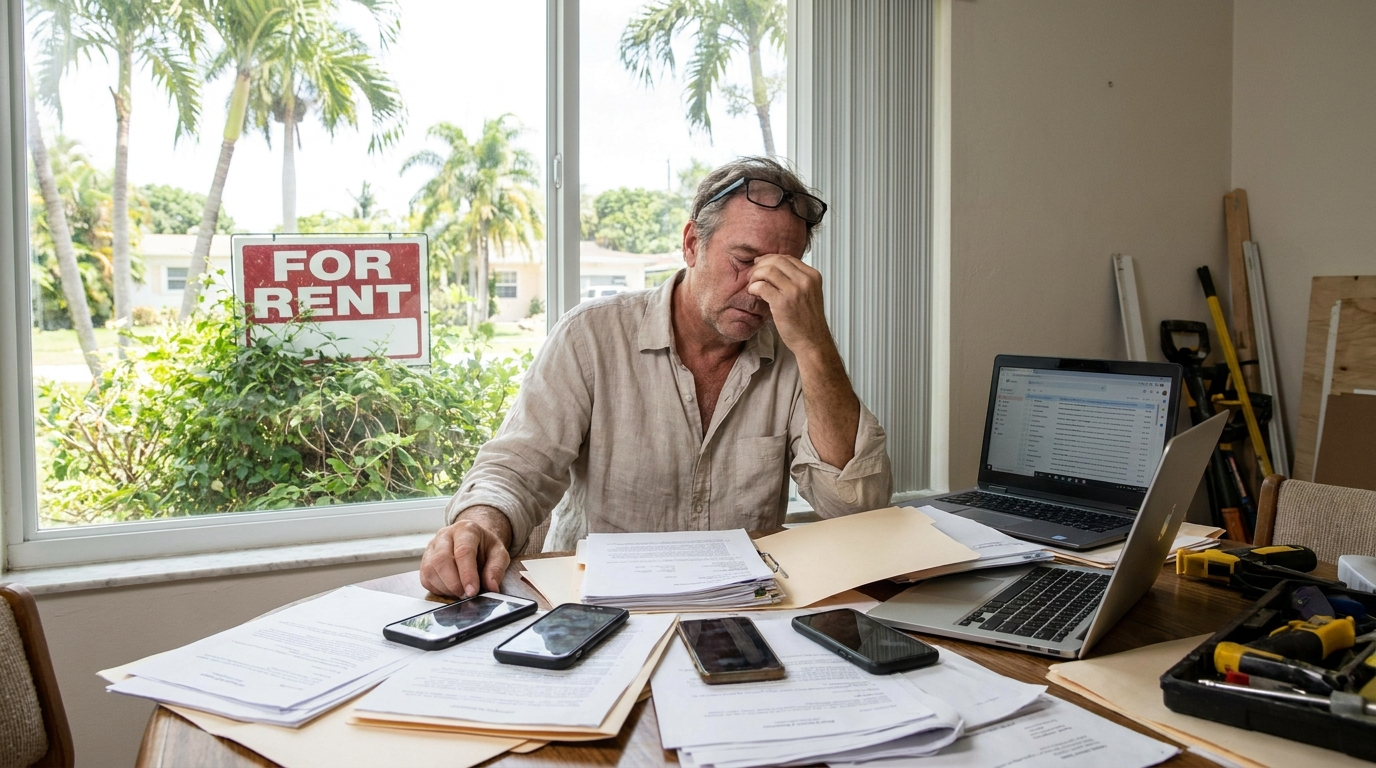
How hard is it to be a landlord? It depends almost entirely on how you approach it. Self-managing a South Florida rental property is a genuine part-time job. Handing it to a property manager costs 8 to 10 percent of rent, but it frees up your time completely. Here is the honest picture of what landlording actually involves.
What self-managing a South Florida rental actually requires
Landlords who self-manage take on responsibilities most people do not fully anticipate before they buy:
- Advertising vacancies, reviewing applications, running credit and background checks, verifying income and rental history, making selection decisions, and doing all of it in compliance with Fair Housing law.
- Using a legally compliant Florida lease agreement, conducting a thorough move-in inspection with written documentation, collecting security deposits, and placing them in a proper Florida escrow account.
- Responding to repair requests, sometimes urgently. No AC in a South Florida summer is a genuine emergency. You will coordinate licensed contractors, oversee work, and approve invoices.
- Following up on late payments, serving proper Florida notices when necessary (the 3-day notice, for example), and maintaining records for tax purposes.
- Handling complaints, lease violations, lease renewals, and occasionally the eviction process.
Time estimate for a well-run single-family South Florida rental: 4 to 8 hours per month during occupancy, and considerably more during turnover.

The Florida-specific landlord challenges
South Florida landlords face some challenges that are more acute here than in other markets:
- Hurricane and weather preparedness. Tenants will have questions before storm season. Landlords are responsible for ensuring the property meets Florida building codes for wind resistance and carries proper insurance coverage.
- Insurance complexity. Florida's landlord insurance market is genuinely difficult. Premiums are high and some insurers have exited the state entirely. Budget $3,000 to $8,000 annually for a non-owner-occupied property, depending on age and location.
- Florida eviction process. Florida is relatively landlord-friendly on eviction law. Non-payment cases typically resolve in 3 to 5 weeks, but the process requires strict procedural compliance: proper 3-day notice, proper filing, and no self-help eviction.
- Pest control. South Florida's climate means ongoing pest pressure year-round. Spell out responsibility in your lease and build pest control into your maintenance budget.
Self-manage vs. hire a property manager: the honest trade-off
Most South Florida landlords with one to three properties face this decision at some point. Here is the math:
- A property manager typically charges 8 to 10 percent of monthly rent, plus leasing fees of $500 to $1,000 to place a new tenant.
- On a $2,000-per-month rental, that is $160 to $200 per month, or $1,920 to $2,400 per year.
- If you have a day job and your time has any value, that fee often costs less than the aggravation of self-management.
- A good property manager also reduces vacancy through faster leasing and better tenant screening, which can pay for the fee by itself.
The investors who consistently build large South Florida portfolios almost always use property managers. The time they save gets reinvested into finding and analyzing new deals.
What makes South Florida landlording worth it
Despite the challenges, South Florida landlords have real advantages. Rental demand stays strong, which keeps vacancies low. Rent growth has been consistent for years. Property appreciation has been substantial. A landlord who bought a modest South Florida property in 2015 has likely doubled their equity while collecting a decade of rent checks.
The key is treating it like a business: proper systems, the right insurance, a trusted contractor network, and either a good property manager or strong self-management discipline. Use our Rental Property ROI Calculator to model your returns. Ready to buy your first South Florida rental? Connect with our investor team or explore properties across all six counties.
Thinking about buying a South Florida rental?
Our team works with investors across Palm Beach, Broward, and Miami-Dade counties. We can help you find the right property, run the numbers, and connect you with vetted property managers. Contact us or browse available listings to get started.
Frequently asked questions
Is it hard to be a landlord for the first time?
The learning curve is real. Most first-time landlords underestimate the time involved in finding and screening tenants, handling maintenance, and staying current on Florida landlord-tenant law. Starting with a single property, using a solid lease, and building a contractor network before you need it will save you a lot of stress.
Do I need a property manager for a South Florida rental?
You do not legally need one, but many landlords find the cost worth it. If you live more than 30 minutes from the property, have a demanding job, or own more than two or three rentals, professional management tends to pay for itself in time saved and better tenant outcomes.
What is the biggest mistake new landlords make in Florida?
Skipping proper tenant screening. A bad tenant in Florida will cost you far more in lost rent, property damage, and legal fees than any amount saved by rushing a vacancy. Run the credit check, verify income, and call the previous landlord.
How much does a property manager cost in South Florida?
Most charge 8 to 10 percent of monthly rent for ongoing management, plus a leasing fee to place new tenants. On a $2,200-per-month rental, you are looking at roughly $175 to $220 per month in management fees.
Is South Florida a good market for rental property investment?
Historically, yes. The combination of population growth, limited housing supply, and strong job markets across Palm Beach, Broward, and Miami-Dade counties has kept rental demand high and supported consistent rent increases. That said, insurance costs and property taxes have risen sharply, so underwriting the deal carefully before you buy is important.
Screening prevents most of the work that follows
The honest answer to how hard this is depends almost entirely on one decision made before anyone moves in, and new landlords consistently rush it because a vacant month feels expensive.
A vacant month costs you one month. The wrong tenant can cost many months, plus legal fees, plus damage, plus the turnover to re-let afterwards. The arithmetic is not close, and it is the single most consequential judgement in the whole business.
Screen consistently and document the criteria you apply to everyone. Verify income independently rather than accepting stated figures, contact previous landlords rather than only the current one, who may want the tenant to leave, and check the eviction and credit position. Apply the same standard to every applicant, both because it produces better outcomes and because fair housing obligations apply to how you select.
What the work actually consists of
People imagine landlording as collecting rent. The realistic list is longer and most of it is unglamorous.
- Marketing and showing the unit each time it turns over, which is where most of the concentrated effort sits.
- Screening and lease preparation, then handling the deposit according to Florida's requirements on holding and notice.
- Maintenance, including the calls that arrive at inconvenient hours, and finding trades who will actually turn up.
- Rent collection and the awkward conversation when it is late, which is a skill rather than a formality.
- Annual insurance renewal, which in Florida is now an active task rather than a rubber stamp.
- Turnover, meaning cleaning, painting, repairs and re-letting, which is the most expensive routine event in the cycle.
- Record keeping for tax, which is far easier maintained monthly than reconstructed annually.
None of that is difficult in isolation. The difficulty is that it is unpredictable in timing and cannot be deferred.
The Florida specific burdens
Three things make landlording here harder than the national picture suggests, and all three have grown.
Insurance is the first. Premiums have risen substantially and renewal is no longer automatic, so shopping cover and maintaining the features that keep it affordable is now part of the job. A landlord policy differs from an owner occupant one and should be quoted as such.
Storm preparation is the second. Securing a property before a storm, dealing with the aftermath, and coordinating with tenants around evacuations are real obligations on a seasonal cycle.
Association rules are the third, where the property sits in one. Leasing restrictions, minimum lease terms, caps on leased units and tenant approval processes all constrain what you can do, and some carry application fees and delays that affect your turnover timeline. Read them before buying rather than before letting.
The eviction process rewards precision
Florida provides a defined statutory process, and it is unforgiving of procedural error. A defective notice can mean starting again, which turns weeks into months.
The practical implication is that this is the wrong place to save money on professional help. Use a Florida attorney rather than a template, follow the process exactly, and keep records of everything from the first missed payment.
Prevention remains far cheaper than cure, which returns to screening. Most landlords who never face an eviction are not lucky, they were careful at the start.
When a manager is worth it
Management typically costs a percentage of collected rent, commonly in the region of eight to twelve percent, plus fees for letting and sometimes for renewals.
It is worth it when you live far from the property. It is also worth it when you have several units and the small tasks exceed your patience. The same goes if you travel or work hours that make responsiveness hard. Or if you would rather own an investment than run a small business.
The critical point is to include that cost in your model from the beginning whether or not you intend to use it. A property that only produces a return when you self manage is a job you bought rather than an investment you made, and treating the fee as optional hides that.
More common questions
Is the first year the hardest?
Usually, because every process is new and the first turnover teaches you what your real costs are. It becomes considerably more predictable afterwards.
What is the most common new landlord mistake?
Accepting a weak tenant to avoid a vacant month. The vacancy costs one month; the wrong tenant can cost many.
Do I need a manager for one property?
Not necessarily, if you live nearby and can respond. Budget the fee anyway, so the numbers still work if you later decide you want your time back.


