

How Many Houses Do You Need to Sell to Make $100K as a South Florida Agent?
June 9, 2026 · 6 min read · By Onias Derilus, Broker
How many houses do you need to sell to make $100,000 in South Florida? The math depends on your split, the average sale price in your market, and your business expenses. Here's the real breakdown.
One of the most common questions from newer real estate agents is: "How many houses do I need to sell to make $100K?" It's a fair question, and the answer depends on where you work, your commission split, and your actual business costs. In South Florida, where median home prices run well above the national average, the math works out better than it does in most U.S. markets. Here is how to figure it out without guesswork.
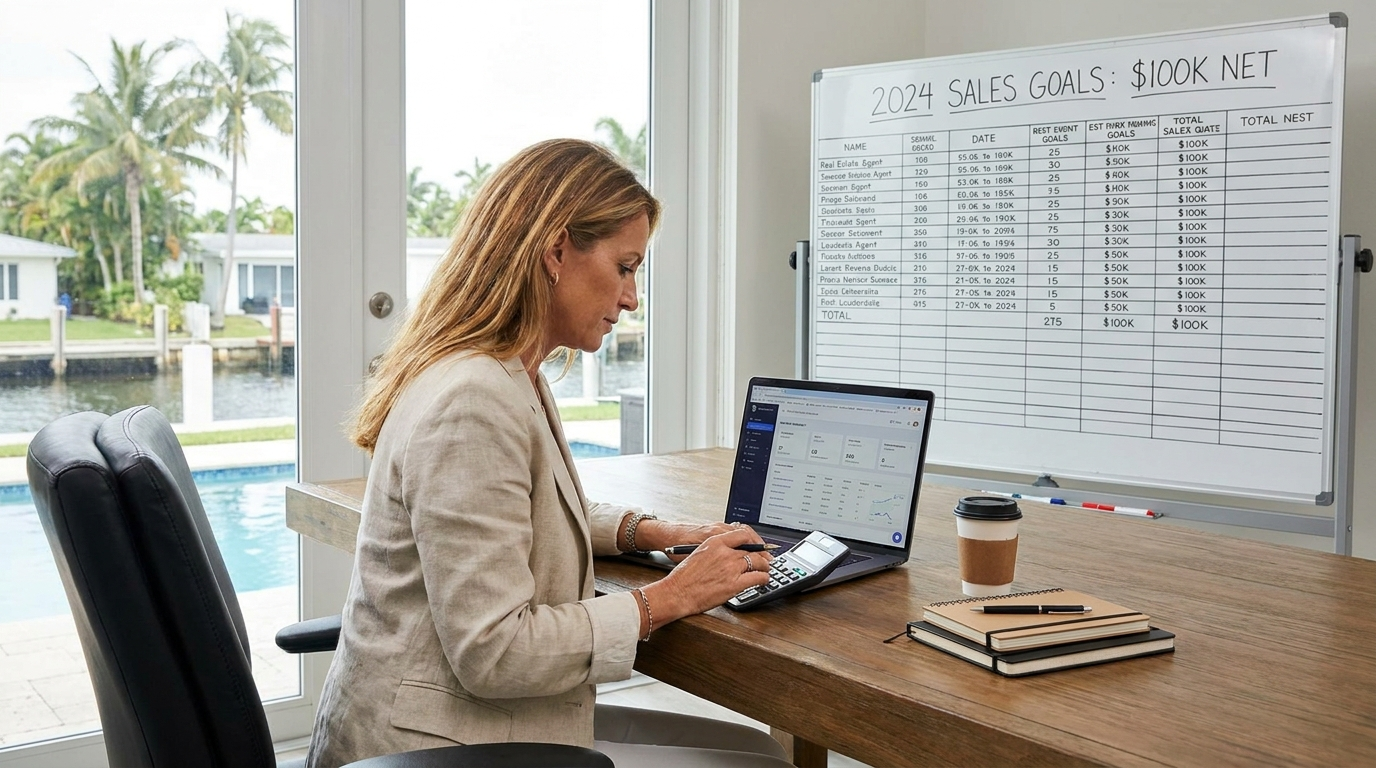
The commission math: start here
In a typical South Florida transaction, the buyer's agent side earns 2.5 to 3% of the sale price (post-NAR settlement). On a $450,000 home, which is close to the median across Palm Beach and Broward counties, that comes out to $11,250 to $13,500 in gross commission.
You don't keep all of it. You work under a brokerage and share commission according to your split agreement. New agents at traditional brokerages often start at 50/50. More experienced agents or those at volume-based shops might run 80/20 or 90/10. Some brokerages charge a flat monthly or annual fee and let you keep 100% above that cap.
Example calculation for a new agent on a 70/30 split:
- Sale price: $450,000
- Commission (3%): $13,500
- Agent's split (70%): $9,450
- After business expenses (roughly 25% of gross): about $7,100 net per transaction
At $7,100 net per transaction, you need approximately 14 transactions to reach $100,000 in take-home income.
The South Florida advantage: higher median prices
South Florida's above-average home prices make the math more favorable than most U.S. markets. If your average sale is $550,000 (realistic in Palm Beach County or Miami-Dade's luxury-adjacent markets) and you are on a 75/25 split, the numbers look like this:
- Commission (3%): $16,500
- Agent's split (75%): $12,375
- After expenses: about $9,300 net
At that level, you need roughly 11 transactions to hit $100,000. That is less than one closed deal per month, a very achievable target for a focused, full-time agent in South Florida.

The business expenses reality
Many newer agents underestimate what it costs to run a real estate business. Real expenses include MLS membership and access fees ($1,500 to $2,500 per year), E&O insurance, marketing and advertising, CRM software, signage and lockboxes, business cards and print materials, transportation, continuing education, and any co-op marketing contributions your brokerage requires.
A realistic budget is 20 to 30% of gross commission income going to expenses. Factor this in before you calculate how many transactions you need to hit your income target.
What it actually takes
Agents who reach $100K in their first or second year in South Florida tend to share a few habits. They work full-time, they work their sphere of influence hard in the first 12 months, and they pick one specific niche (a geographic farm, a buyer segment, an investor focus) and stay consistent with it. They also track their pipeline closely so they always know where their next deal is coming from.
Interested in joining Pure Equity or exploring real estate careers in South Florida? Contact our team to learn about agent opportunities across our six-county footprint.
Working backwards from the goal
The number of homes you must sell to net $100,000 depends on three variables: your average sale price, your commission rate, and your brokerage split. Change any one and the answer moves substantially, which is why a single headline number is misleading.
Start with gross commission income rather than transaction count. To take home $100,000 after costs and self-employment tax, most agents need meaningfully more than $100,000 in gross commission. Business expenses, dues, marketing, and tax all come out first.
Why price point changes the answer so much
Commission scales with price, so where you work matters as much as how hard you work. Median list prices across the counties we serve range from roughly $265,000 in Okeechobee to about $599,000 in Miami-Dade, with Palm Beach near $480,000 and Broward near $389,000.
An agent averaging Miami-Dade prices reaches any income target in materially fewer closings than one averaging Okeechobee prices, for identical effort per deal. That is the strongest argument for choosing a market deliberately rather than taking whatever business arrives.
Commission rates are negotiable and are not set by law or any board, so build your own estimate from what you actually charge rather than from an assumed standard rate.
The costs between gross and take-home
- Brokerage split, which may improve after you hit a production threshold.
- Self-employment tax, which surprises first-year agents more than any other line.
- Marketing, including photography, signage, and any paid lead generation.
- Dues and insurance: licence renewal, association and multiple listing service fees, errors and omissions coverage.
- Vehicle and time. Showing property across three counties has a real cost per closing.
A reasonable planning assumption is that take-home is well below gross commission. Build your target from net, then work back to the transaction count.
Fewer, larger transactions or more, smaller ones
Both routes reach the same income, and they demand different businesses. Higher-priced listings mean fewer clients, longer sales cycles, and more competition for each opportunity. Lower-priced transactions mean more volume, more simultaneous files, and more administrative load per dollar earned.
Days on market matter here too. Palm Beach County averages about 107 days and Highlands about 214. A market with slower absorption ties up your listings, and therefore your capacity, for longer.
The part that is not arithmetic
Most agents fall short of income goals for a pipeline reason, not a maths reason. Reaching any target requires a predictable flow of conversations, and the agents who hit their numbers usually have a defined market, a routine for staying in contact with past clients, and enough listing business that marketing one property generates the next client.
If you are weighing a real estate career, work out the transaction count for your intended price point, then ask honestly how many months of expenses you can cover while building to it.
Questions about reaching $100K
Is $100,000 realistic in the first year?
For most new agents, no. The first year is usually spent building a pipeline, and commissions arrive only after a client, a contract, and a 30 to 45 day closing period. Treat it as a two to three year target unless you begin with a substantial network.
Does a higher split solve it?
Only if the business exists. A better split multiplies closings you actually have, so early on, training and mentorship usually produce more income than a few points of split.
Do luxury agents earn more per hour?
Not automatically. Higher price points bring longer cycles, more competition for each listing, and higher marketing costs. The income per closing is larger, but so is the work and the risk of the deal not closing.
How should I choose which market to work?
Pick somewhere you can genuinely know street by street, and where the price point supports your income goal at a transaction count you can sustain. We are happy to talk through how the eight counties we serve differ on price, pace, and inventory.
Building the pipeline the number depends on
Any transaction target implies a conversation target. Not every conversation becomes a client, not every client buys or sells within the year, and not every contract closes. Working backwards, a modest annual closing goal typically requires a steady flow of new contacts every single month, which is why consistency beats intensity in this business.
The agents who reach income goals reliably tend to have three things: a defined geography they know street by street, a routine for staying in contact with past clients and their own network, and enough listing business that marketing one property produces the next client. None of that is glamorous, and all of it compounds.
Why listings change the maths
A listing works while you sleep. Signage, online exposure, and enquiries from that one property generate contacts with other buyers and sellers, some of whom become clients. Buyer representation does not scale the same way: each client consumes showings and hours, and the work ends at closing.
That is the structural reason experienced agents drift toward listings, and it is also why the seller side is where a career becomes durable. An agent with a steady listing pipeline has a business; an agent dependent on new buyer leads has a job that restarts every month.
A realistic first-year plan
Set the transaction count for your intended price point using the arithmetic above, then halve your expectation for year one and plan your finances around that. Track conversations rather than closings, because closings are a lagging indicator and will discourage you before the pipeline matures.
If you are weighing a real estate career in South Florida and want an honest read on what the first year involves at a small brokerage, get in touch. We would rather have that conversation before you commit than after.


