

How Much Does a Busy Street Affect Home Value in South Florida?
June 9, 2026 · 5 min read · By Onias Derilus, Broker
A busy street can reduce a South Florida home's value by 5,15% compared to similar homes on quiet streets. But the discount varies widely by price range, buyer type, and what 'busy' actually means. Here's what the data shows.
How much does a busy street affect resale value? It comes up constantly from South Florida buyers and sellers, and the answer is more concrete than most people expect. Location on or near a high-traffic road is a recognized valuation factor in real estate appraisal, and the price impact is real. The size of that impact depends on several variables that play out differently across South Florida's markets.
The general discount: what appraisers say
Real estate appraisers typically apply a 5 to 15 percent discount for homes directly on or immediately adjacent to high-traffic roads, compared to similar homes on quiet interior streets. The specific number depends on a few things.
- Traffic volume: A residential collector street with moderate traffic might warrant a 3 to 5 percent discount. A four-lane arterial or state road typically lands at 8 to 15 percent.
- Price point: Luxury buyers are more sensitive to street traffic. A $1.5M home on a busy road may take a larger percentage hit than a $350,000 home in the same neighborhood.
- Sound barriers and landscaping: Homes with masonry walls, mature trees, or natural buffering tend to see smaller discounts than those with no separation from road noise and headlights.
- Setback: A property set back 50 feet from a busy road fares better than one with its front door 15 feet from traffic.
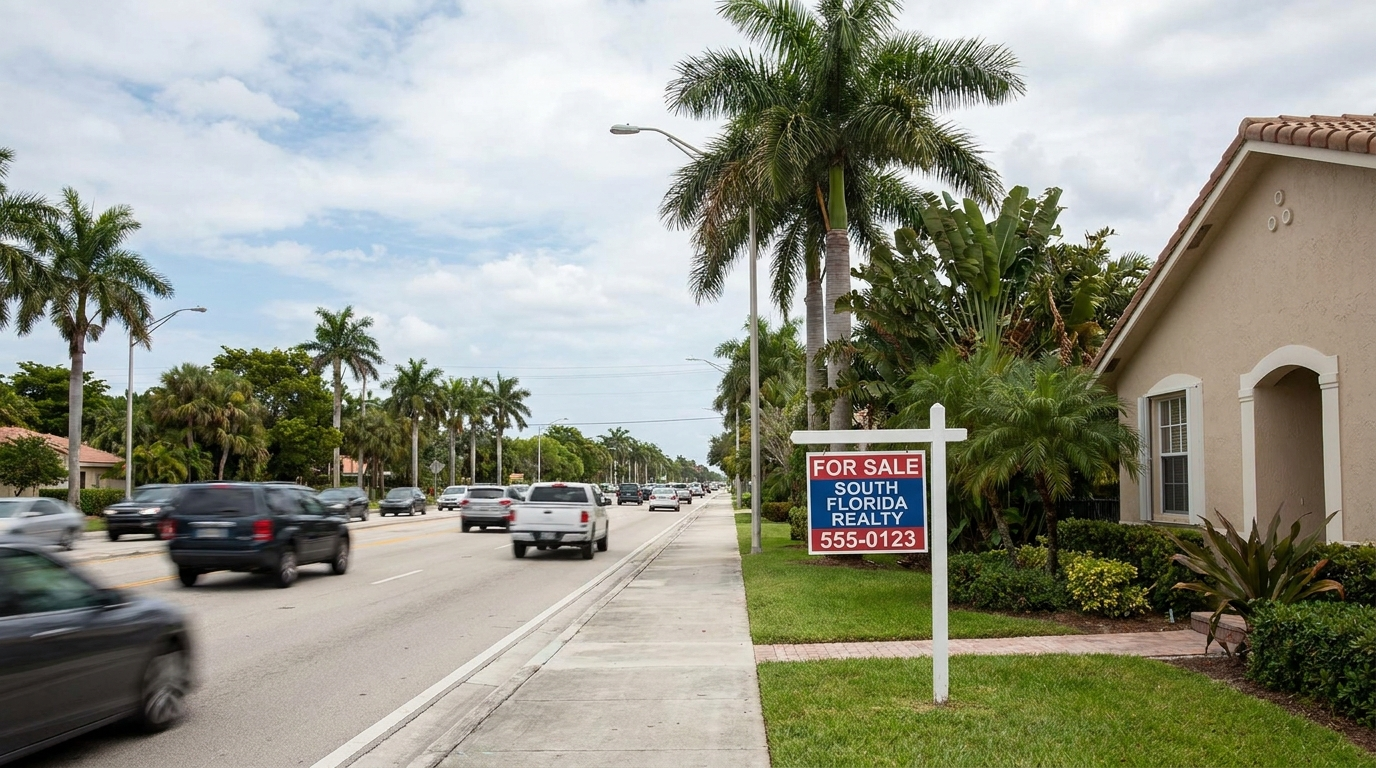
South Florida-specific traffic considerations
South Florida has a distinctive road network, and it creates busy-street dynamics buyers should know before making an offer.
- State roads and US highways: US-1, US-441, SR-7, Sunrise Boulevard, Atlantic Avenue. These major corridors run directly through residential areas. Homes on these roads face the steepest discounts (10 to 15 percent) because of heavy commercial truck traffic, consistent noise, and safety concerns for families with children and pets.
- Residential arterials: Roads like Military Trail, Lyons Road, or Sample Road carry significant traffic but are primarily residential in character. Typical discount range: 5 to 10 percent.
- Busy neighborhood streets: Higher-than-average residential traffic, but not major arterials. The discount is usually 2 to 5 percent, often negligible in practical terms.
- School zones and school roads: Homes adjacent to school roads have complex traffic patterns. The road is heavy at drop-off and pickup, quiet otherwise. These may carry a modest 2 to 5 percent discount tied to traffic and parking congestion at peak times.
When a busy street discount is actually an opportunity
For investors and buyers who can look past the stigma, busy-street properties offer consistent pricing advantages.
- For rentals: Renters are generally less sensitive to street traffic than owner-occupants. A property bought at a 10 percent discount but renting at only a 3 to 5 percent discount to quiet-street comparables produces better cash flow and a stronger cap rate. The busy-street discount is captured at acquisition.
- For flippers: A distressed busy-street property bought at a 12 percent discount to quiet-street ARV can still sell at a 7 percent discount after renovation. That 5-point spread is profit captured during the flip.
- For owner-occupants who genuinely do not mind: If you work from home and traffic noise does not bother you, paying a 10 percent discount for a home that meets your needs is simply good buying. The market prices in the discount whether you care about the traffic or not.
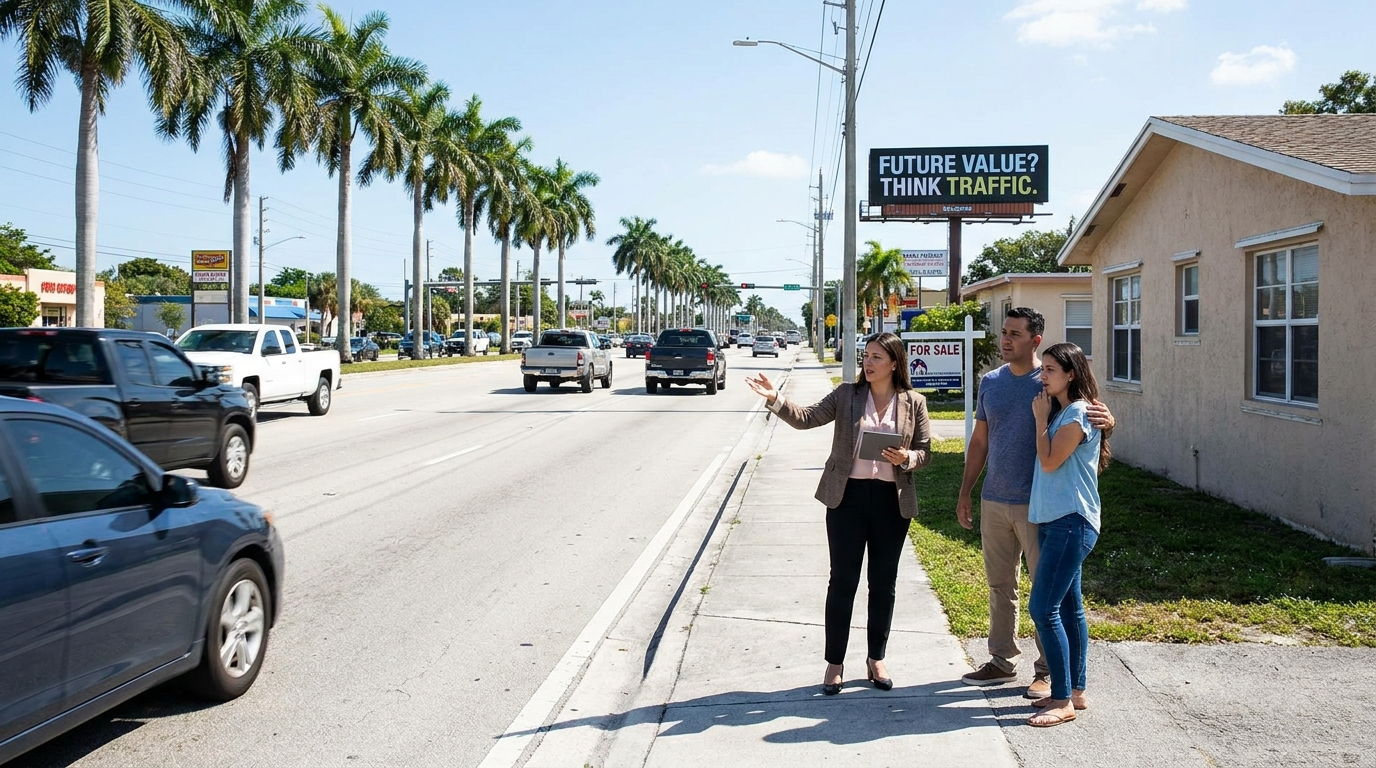
Before you buy on a busy South Florida street
If you are seriously considering a property on a high-traffic road, do these things before committing.
- Visit at multiple times of day, including morning rush, midday, and evening, to experience the actual traffic and noise level firsthand.
- Ask your agent to pull busy-street comps specifically, not just general neighborhood comps, so you understand the realistic resale price range.
- Factor the discount into your pricing expectations if you plan to sell within five years.
- Check Google Maps traffic data for peak congestion patterns on that specific road.
Our team helps South Florida buyers evaluate location-specific factors, including traffic impact, flood zones, school district boundaries, and neighborhood trajectory, before committing. Reach out here or start your search with us today.
How the discount is actually measured
Articles quoting a fixed percentage for a busy road are guessing. Appraisers do not apply a standard deduction, because the effect varies enormously between properties, and inventing a number would be dishonest.
The real method is paired sales analysis. You find recent closed sales on the busy road and comparable closed sales one or two streets back, control for size, age, condition and lot, and the residual difference is the market's own answer for that specific street.
That is the only figure that means anything, and it is genuinely obtainable. It also explains why the effect ranges from almost nothing to substantial: a moderately trafficked road in a dense area barely registers, while a six lane arterial next to a bedroom window is a different matter.
What buyers actually object to
The word traffic covers several distinct objections, and they are not equally damaging.
- Noise. The most common, and the most fixable. Impact windows, which many Florida homes need anyway, cut road noise substantially as a side effect.
- Safety. The one that eliminates buyers rather than discounting them. Families with young children frequently will not consider a property where the front door opens onto fast traffic, at any price.
- Access. Turning left out of the driveway at peak times, and whether guests can park.
- Air and dirt. Real on major arterials, and it shows up as more frequent exterior cleaning.
Knowing which objection applies tells you what to do about it, because two of these can be mitigated and one cannot.
What a seller can genuinely do
Start by fixing what is fixable. Impact windows and doors reduce noise and, in Florida, may also qualify for a wind mitigation insurance credit where the features meet the requirements, so the same spend does two jobs. Confirm with your carrier what actually qualifies rather than assuming.
Then use landscaping and fencing properly. A solid wall or dense hedge along the frontage does more for perceived quiet and privacy than almost any interior improvement, and it changes the impression a buyer forms in the first ten seconds.
Finally, control the showing conditions. Schedule viewings outside peak traffic where you reasonably can, and make sure the rear garden, if it is the quiet side, is the part buyers spend time in.
Price it correctly from the start
The costly mistake is pricing as though the road does not exist, then reducing repeatedly as the market disagrees. Buyers see the reduction history and read it as a property with a problem, which is worse than the discount you were avoiding.
Get the paired sales analysis done before listing and price to it. A home correctly priced for its location sells in a normal timeframe. One priced as if it were a street back sits, accumulates days on market, and eventually sells for less than the honest price would have achieved.
The buyer's side of the same trade
For a buyer who genuinely is not troubled by the road, this is one of the few reliable ways to get more house or a better area for the money. The discount is real and it is available immediately.
Two cautions. The discount will still be there when you sell, so do not underwrite a resale at the quiet street price. And go and stand outside at the worst time of day, typically weekday morning and late afternoon, before deciding it does not bother you. A Sunday afternoon viewing is not a fair test.
Not all busy streets are equal
Two properties can both be described as being on a busy road and face completely different market reactions, so be specific about which one you have.
Speed matters more than volume. A steady stream of slow moving traffic on a residential connector bothers buyers far less than a smaller number of vehicles moving quickly, because the objection is noise and safety rather than the count.
Setback matters nearly as much. A house sitting well back behind mature planting reads as quiet even on a significant road, while an identical house close to the kerb does not. Whether the bedrooms and the main living space face the road or the rear garden can move the effect more than the road itself.
And the pattern of the traffic counts. A road that is busy for two hours a day is a different proposition from one that carries constant commercial traffic, including at night. Buyers who visit at a quiet time still ask neighbours, so being straightforward about it builds more trust than hoping it goes unnoticed.
More common questions
Does a busy road affect a condominium as much as a house?
Usually less, particularly on higher floors and in buildings already constructed with impact glazing. Ground floor units facing the road are the exception.
Will impact windows remove the discount entirely?
No. They address noise, which helps, and they do not change the safety or access objections that some buyers weigh most.
Is a corner lot on a busy street worse?
Often, because the exposure is on two sides. It can also allow a driveway on the quieter street, which materially improves the access objection.
Can you run the paired sales analysis for my street?
Yes. That comparison against closed sales one street back is the only honest way to price it, and it is standard work anywhere in the eight counties we serve.


