

How to Calculate Cap Rate in South Florida Real Estate
June 9, 2026 · 7 min read · By Onias Derilus, Broker
Cap rate is the most important metric for evaluating investment property, and one of the most misunderstood. Here's exactly how to calculate it and what the numbers mean in South Florida's market.
If you're evaluating an investment property in South Florida, the cap rate (capitalization rate) is the first number experienced investors reach for. It gives you a quick, financing-agnostic snapshot of a property's income potential relative to its price. Like most useful metrics, though, it's frequently misunderstood, misapplied, or cherry-picked by sellers trying to make a deal look better than it is. Here's how to calculate cap rate correctly and what the numbers actually mean in Palm Beach, Broward, Miami-Dade, and beyond.
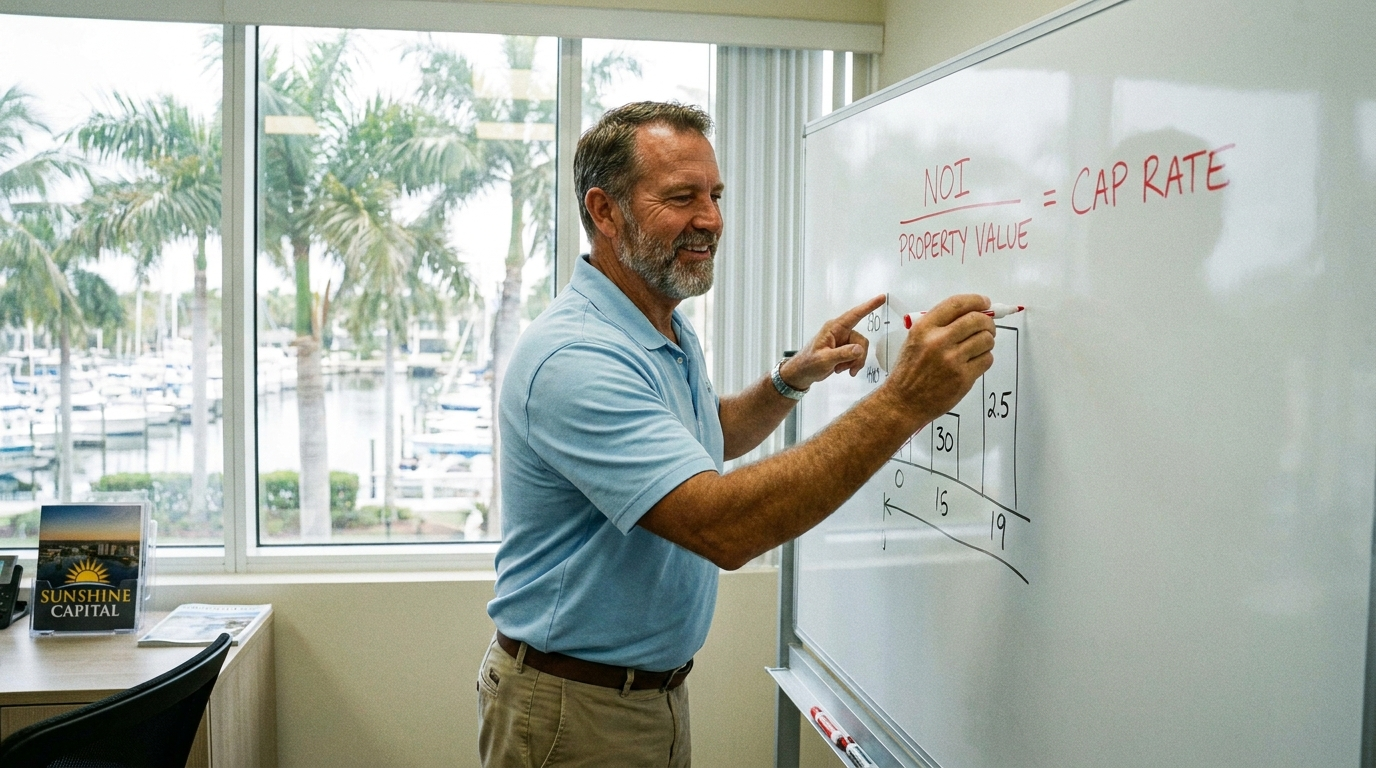
The cap rate formula
The formula is simple:
Cap Rate = Net Operating Income (NOI) / Current Market Value (or Purchase Price)
Net Operating Income is the annual income a property generates after all operating expenses, but before mortgage payments and income taxes. The key word is "operating": NOI excludes debt service intentionally, so you can compare properties regardless of how they're financed.
Example: A duplex in Delray Beach generates $36,000/year in gross rents. After vacancy (5%), property taxes, insurance, property management (10%), maintenance reserves, and HOA fees, you're left with $22,000 in NOI. If the property costs $440,000, the cap rate is $22,000 / $440,000 = 5.0%.
What goes into NOI: common mistakes
The most common mistake investors make is using gross rental income as a proxy for NOI. Sellers and their agents will sometimes advertise "5% cap rate" using an NOI that only deducted taxes and insurance, ignoring vacancy, management fees, capital reserves, and maintenance. Always build your own NOI from scratch using realistic assumptions:
- Gross potential rent: based on current market rents, not a seller's pro-forma
- Vacancy allowance: 5-8% is typical in South Florida's strong rental market
- Property management: 8-12% of gross rents if professional management is used
- Property taxes: verify the actual tax bill; South Florida taxes can be high, especially after homestead exemption loss
- Insurance: get your own quote; South Florida insurance costs have risen sharply in recent years
- HOA fees: if applicable, these reduce NOI directly
- Maintenance and capital reserves: 5-10% of gross rents is a reasonable placeholder
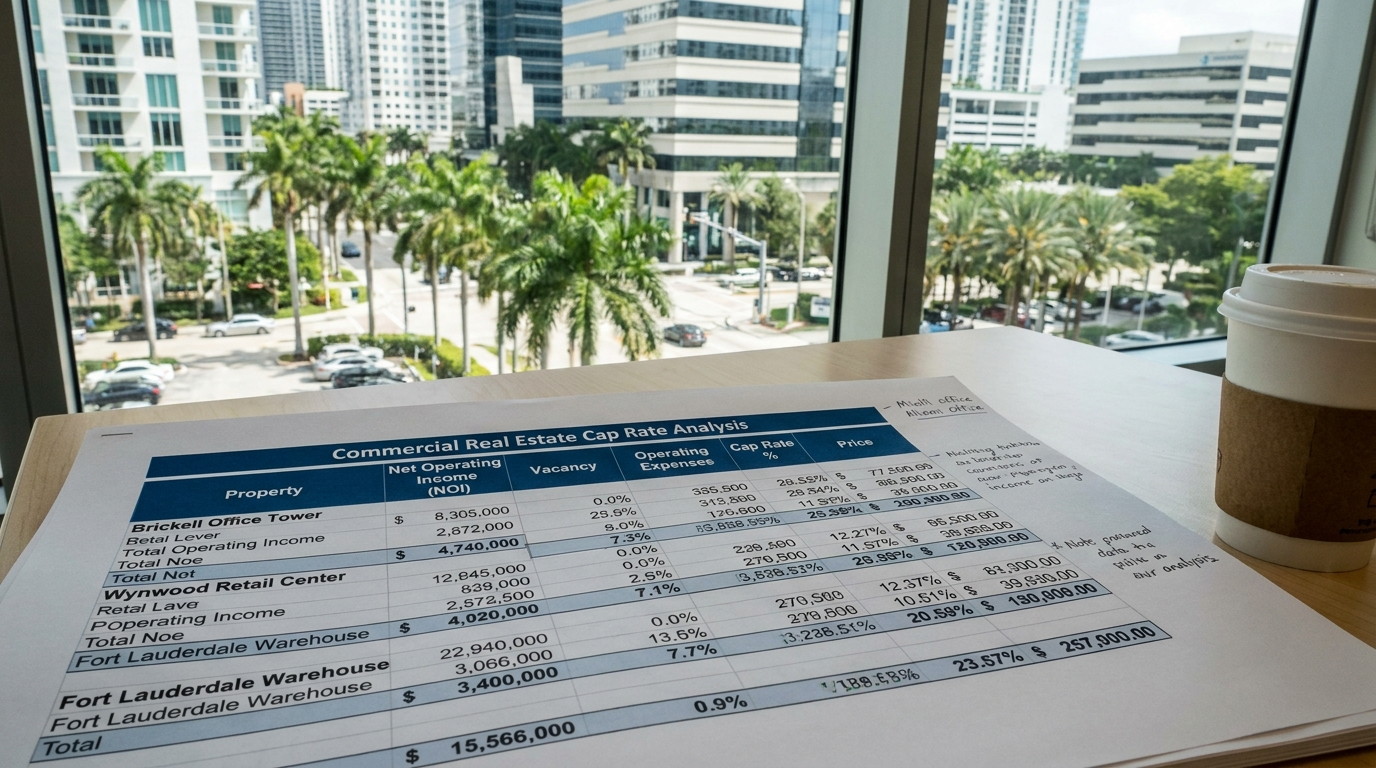
Cap rates by area in South Florida (2026)
Cap rates vary meaningfully across South Florida's counties. As a general guide in 2026:
- Miami Beach / Brickell / Coconut Grove: 3-4%. Ultra-low cap rates driven by appreciation speculation and international demand.
- Fort Lauderdale / Boca Raton / Palm Beach Gardens: 4-5.5%. Strong markets with some income potential.
- Inland Broward / Palm Beach (Lauderhill, Lake Worth, Boynton Beach): 5-6.5%. Better cash flow territory.
- St. Lucie and Martin Counties: 5.5-7%. Emerging markets with better yields.
- Highlands County: 7-9%+. Highest yields, with lower appreciation expectations.
Cap rate vs. cash-on-cash return
Cap rate ignores your financing. It measures the property, not your investment structure. Cash-on-cash return (annual pre-tax cash flow divided by total cash invested) tells you what your actual dollars are earning after debt service. Both metrics matter. Cap rate tells you whether the property is priced well; cash-on-cash tells you whether your deal works given your specific financing.
Use our Rental ROI Calculator to model both cap rate and cash-on-cash return on any South Florida property you're evaluating. Or contact our team for a full investment analysis on specific properties in your target market.
The formula, and the part people get wrong
Cap rate is net operating income divided by purchase price. If a Broward duplex costs $600,000 and produces $36,000 in net operating income, the cap rate is 6 percent. The arithmetic is trivial. The reason two investors reach different answers on the same building is that they disagree about what belongs in net operating income.
Net operating income is gross rent minus operating expenses, before debt service. Mortgage payments are not an operating expense, which surprises people. Cap rate deliberately ignores financing so you can compare two buildings on their own merits, regardless of how each buyer pays for them.
Expenses that belong in the calculation
- Property taxes. In Florida these reset on sale, so use the tax bill you will pay, not the one the seller pays under a long-held homestead or Save Our Homes cap.
- Insurance. This is the number that breaks South Florida pro formas. Windstorm and flood coverage have risen sharply, and an out-of-date quote can turn a 6 percent cap rate into a 4 percent one.
- Vacancy. Nobody collects 12 months of rent every year. Five to eight percent is a normal allowance.
- Repairs, maintenance, and capital reserves. Roofs and air conditioning systems fail on a schedule. Setting nothing aside does not make the cost disappear, it just moves it into a year you did not plan for.
- Management. Include it even if you self-manage. Your time has a cost, and the day you stop managing, the buyer of your building will price it in.
- Association dues, where the property sits in a condominium or homeowners association.
What counts as a good cap rate in South Florida
There is no universal number. A cap rate is a price, and prices reflect risk and demand. Coastal Miami-Dade and Palm Beach properties trade at lower cap rates because buyers accept less current income in exchange for appreciation and liquidity. Inland and rural markets show higher cap rates because the income has to compensate for slower resale.
You can see that trade in our own inventory. Miami-Dade carries a median list price near $599,000, while Okeechobee sits near $265,000 and Highlands near $309,500. Rents do not fall proportionally with those prices, which is why yields tend to look better inland. What also differs is exit speed: Highlands averages about 214 days on market against roughly 107 in Palm Beach County, so a higher cap rate there is partly payment for a slower sale.
Where cap rate stops being useful
Cap rate is a snapshot of one year of income against one price. It says nothing about appreciation, nothing about your loan, and nothing about taxes. Because it excludes financing, two investors with identical cap rates can have completely different cash returns depending on how they borrowed.
For a leveraged purchase, cash on cash return answers the question cap rate cannot: what did the money you actually put in earn this year? Use cap rate to compare buildings and cash on cash to evaluate your own deal. They are complementary rather than competing.
A quick sanity check before you buy
Rebuild the seller's numbers rather than accepting them. Ask for actual leases instead of a summary rent roll, get a real insurance quote in writing for your own name, and look up what the taxes become after the sale rather than what they are now. Most disappointing South Florida rental purchases trace back to one of those three figures being optimistic rather than to anything exotic.
Common questions about cap rate
Does cap rate include the mortgage?
No. Cap rate is calculated before debt service, on purpose, so a property can be compared on its own performance rather than on how a particular buyer financed it.
Is a higher cap rate always better?
Not necessarily. A high cap rate often signals higher risk, slower resale, or deferred maintenance. The question is whether the extra yield fairly compensates for whatever is causing it.
How do I find cap rates for a specific area?
Work from actual closed sales and verified income rather than asking prices and pro formas. We can pull recent comparable sales and what similar units are genuinely renting for in any of the eight counties we serve.
Do I use current or market rent?
Run both. Current rent tells you what you buy today; market rent tells you the upside if leases are below market. Underwriting the deal only on market rent assumes a repositioning that has not happened yet.
Working an example end to end
Numbers make this concrete. Take a small St. Lucie County rental listed at $410,000, which is close to the county median. Suppose it rents for $2,800 a month, so gross annual rent is $33,600.
Now subtract realistic operating costs. Property taxes reset on sale, so budget from the new assessed value rather than the seller's bill. Insurance in coastal Florida is the largest single variable and needs a written quote. Allow five percent for vacancy, set aside for repairs and future capital items, and include management even if you intend to self-manage. Those deductions commonly consume 35 to 45 percent of gross rent on a single-family rental, and more on a condominium once association dues are included.
At 40 percent, net operating income is about $20,160, and the cap rate on a $410,000 purchase is roughly 4.9 percent. If your insurance quote comes back materially higher than assumed, that figure can fall below 4 percent quickly. This is precisely why the quote should arrive before you remove your inspection contingency, not after.
How cap rate affects what a property is worth
The formula rearranges. Value equals net operating income divided by cap rate, which means the income a building produces sets its price for an investor buyer. Raising net operating income by $5,000 a year, whether by increasing rent at renewal or by reducing an expense, adds roughly $100,000 of value at a 5 percent cap rate.
That relationship is the most useful thing about cap rate for an owner rather than a buyer. If you are holding a rental and thinking about selling, the lever that moves your sale price is not cosmetic. It is the documented income. Clean books, current leases at market rent, and a re-shopped insurance policy can be worth more than a renovation when the buyer is an investor.
If you own a rental in any of the eight counties we serve and want to know what it would sell for on today's income, we can run the comparable sales and tell you.


