

How to Get Into Land Development in South Florida (Beginner's Roadmap)
June 9, 2026 · 7 min read · By Onias Derilus, Broker
Land development in South Florida is one of the highest-risk, highest-reward paths in real estate. Here's how new developers get started, the capital requirements, the entitlement process, and the first projects that actually work.
If you want to know how to get into land development, the short answer is: it requires more capital, more patience, and more local knowledge than almost any other path in real estate. In South Florida, developable land is genuinely scarce and demand is structurally strong. The opportunity is real. So is the learning curve. Here is the honest roadmap for getting started.
What land development actually involves
Land development is not just buying a lot and building a house. It is the process of taking land through entitlement, which means getting governmental approvals that allow it to be developed in a specific way. After entitlement, you can sell the land to a builder, build yourself, or both. The entitlement process in South Florida can involve:
- Zoning analysis and rezoning applications (if current zoning does not allow your intended use)
- Site plan review and approval
- Environmental permitting (particularly significant in South Florida given wetlands, flood zones, and protected habitat)
- Utility concurrency (confirming sufficient water, sewer, and road capacity)
- County and municipal approval processes, which can take 12 to 36 months even for straightforward projects
Entitlement is where most of the value in land development is created, and where most of the risk lives. A parcel worth $500,000 raw may be worth $2M or more after successful entitlement. It may also be worth $300,000 if entitlement is denied.
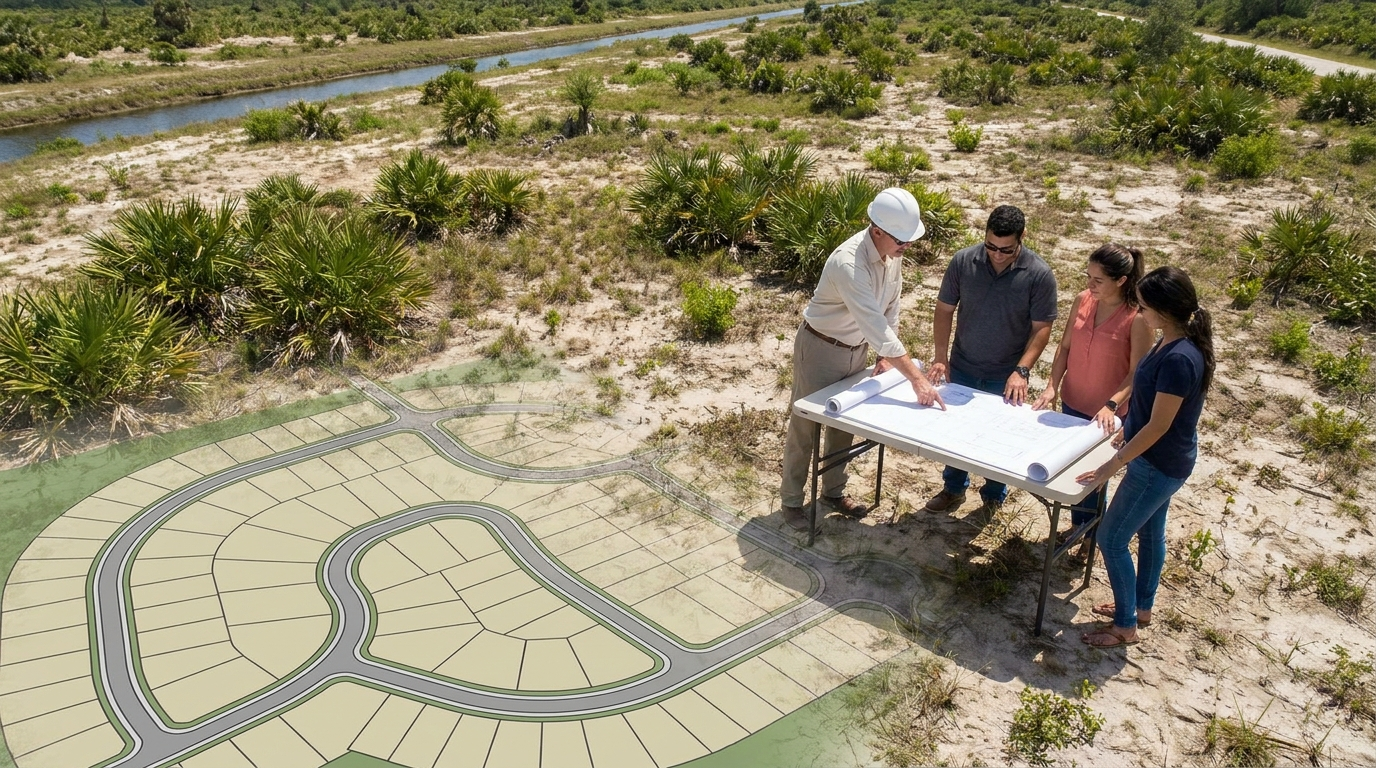
Capital requirements: how much do you need?
Land development requires significantly more capital than buying a rental property. Here is a realistic breakdown for a small residential land development project in South Florida:
- Land acquisition: $200,000 to $2M or more depending on location, size, and current entitlement status
- Due diligence: environmental assessment, survey, title search, feasibility studies run $15,000 to $40,000
- Entitlement costs: civil engineer, land use attorney, application fees, and traffic studies typically run $50,000 to $200,000
- Carrying costs: property taxes and loan interest accumulate throughout the entitlement period, often two to three years
- Infrastructure: roads, utilities, and drainage when building lots add another $50,000 to $500,000 or more
Most new developers enter land development with $500,000 to $2M in available capital, combining personal funds with investor money. Below that level, the cushion for entitlement delays and cost overruns is too thin to absorb the unexpected.
Good first land development projects in South Florida
New developers should start with projects that limit entitlement risk. A few paths that work well:
- Lot splits: buy a large lot in a market that allows subdivision and split it into two or more buildable lots. Relatively simple, low entitlement risk, solid profit margin.
- Infill development: buy a vacant lot in an already-developed neighborhood where zoning is clear and infrastructure is already in place. Build one or two homes. Lower risk than raw land.
- Assemblage: buy multiple adjacent parcels to create a larger developable site. More complexity, but the assembled parcel typically commands a meaningful premium over individual lot values.
- Entitled land purchase: buy land that has already cleared entitlement. You pay more up front, but you eliminate entitlement risk entirely. A good first project if you can find it at a reasonable price.
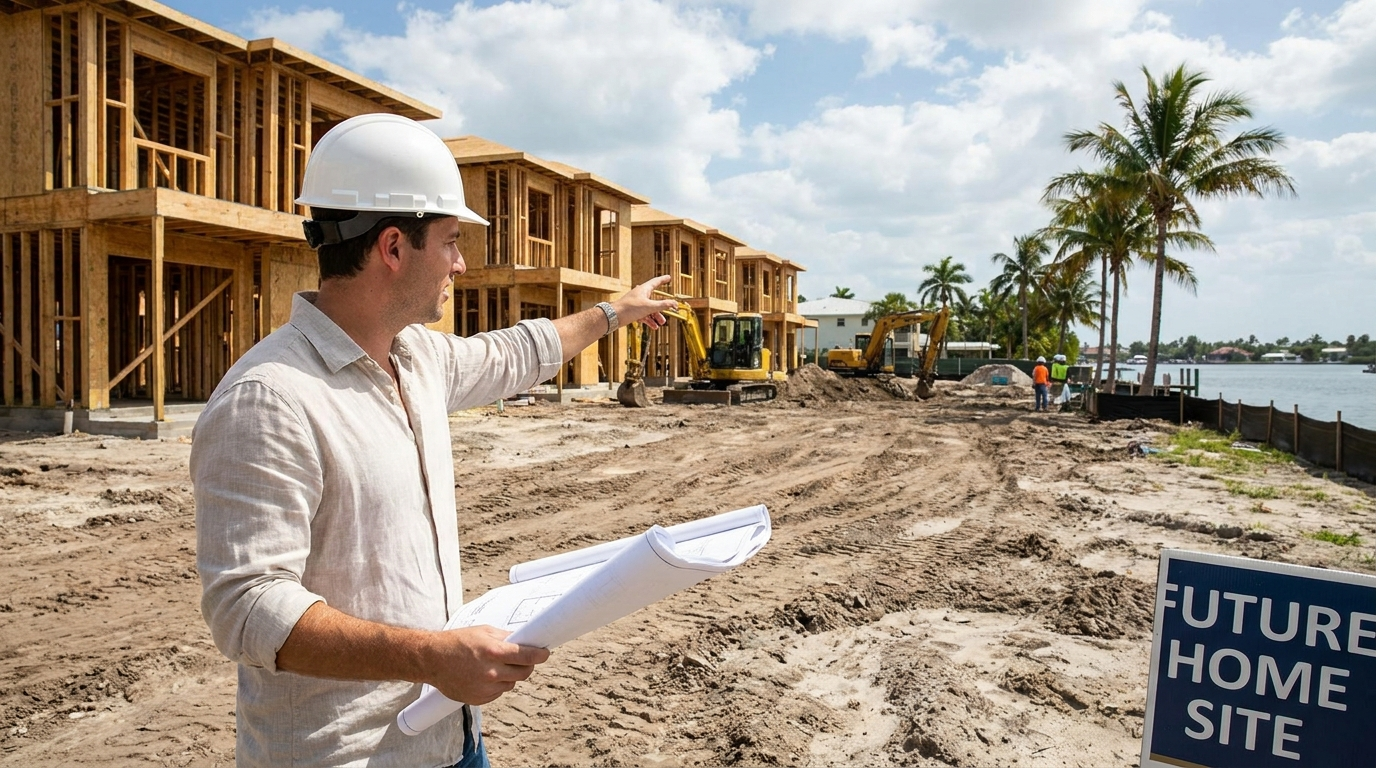
Partnering your way into development
Many successful South Florida developers got their start by partnering with experienced operators rather than working alone. A few common structures:
- Capital partner and operating partner: you bring the deal, the vision, and the project management; an investor funds it in exchange for a profit split.
- Joint venture with a builder: you find the land and navigate entitlement; the builder provides construction capital and expertise in exchange for a share of profits.
- Apprenticeship: work for or alongside an established developer on their projects first. You learn the process, the relationships, and the mistakes to avoid before you launch your own deal.
South Florida's land market is highly relationship-driven. The best deals move through networks before they ever reach the open market. Our team works with landowners, developers, and investors across all eight South Florida counties. Connect with us if you are exploring land development opportunities, and browse Highlands County and St. Lucie County for land investment opportunities with strong growth fundamentals.
Frequently asked questions
How long does the entitlement process take in South Florida?
It varies by county, project type, and whether rezoning is required. Simple infill projects on already-zoned land can close in under six months. Projects requiring rezoning, environmental review, or traffic studies often take 18 to 36 months. Budget for the longer end and plan your financing accordingly.
Do I need a real estate license to develop land in Florida?
No. A license is not required to develop land you own. You will need licensed professionals on your team, including a civil engineer, a land use attorney, and likely an environmental consultant, but the developer role itself does not require a license.
What is the biggest mistake new land developers make?
Underestimating entitlement timelines and costs. Most new developers budget for a 12-month entitlement and find themselves 24 months in with cost overruns they did not plan for. Conservative assumptions on both timeline and budget are the single most important discipline to build early.
Is South Florida a good market for land development right now?
Developable land is scarce in the coastal counties, which keeps land values firm. Interior counties like Highlands, Okeechobee, and St. Lucie still have affordable raw land with improving infrastructure. Both markets have active buyers for entitled lots. The fundamentals are sound, but execution risk is real and financing terms matter more than they did a few years ago.
Entitlement is the job, and everything else is execution
People imagine development as building. In practice the value is created before anything is built, in the process of getting permission, and that is where developers make or lose money.
Entitlement means obtaining the approvals that allow a use and a density: comprehensive plan amendments where the future land use designation must change, rezoning where the current district does not permit your plan, site plan or plat approval, and the environmental and concurrency reviews that sit alongside them.
A parcel that can lawfully accommodate more or different use than it currently may is worth more, and that increase is the developer's return. Construction is a cost centre executed afterwards, which is why plenty of developers entitle land and sell it without ever building.
The approvals are public, political and uncertain
This is the part that separates development from every other property activity, and newcomers consistently underestimate it.
Rezonings and plan amendments go to public hearings before appointed boards and elected commissions. Neighbours may object, and organised opposition can defeat a technically sound application. Staff recommendations matter and are not binding on the decision makers.
So you are not buying a process with a predictable output. You are funding an application that may fail, and the money spent on engineering, planning consultants, traffic studies, environmental work and legal representation is spent whether or not you succeed. Budget for the failure case rather than assuming approval.
Buy with the risk in the contract, not on your balance sheet
The single most useful structural device in this business is not paying for land until you know you can use it.
An option agreement, or a purchase contract with a long entitlement contingency, lets you control a parcel while pursuing approvals, and walk away if they fail. You pay for the option and for the professional work, which is a real cost, and you do not end up owning land you cannot use.
Sellers who understand development expect this and price it. Sellers who do not may simply refuse, which is itself informative about how long the parcel has been on the market and why.
Assemble a team before you assemble land
Development is a coordination job and the people are the capability. At minimum you need a civil engineer, a land use attorney with experience in the specific jurisdiction, a planner, and a surveyor.
Jurisdictional experience is the part that matters most. Each county and municipality has its own comprehensive plan, its own review culture and its own history with particular parcels. A land use attorney who has appeared before that commission repeatedly knows what will pass and what will not, which is worth more than general expertise.
Speak to the planning department early and informally too. Staff will often tell you plainly whether an idea is viable, and that conversation is free.
Realistic entry points
Starting at the scale the word development implies is how people lose everything. The sensible entries are smaller.
A minor lot split where zoning already permits it involves no rezoning and modest cost. Improving a parcel toward buildable, adding access, utilities and a passing perc test, creates value without any approval at all. And joining an experienced developer as a junior partner, contributing work rather than capital, buys you a full cycle of education at somebody else's risk.
Each of those teaches you the process at a scale where being wrong is survivable, which is the only sensible way to learn this.
Timelines are long and the money is committed throughout
Entitlement runs on the public calendar rather than yours. Applications have submission deadlines, hearings are scheduled months out, continuances happen, and revisions restart parts of the process.
Throughout that period your capital is committed and producing nothing. Which is why the option structure matters, why partnering makes sense early, and why anyone approaching this with money they might need is approaching it wrongly.
More common questions
Do I need a licence to develop land?
Developing your own property is not licensed activity. Construction requires licensed contractors, and selling on behalf of others is a separate question.
How long does entitlement take?
It varies by jurisdiction and by what you are asking for, and it is measured in many months rather than weeks. Ask the planning department about their current calendar.
What is the most common failure?
Buying land outright on the assumption of an approval that then does not come. Control it with an option instead.


