

Interest Rates vs. House Prices in South Florida: What the Data Actually Shows
June 9, 2026 · 6 min read · By Onias Derilus, Broker
Conventional wisdom says higher interest rates crash home prices. South Florida's market keeps proving that wrong. Here's what the data actually shows about the interest rates vs house prices relationship, and why this market behaves differently.
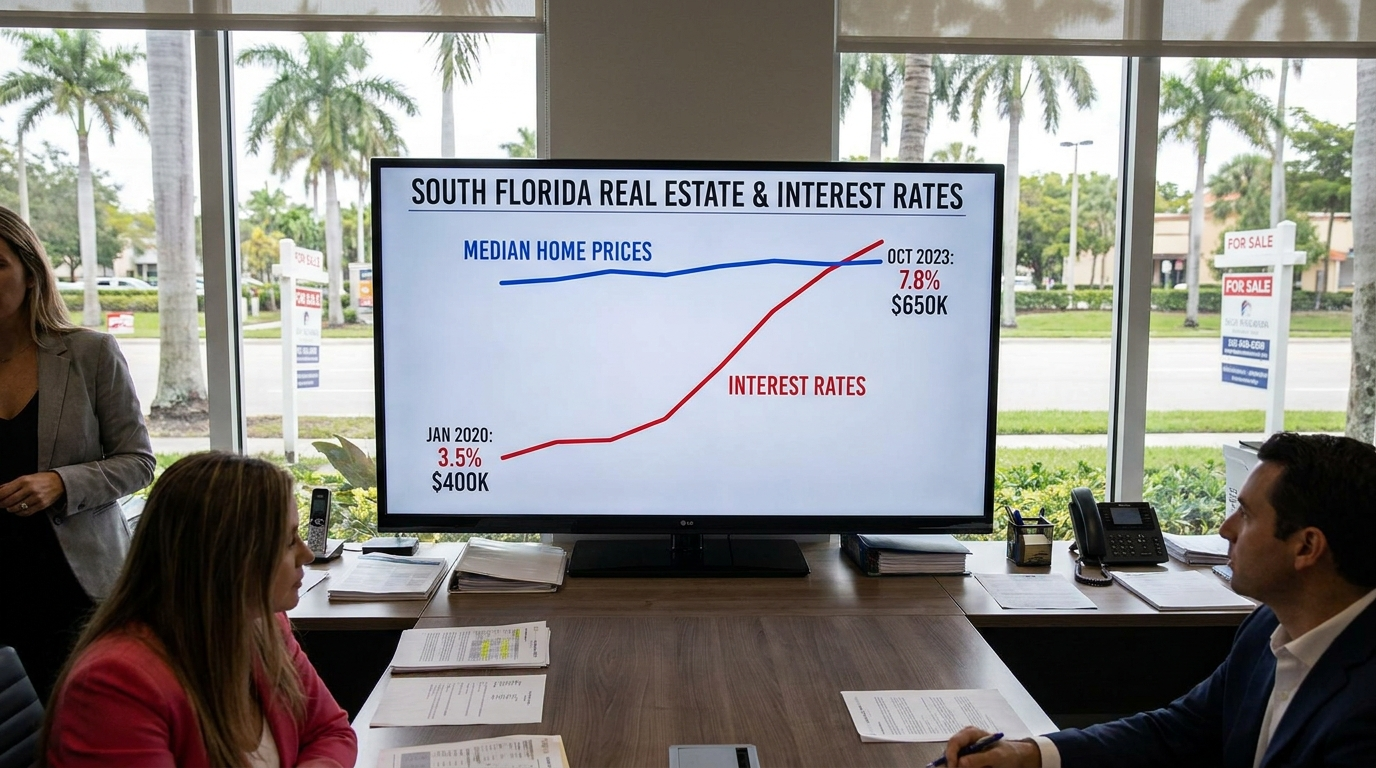
The conventional wisdom about interest rates vs. house prices is simple: rates go up, prices go down. It makes intuitive sense. Higher rates reduce buying power, so buyers can afford less, so prices fall. But South Florida's real estate market has consistently defied this logic. Understanding why is essential for buyers, sellers, and investors making decisions here. Looking at any interest rates vs house prices graph, you will notice the relationship is rarely as clean as the theory suggests.
What the national data shows
Nationally, there is a historical inverse relationship between interest rates and home prices, but it is weaker and slower than most people assume. When the Fed raised rates aggressively in 2022-2023, national median home prices dipped modestly in some markets and then resumed climbing. The reason: housing supply did not increase commensurately with demand destruction. With fewer homes for sale, prices held even as buyers retreated.
The classic interest rates vs. house prices graph shows rates and prices moving in opposite directions over decades. The timing lag is often 18-36 months, and local supply conditions frequently overwhelm the rate effect entirely.
Why South Florida is different
South Florida's housing market has structural demand drivers that most of the country lacks. These factors insulate prices from interest rate pressure in ways that markets dependent on first-time buyers or rate-sensitive local employment do not experience:
- Cash buyers. In Palm Beach, Miami-Dade, and coastal Broward, cash transactions routinely represent 30-45% of all closings. Cash buyers are entirely unaffected by mortgage rate changes. When rates rise, they become relatively more competitive because they often face fewer financed buyers.
- International demand. South Florida attracts consistent buyer interest from Latin America, Europe, and Canada. Many purchase in cash or finance through foreign institutions at different rate structures. This demand is driven by political stability and lifestyle considerations, not the 10-year Treasury yield.
- Domestic migration. The ongoing influx of buyers from New York, New Jersey, California, and Illinois continues to sustain demand. Many arrive with equity from high-priced home sales. A buyer from Manhattan with $800,000 in equity from a co-op sale is not rate-sensitive in the same way a first-time buyer in Ohio is.
- Constrained supply. The Atlantic Ocean, the Everglades, and decades of existing development have left little new land to build on along the coast. Supply cannot expand quickly enough to absorb demand shocks, which keeps a floor under prices.
What happened to South Florida prices when rates rose in 2022-2024
When the Federal Reserve raised rates from near-zero to over 5% between 2022 and 2024, South Florida saw these results:
- Transaction volume fell 20-35% as rate-sensitive buyers stepped back
- Days on market increased modestly, from an average of 18 to 35-45 days in most submarkets
- Price reductions became more common, but median prices held or continued rising in most counties
- The luxury segment ($2M+) was largely unaffected because cash buyers dominated
Palm Beach County median prices continued rising through the rate hike cycle. Miami-Dade saw a brief plateau before resuming appreciation. Only the most rate-sensitive segments, such as entry-level condos and inland starter homes with thin margins, experienced meaningful price softening.
What this means for buyers and sellers in 2026
For buyers: don't wait for rates to fall before you buy, assuming prices will drop while you wait. South Florida's market structure makes that a losing strategy in most submarkets. Buy when the deal makes sense for your finances and refinance when rates improve.
For sellers: rate sensitivity does affect your buyer pool, particularly for properties priced below $600,000 where most buyers are financing. Price correctly from day one, and expect slightly longer days on market than during the zero-rate era.
For investors: rate increases compress leveraged returns. Model your deals at current rates, not the rates of two years ago. Our Rental Property ROI Calculator and Fix & Flip Calculator let you run scenarios at any rate. Check the Florida Realtors market statistics for current county-level data.
The mechanism, in one paragraph
Rates and prices are connected through the monthly payment rather than directly. Most buyers shop by what they can afford each month, so when rates rise the same payment supports a smaller loan, and demand cools at any given price.
Prices then respond, and slowly. Sellers are reluctant to accept less than recent comparable sales, so instead of falling immediately, markets first show longer days on market, more price reductions and fewer transactions. Price change is the last thing to move, not the first.
That lag is why headlines about prices holding up can be true at exactly the moment a market is weakening, and it is the single most useful thing for a buyer or seller to understand.
Read absorption, not asking prices
Because prices lag, the honest indicators are the ones that move first. Watch days on market, the share of listings reducing price, and the ratio of pending sales to active inventory.
Our counties currently average about 107 days in Palm Beach and St. Lucie, 109 in Martin, 119 in Indian River, 124 in Broward, 137 in Miami-Dade, 144 in Okeechobee and 206 in Highlands. Those figures describe how long the market is taking to absorb what is listed, and they tell you more about negotiating position than any median price does.
Note also that days on market is a trailing figure. It reflects listings that went under contract weeks or months ago, so it describes what happened rather than what is happening now.
Why South Florida responds differently
Three local features soften the rate mechanism here relative to most of the country.
- A large cash share. A meaningful proportion of transactions in this region involve no mortgage at all, and those buyers are indifferent to rates.
- In migration. Buyers arriving from higher cost states are comparing against what they sold, not against local affordability, which supports demand independently of rates.
- Constrained supply on the coast. The ocean on one side and the Everglades on the other limit how much new coastal land exists, which supports prices in a way an open metro cannot match.
None of this makes the market rate proof. It does mean the effect shows up more in volume and in time to sell than in headline prices.
The waiting question, answered honestly
Buyers frequently plan to wait for lower rates. The problem is that everyone else is waiting for the same thing, so a rate fall brings competing buyers back at the same moment, and competition pushes prices up.
The rough trade is that a lower rate on a higher price can leave your payment unchanged while your loan balance is larger. And if you are also selling, remember you face the same rate environment on both sides of the move, so waiting rarely helps as much as it appears to.
The practical position is that you can refinance a rate later and you cannot renegotiate a purchase price after closing. That argues for buying a house you can afford at today's payment, rather than timing a market that is difficult to time.
What sellers should take from this
When rates rise your buyer pool shrinks at every price point, and the correct response is preparation rather than panic. Price to the current comparable set on day one, because a new listing gets a burst of attention that never repeats and testing a high number wastes it.
Consider a concession toward the buyer's costs, including a rate buydown, before considering a price reduction of the same size. Concessions often deliver more perceived benefit per dollar, since they change the buyer's monthly figure directly, which is the constraint they are actually working against.
Why the payment, not the price, is the real constraint
It is worth making the arithmetic concrete without quoting a rate, since rates move weekly and any number written here would be wrong shortly.
Take your own current quote and work out the payment on the price you are considering. Then rerun it one percentage point higher and one lower. The spread you get is the honest measure of how much rate movement actually matters to your budget, and it is usually larger than people expect on a thirty year loan.
Do the same exercise the other way. Hold the payment constant and see what price each rate supports. That second version is what the market as a whole is doing when rates move, and it explains why demand cools without prices immediately falling.
More common questions
Do house prices fall when rates rise?
Sometimes, and usually later and less than people expect. Transaction volume and days on market react first, and prices adjust slowly if at all.
Should I wait for rates to drop before buying?
Consider that lower rates bring competing buyers back simultaneously. A lower rate on a higher price may leave you no better off and with more debt.
What rate should I assume when budgeting?
Use an actual quote for your own circumstances rather than a published average. Credit profile, down payment and loan type move the number enough that averages are not useful for planning.


