

Real Estate vs. Business: Which Is the Better Investment in South Florida?
June 9, 2026 · 6 min read · By Onias Derilus, Broker
Real estate vs. business ownership: both can build wealth, but they work very differently. Here's an honest comparison of returns, risk, liquidity, and lifestyle, and why most South Florida wealth builders choose one path over the other.
Real estate vs. business ownership is one of the most consequential investment decisions an entrepreneur or high-income professional in South Florida can make. Both paths can generate real wealth. Both carry real risk. They differ substantially in time commitment, capital requirements, liquidity, and the type of returns they produce. Here is the honest comparison.
How wealth is created differently
A business creates wealth primarily through income: the profits it generates above operating costs. A successful small business might produce $150,000 to $500,000 per year in owner profit, which the owner can save, reinvest, or redeploy elsewhere. The value of the business itself can also grow, but that value is tied to continued performance and is often illiquid until a sale.
Real estate creates wealth through several simultaneous mechanisms. Rental income covers carrying costs. Mortgage paydown means tenants are retiring your loan balance each month. Appreciation grows the underlying asset value. Depreciation and 1031 exchanges provide meaningful tax shelter. These forces work in parallel. You do not choose one over the others.
Risk comparison
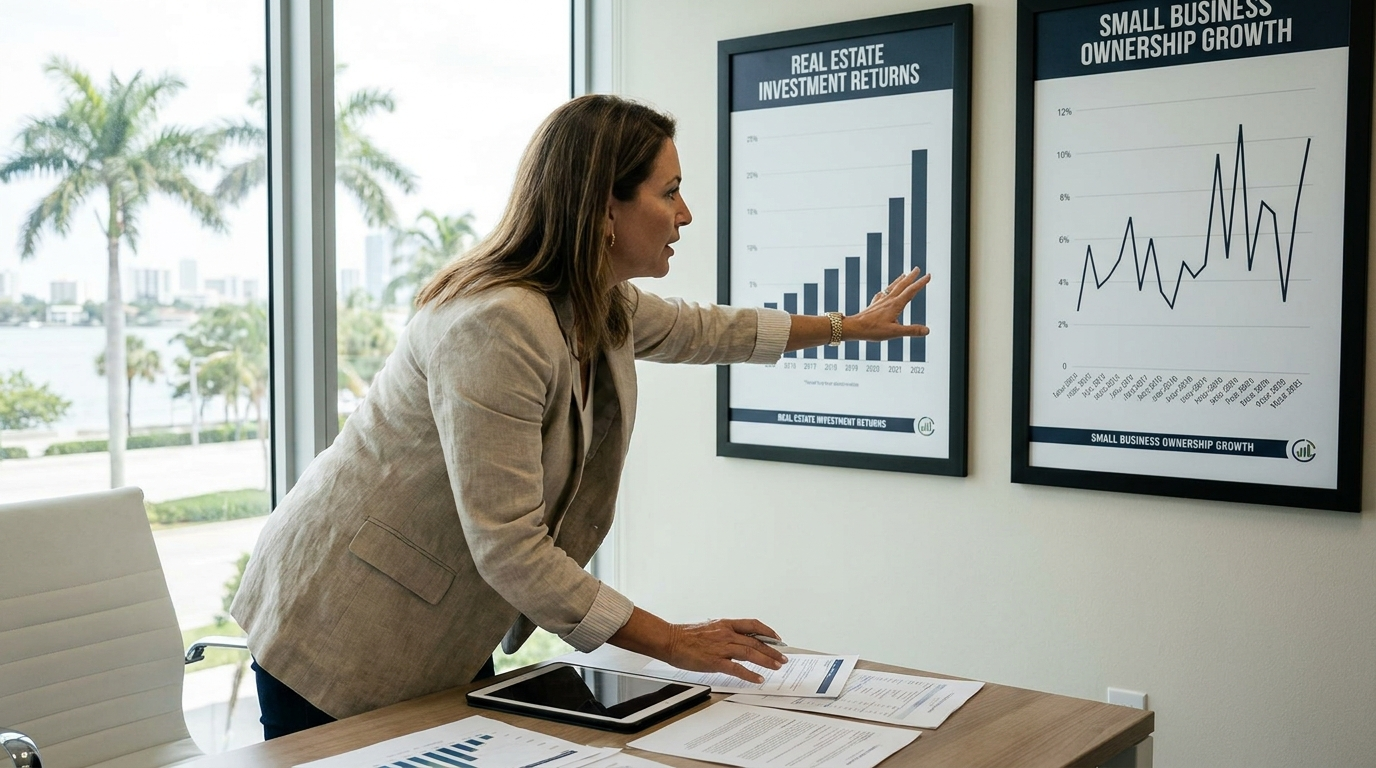
Small business failure rates are worth knowing before you commit capital: roughly 50% of small businesses fail within five years, and 65% within ten. A business can go to zero, taking all invested capital with it and sometimes leaving debt behind. The risk is concentrated and operational. Lose a key employee, a major client, or face a market shift and the entire enterprise can be threatened.
Real estate risk works differently. Properties rarely go to zero. South Florida real estate corrected 15 to 25% during the 2008 to 2011 downturn, the most severe modern example. Properties held through that period recovered and continued to appreciate. The primary risk in real estate is leverage: over-leverage combined with a vacancy period can force a sale at the wrong time. Managed conservatively, the risk profile is substantially lower than small business ownership.
Time and lifestyle comparison
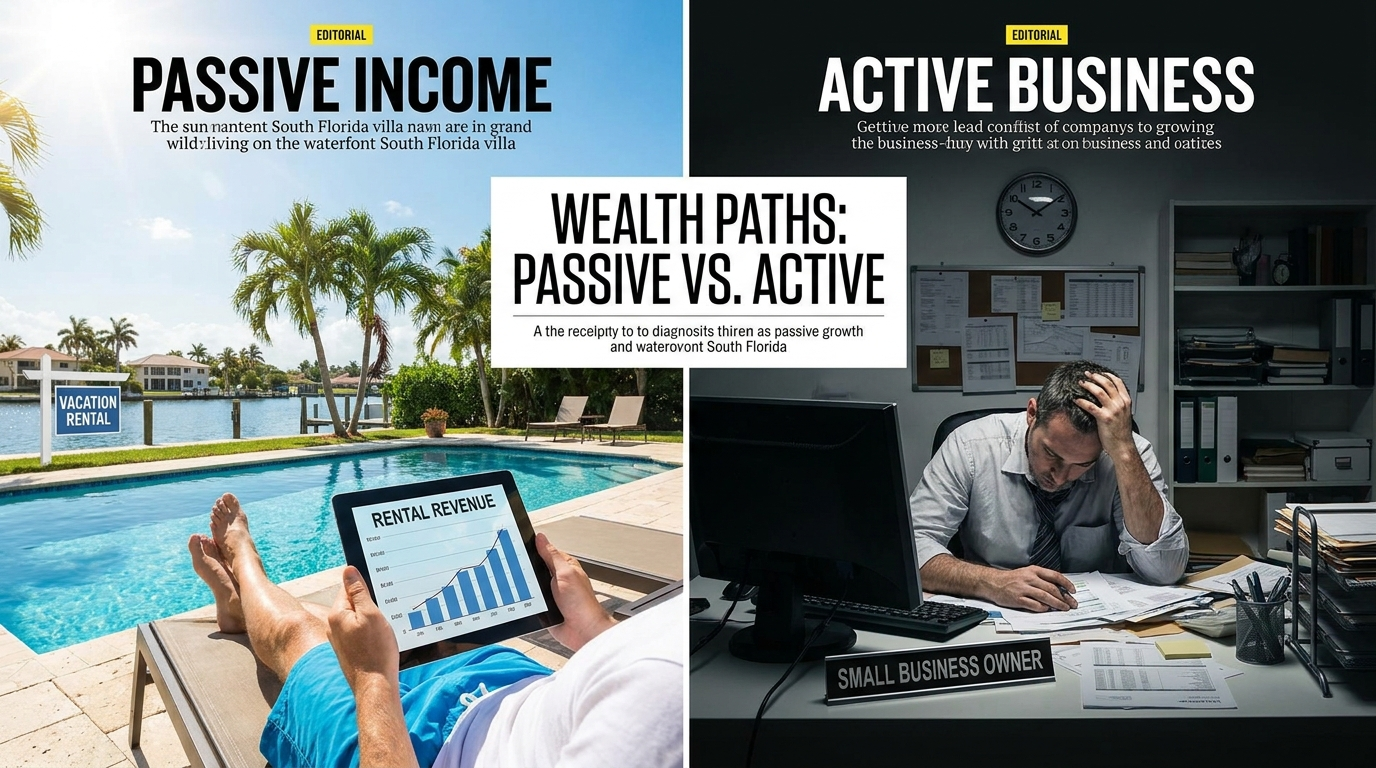
This is where real estate's advantage becomes clearest for many South Florida investors. A rental portfolio, once stabilized with a property manager, is genuinely passive. Figure 2 to 4 hours per month per property. A small business, by contrast, typically demands 50 to 70 hours per week from the owner, especially in the early years. Many business owners effectively create a job, not an asset.
Real estate scales without proportionally scaling your time. A portfolio of 10 properties with a property manager might take 10 to 20 hours per month to oversee. A business generating equivalent income would likely consume five to ten times that.
Return comparison (South Florida context)
Returns depend on execution in both paths. In South Florida's current market, a realistic comparison looks like this:
- Real estate (leveraged, buy-and-hold): 8 to 15% total annual return when combining cash flow, mortgage paydown, and appreciation. Tax-advantaged through depreciation. Relatively predictable.
- Small business: Potentially 30 to 50% or more return on invested capital in a successful business, but with a far higher probability of total loss and significant ongoing time demands.
The businesses that outperform real estate tend to be highly scalable, tech-enabled, or in high-margin service sectors. The average brick-and-mortar South Florida small business (retail, restaurant, local service) often underperforms a well-managed real estate portfolio once you factor in the owner's time cost.
Why most South Florida wealth builders choose real estate
The answer is not that businesses are bad investments. Most people underestimate the lifestyle cost of business ownership and overestimate their ability to build a truly scalable enterprise. Real estate's combination of leverage, tax advantages, appreciation, and passive income creates a wealth-building path that is accessible to more people and produces more predictable outcomes.
Many successful South Florida investors do both: they run a business that generates income and deploy that income into real estate, creating two compounding engines working simultaneously. If you are evaluating where to put capital next, use our Rental Property ROI Calculator to model specific South Florida deals. Ready to move forward? Tell us what you are looking for and we will find properties that match your investment criteria. You can also explore investment opportunities by county.
The comparison people skip: what each one demands of you
Return arguments dominate this topic and they are the least reliable part. The differences that decide which suits you are structural, and you can know them in advance.
- Time. A rental with a manager is close to passive. An operating business is a job before it is an investment, and usually your only job.
- Leverage. You can borrow most of a property's purchase price on long fixed terms. Lending against a small business is harder, shorter and frequently secured against you personally.
- Failure mode. A bad rental year is a vacancy and a repair bill. A failed business can take your capital, your income and your time simultaneously.
- Ceiling. Property returns are bounded by rents and values in a specific market. A business has a much higher ceiling and a much higher chance of returning nothing.
- Exit. A property sells into an established market with comparable sales. A small business sells slowly, to a narrow buyer pool, at a price that often depends on you staying involved.
None of these makes one better. They describe two genuinely different commitments, and picking the wrong one for your circumstances is the actual risk.
Liquidity is the difference that bites first
Property is illiquid and people underestimate how illiquid. Across our counties, average days on market currently runs about 107 in Palm Beach and St. Lucie. It runs 124 in Broward, 137 in Miami-Dade, 144 in Okeechobee and 206 in Highlands. Closing adds another month or more after that.
So converting property to cash takes months even in the faster markets. A business is generally worse, since selling one takes many months and frequently requires you to remain through a transition.
The practical consequence is the same for both: neither is where your reserve should sit, and the investors who get into trouble are usually those who committed money they later needed.
Concentration works differently
One rental exposes you to one street and often one tenant. One business exposes you to one market, one customer base and frequently one key relationship.
Property spreads more easily as you add units, because a second and third property in different neighbourhoods genuinely diversifies the vacancy risk. A business rarely diversifies by growing, since expansion usually deepens exposure to the same market rather than spreading it.
In Florida there is a specific shared risk worth naming. Insurance costs have risen substantially and a hurricane can affect both a rental portfolio and a local business at once, so treating them as uncorrelated in this state is optimistic.
The tax positions are not comparable
Rental property allows depreciation, deduction of operating costs and mortgage interest, and potentially a 1031 exchange when reinvesting in other investment property. An operating business has its own entirely different set of deductions, elections and payroll considerations.
These differ enough that comparing pre tax returns is close to meaningless. It is also a question for an accountant rather than for an article, because the right answer depends on your own income, entity structure and plans.
The combination most people actually end up with
Framing this as a choice hides the pattern that works for a lot of people, which is a business that generates income and property that stores it.
The business produces cash and carries the higher return and higher risk. Property converts some of that cash into a slower, leveraged, longer lived asset that does not depend on you turning up. Many local business owners end up owning the premises they operate from for exactly this reason, which is a version of the same idea.
The sequencing matters more than the split. Buying property before the business is stable puts a fixed obligation against variable income, which is the arrangement that fails first when a quarter goes badly.
A test worth running before committing to either
Rather than comparing returns in the abstract, answer three questions honestly about yourself.
First, how much of your time do you actually want to sell. If the answer is very little, an operating business is the wrong instrument regardless of its ceiling, and no return justifies buying yourself a job you did not want.
Second, how long can the money stay committed. Both are illiquid, and if the honest answer is under three years, neither is appropriate and the question is premature.
Third, what happens to you if it returns nothing for two years. A rental with reserves is survivable. A business consuming your income and your savings simultaneously is a different kind of exposure, and it is the scenario worth planning for rather than the successful one.
More common questions
Which builds wealth faster?
A successful business, usually and by a wide margin. The qualifier does a great deal of work, since most businesses do not reach that outcome.
Can I do both at once?
Many people do, and starting both simultaneously stretches attention and capital at the worst possible moment. Establish one before adding the other.
Is property genuinely passive?
Closer to it than a business, and not passive. Budget eight to twelve percent of rent for management if you do not want the calls.


