

Are Turnkey Rental Properties Worth It in South Florida? (Honest Analysis)
June 9, 2026 · 6 min read · By Onias Derilus, Broker
Turnkey rental properties are sold as passive investment, renovated, tenanted, and ready to cash flow. In South Florida, they can deliver on that promise. But the premium you pay for turnkey convenience has to be weighed carefully against the numbers.
Turnkey rental properties (renovated, tenanted, and managed assets delivered to the buyer with no work required) have become a significant segment of South Florida's investment market. For out-of-state investors and busy professionals who want real estate exposure without the hands-on demands, turnkey offers an appealing option. The promise comes with real trade-offs, though, and serious investors need to understand both sides before committing.
What "turnkey" actually means
A true turnkey rental property is:
- Fully renovated to rentable condition: new flooring, updated kitchen and baths, fresh paint, mechanicals serviced
- Already leased to a tenant paying market rent
- Under management by a property management company (typically the same entity selling the property)
- Generating positive cash flow from day one of ownership
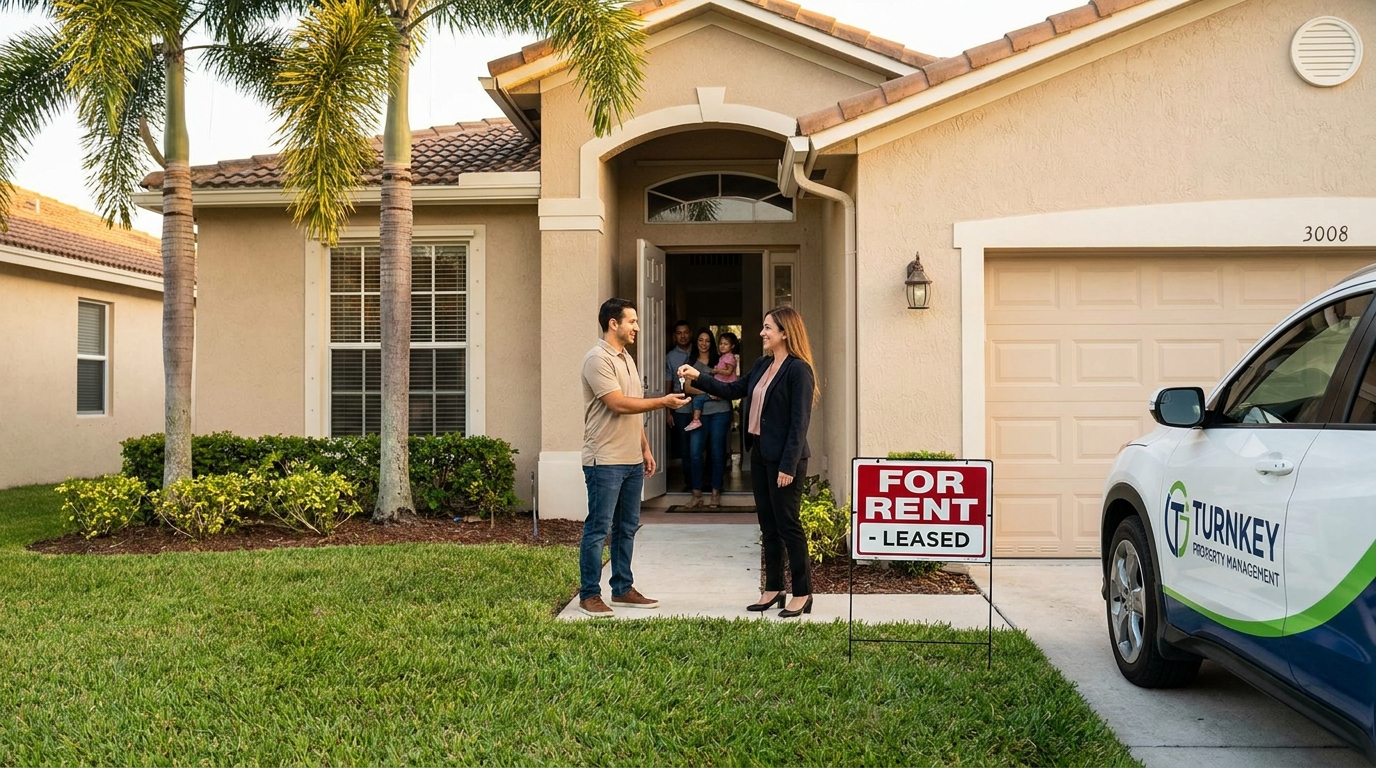
What you're buying is a stabilized income stream, not a project. You close on the property, and rent checks (minus management fees) start flowing to you without lifting a finger.
The turnkey premium: what you pay for convenience
Turnkey properties cost more than comparable unrenovated properties, sometimes significantly more. The seller has priced in the renovation cost, the time value of carrying the project, the risk of renovation overruns, and a profit margin. In South Florida, turnkey properties often trade at or above what the renovated property would sell for on the MLS if listed as a primary residence.
This premium compresses your returns. A property you could buy distressed for $200,000, renovate for $35,000, and rent for $1,900/month might be offered as a turnkey for $265,000 to $280,000, already tenanted at $1,900/month. The cash-on-cash return drops from potentially 8 to 10 percent (if you did the work yourself) to 5 to 6 percent (after paying the turnkey premium). That is real money left on the table.
When turnkey makes sense in South Florida
Turnkey is worth considering in these situations:
- You're out-of-state or out-of-area. Managing a renovation remotely in South Florida is genuinely difficult. Contractor oversight, permit inspections, and material sourcing all require local presence. If you're in New York or California, the turnkey premium may be worth paying to avoid renovation execution risk.
- Your time has high value. If your professional income exceeds $300 per hour, spending 200 hours managing a renovation to save $30,000 on a turnkey premium is a bad trade. The math of your own time matters.
- You want predictability over optimization. A turnkey deal's returns are known quantities you can underwrite precisely. A renovation deal's returns are projections subject to contractor performance, permit delays, and cost overruns. Turnkey trades upside for certainty.
When turnkey does NOT make sense
- When the numbers don't work at the turnkey price. Run every turnkey deal through a real cash flow analysis. If the cap rate at the asking price is below 4% in a market where conventional financing costs 7% or more, you'll be cash-flow negative regardless of how convenient the purchase is.
- When the seller is also the property manager. This is a genuine conflict of interest. A turnkey provider who manages the property after sale has financial incentive to place tenants quickly, even marginal ones, to close the deal. Verify the tenant independently before closing.
- When you're buying in a market you don't understand. Some turnkey sellers market South Florida properties to out-of-state investors at inflated prices in neighborhoods with weaker rental demand. Without local market knowledge or an independent local advisor, you can overpay significantly.

How to evaluate a South Florida turnkey deal
Before you close on any turnkey property:
- Verify the lease: get a copy of the actual signed lease, not just the seller's representation of rental income
- Review the tenant's payment history: ask for 12 months of rent receipts or bank statements showing deposits
- Get an independent inspection: even a renovated property can have deferred issues the seller did not address
- Pull independent comps: verify the ARV and rental comps through your own agent, not the seller's data
- Run your own cash flow model: use our Rental Property ROI Calculator with conservative assumptions
Our team helps investors evaluate turnkey and non-turnkey rental properties across all eight South Florida counties, with independent comp analysis and cash flow modeling. Reach out here or explore properties by county.
Frequently asked questions
Are turnkey properties a good investment in South Florida?
They can be, but the answer depends entirely on the price relative to actual market rents and what financing costs you. Many turnkey deals in South Florida are priced to produce 5 to 6 percent cash-on-cash returns at current interest rates, which leaves little margin. The best turnkey deals come from sellers who prioritize repeat business over squeezing every dollar from a single sale.
How do I verify that a turnkey property's rent is real?
Ask for the signed lease and 12 months of rent receipts showing actual deposits. A seller who hesitates on either is a red flag. Also pull rental comps independently through a local agent to confirm the stated rent is in line with the market.
What's the difference between a turnkey property and a rental property I find on the MLS?
An MLS rental property may or may not be renovated, tenanted, or managed. You're responsible for getting it rent-ready and placed. A turnkey property comes with all of that done. The difference is work versus premium: turnkey costs more upfront and saves execution work on your end.
Should I use the turnkey seller's property manager?
Not necessarily. The turnkey seller often has a financial relationship with the property manager, which can affect how carefully tenants are screened. Get two or three independent management quotes after closing, and evaluate switching if fees or service quality don't hold up.
What South Florida counties have the most turnkey rental activity?
Palm Beach and Broward counties see the most turnkey volume, driven by strong rental demand and large investor buyer pools. St. Lucie and Martin counties attract investors looking for lower price points with reasonable yields. All eight counties we cover have active rental markets worth evaluating.
Understand who is being paid, and for what
The turnkey model bundles several transactions that are normally separate, and each one is a place where somebody earns. Knowing where the margin sits is the whole diligence.
A provider typically acquires a property at a discount, renovates it, places a tenant, and sells it to you as a finished income producing asset. They may also retain the management contract afterwards. So the provider can earn on the acquisition spread, the renovation, the sale and the ongoing management.
None of that is illegitimate. You are buying convenience and someone else's local knowledge, and both have real value. The point is that the price includes all of it, so the yield you are quoted is the yield after somebody else took the margin you would otherwise have captured.
Verify the rent independently, and verify the tenant
The advertised return depends entirely on the rent figure, which is the number to check first and the one easiest to present favourably.
Ask for the signed lease rather than a stated rent, and confirm how long it runs and what the renewal position is. Ask for a payment history showing the tenant has actually paid, and how long they have been in place. A property sold with a brand new tenant at an above market rent is a different asset from one with a two year payment record.
Then check the rent against comparable local listings yourself. If the quoted figure sits above what similar properties are letting for, the return will normalise downward at renewal and the yield you underwrote will not survive.
Inspect it yourself, or have someone independent do it
The renovation was performed by the party selling to you, which means the only person who has assessed the work has an interest in your accepting it.
Commission your own inspection from someone you engaged. Ask specifically about roof age and remaining life, the air conditioning system, electrical panel and plumbing, since those are the capital items that determine what you spend in the first five years. Cosmetic renovation over deferred capital items is the specific risk in this model.
In Florida, get an insurance quote on the address before committing. Roof age drives both premium and insurability, and a property that is expensive or difficult to insure changes the return regardless of the rent.
The management dependency is the structural risk
Out of state buyers are the natural market for this model, and that produces a specific exposure worth naming.
If the provider also manages the property, your rent collection, maintenance decisions, tenant selection and reporting all sit with the party who sold it to you. If that relationship deteriorates, or the company fails, you are managing a property remotely in a market you do not know.
So ask what happens if you want to change manager, whether the management agreement is separable from the purchase, and what notice applies. Establish who else manages property in that submarket, so you know an alternative exists before you need one.
Where the model fits and where it does not
It fits buyers who genuinely cannot be local, who value time over yield, and who have done enough diligence to know what they are paying the premium for.
It fits poorly for anyone in the region already. Across our eight counties you can find, renovate and let a property yourself and keep the margin the provider would take, and you have the local knowledge to judge the submarket. County medians currently run from about $274,900 in Okeechobee and $309,000 in Highlands to $480,000 in Palm Beach and $599,000 in Miami-Dade, so the entry points vary enormously and local judgement is worth real money.
It also fits poorly for anyone relying on the advertised return without verification, since that is the entire mechanism by which this model disappoints people.
More common questions
Are turnkey properties a good investment?
They can be, if you verify the rent, inspect independently and understand the premium you are paying for convenience. The model is fine; unverified numbers are the problem.
Should I use the seller's property manager?
Often convenient and it concentrates risk with one party. Establish whether the management agreement is separable and who else operates in that market.
How do I verify the rent is real?
Ask for the signed lease and a payment history, then compare against comparable local listings yourself rather than accepting a stated figure.


