

Will the Housing Market Crash in South Florida? What the Data Says
June 9, 2026 · 7 min read · By Onias Derilus, Broker
Every market cycle prompts the same question: is a crash coming? Here's an honest, data-driven analysis of whether South Florida's housing market is heading for a correction, and what the indicators actually show.
The question "when will the housing market crash again?" comes up every time prices rise faster than the fundamentals seem to justify. South Florida has been one of the country's hottest markets for several years running, so the concern is understandable. The 2008 collapse hit this region especially hard: Miami-Dade and Broward prices dropped more than 50% from peak to trough. Whether that can happen again depends on what actually caused it the first time.

Why 2026 is structurally different from 2006
The 2008 crash had a specific cause: mass issuance of subprime mortgages to unqualified borrowers, widespread mortgage fraud, negative-amortization loan products, and a widespread assumption that home prices could never fall. None of those conditions exist today at any meaningful scale.
Today's South Florida homeowners are largely qualified borrowers with real equity. Mortgage delinquency rates are at historically low levels. The share of South Florida homes purchased with no money down is a fraction of the pre-2008 norm. That matters because the 2008 crash was amplified by mass foreclosure. Underwater borrowers walked away. That cycle is far less likely when most owners have a real equity cushion behind them.
The supply constraint story
South Florida has a structural supply problem that puts a floor under prices over time. There is very limited land left for new construction in the coastal counties. The Everglades sit to the west; the ocean is to the east. Palm Beach, Broward, and Miami-Dade are geographically boxed in. The kind of housing supply surge that typically corrects overpriced markets elsewhere simply cannot happen here at scale.
That is not a guarantee of rising prices. But markets where supply can expand freely in response to demand are much more vulnerable to sharp corrections than markets where supply is physically constrained. South Florida sits firmly in the second category.
The demand side: migration and international capital
South Florida's demand is structural, not cyclical. Domestic migration from high-tax northern states continues year over year. International buyers, particularly from Latin America, Europe, and Canada, have maintained sustained interest at the luxury tier. Remote work has made South Florida accessible to high-income earners who previously could not justify the cost of living. These are not speculative buyers who will exit quickly if prices wobble.
What could cause a significant correction
Any honest analysis has to acknowledge the real risks. Several factors could move prices lower:
- Insurance crisis escalation: South Florida's property insurance market is already under severe stress. If major insurers exit the state or premiums become unaffordable for middle-market buyers, affordability deteriorates faster than incomes can absorb it, which softens demand significantly.
- Interest rate spike: A return to 8-9% mortgage rates would materially cut purchasing power and could push prices lower in the $300,000-$600,000 range, where rate sensitivity is highest.
- Climate risk repricing: Growing awareness of flood risk and intensifying hurricane seasons could eventually cause capital to reprice coastal properties. That appears to be a slow-moving, decade-scale risk rather than an acute crash catalyst right now.
- Condo market stress: Florida's new condo reserve requirements, enacted after the Surfside collapse, are forcing large special assessments in older buildings. Some condo values are structurally impaired because of this. The result could be a meaningful correction in specific condo submarkets without touching the single-family market at all.
What this means practically
A 2008-style crash in South Florida is unlikely given today's fundamentals. A moderate 10-15% correction from peak prices in rate-sensitive segments is possible, and it has already started in some submarkets. For long-term investors with equity cushions, the structural case for South Florida real estate is still intact.
Trying to time the market perfectly is how most people miss the best opportunities. The more useful question is whether a specific property, at a specific price, with specific financing, works for your goals. Our team can walk through that analysis for any property across our six-county service area.
Ready to evaluate a specific property?
Whether you are buying, selling, or investing, understanding local market conditions is the first step. Contact our team or explore properties across our South Florida service area.
Frequently asked questions
Will the housing market crash in 2025 or 2026?
A broad crash is not what the data supports. A correction in specific segments, particularly rate-sensitive price bands and older condos with deferred maintenance issues, is already underway in parts of South Florida. That is meaningfully different from a market-wide collapse.
How is South Florida different from other housing markets?
Geographic supply constraints, sustained domestic and international demand, and the relatively high equity positions of current owners make South Florida more resilient than most U.S. markets. The insurance environment and climate risk are the factors most specific to this region that could move prices lower over time.
What happened to South Florida prices in 2008?
Miami-Dade and Broward prices fell more than 50% from peak to trough between roughly 2007 and 2011. The primary driver was foreclosure volume as subprime borrowers defaulted. That financing environment does not exist today.
Is now a good time to buy in South Florida?
That depends entirely on the property, the price, and your specific financial situation. The market-level question matters less than the property-level question. A well-priced single-family home in a supply-constrained area with good rental income potential is a very different conversation from a 1970s condo facing a $50,000 special assessment.
Prices do not crash markets, forced selling does
The question is almost always framed around prices, and prices are the symptom rather than the mechanism. What produces a genuine crash is a large number of owners having to sell at the same time into a market that cannot absorb them.
A falling value costs you nothing if you keep the property. Paper losses are not realised. What converts a soft market into a collapse is owners who cannot hold: payments they can no longer make, loans that reset beyond their means, or costs that rise past what the household can absorb.
So the useful question is not whether prices might fall. It is what would make a large number of Florida owners have to sell at once, and that is a much more answerable question.
What could actually force selling here
Three pressures are worth watching in this state specifically, and they are not the ones usually discussed.
Insurance is the first. Premiums have risen substantially, and unlike a mortgage payment the cost is not fixed at purchase. An owner who bought comfortably can find the total monthly figure has moved beyond what they planned for, and that pressure lands on everyone in an area at once rather than on individuals.
Condominium assessments are the second, and they are the most concentrated risk in Florida right now. Qualifying buildings must fund reserves rather than waiving them, and buildings that deferred maintenance for years face catch up costs. A large special assessment on a fixed income owner is precisely the kind of event that forces a sale, and it arrives building by building rather than randomly.
Employment is the third and it is the ordinary one. Job losses concentrated in a region produce forced sales in that region, which is the mechanism behind most local downturns anywhere.
What to watch instead of forecasts
Nobody can tell you when, and several indicators move before prices do and are publicly observable.
- Days on market rising across a county. Absorption slows before prices fall.
- The share of listings reducing price. Sellers meeting the market is an earlier signal than closed prices.
- Inventory building. Particularly if it builds while sales volume falls rather than rises.
- Condominium listings clustering in specific buildings. Frequently a sign an assessment has landed there.
- Insurance non renewals in an area. Because they constrain the buyer pool as well as the owners.
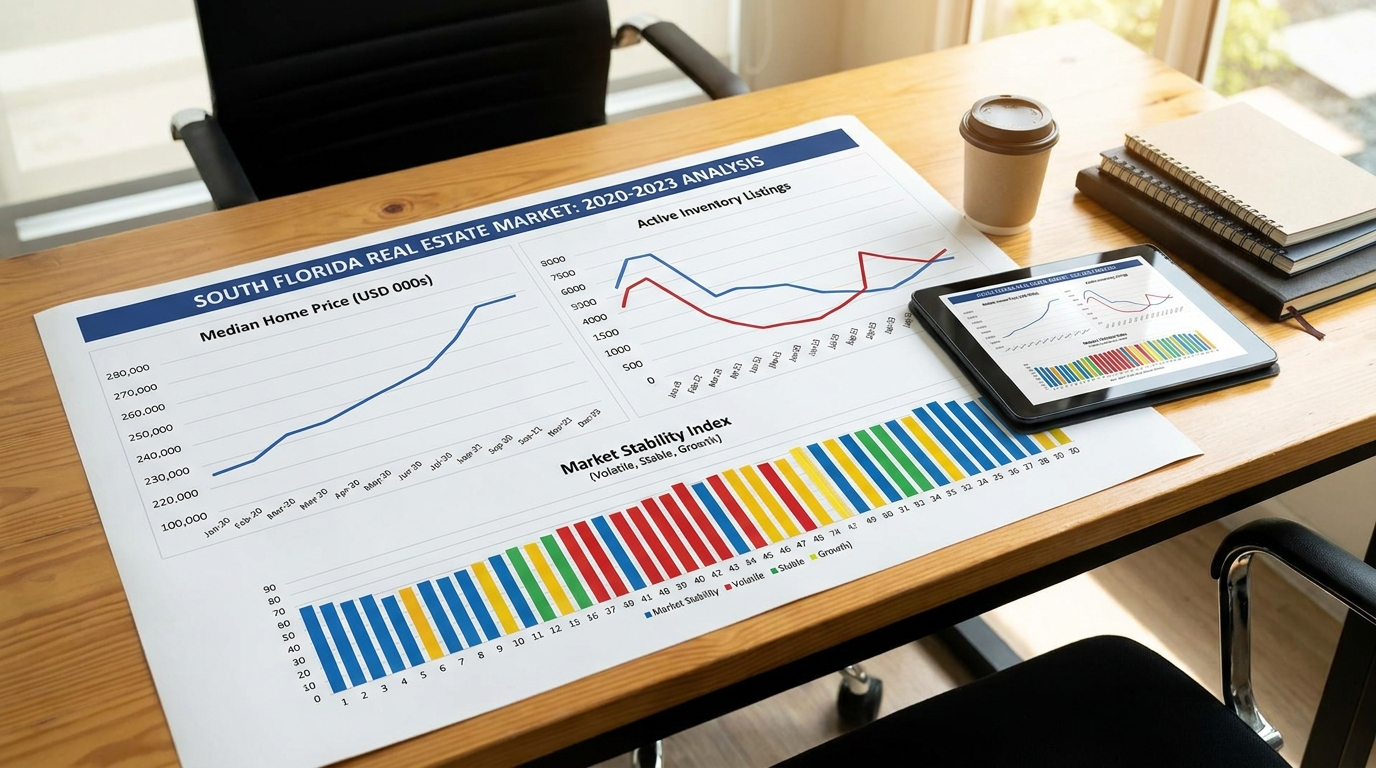
Days on market is a trailing figure, so read it alongside pending sales, which move in real time. Current county averages run about 107 in Palm Beach and St. Lucie, 124 in Broward and 137 in Miami-Dade.
A correction and a crash are different events
The words get used interchangeably and they describe very different experiences for an owner.
A correction is prices flattening or easing while transactions continue. Sellers wait, buyers gain negotiating room, and anyone who does not need to move is largely unaffected. This is a normal feature of property markets and it happens regularly.
A crash involves distressed inventory arriving faster than the market absorbs it, which requires forced sellers in volume. That is a different condition with a different cause, and treating every softening as the start of one is how people make poor decisions in both directions.
What protects you either way
Since the mechanism is forced selling, the protection is not needing to sell.
That means buying at a payment you can sustain if your circumstances change, holding reserves rather than deploying everything into the purchase, and being honest about your likely holding period. Someone who might move within three years is exposed to timing in a way a ten year owner simply is not.
For condominium owners specifically, the reserve study and funding plan are the most useful documents you can read. They tell you whether an assessment is coming, which is the single most likely thing to force a sale in this market.
More common questions
Will prices fall this year?
No honest answer exists, and anyone offering one is guessing. Watch absorption and inventory rather than forecasts, since those move first.
Is now a bad time to buy?
It depends on your holding period and your payment rather than on the market. A long hold at a sustainable payment is resilient to timing; a short one is not.
Would a crash here look like 2008?
That episode involved lending standards that no longer apply in the same form. The current Florida pressures are insurance and condominium assessments, which is a different mechanism and concentrates differently.


