

How Accurate Is Zillow in South Florida? What the Data Shows
June 9, 2026 · 6 min read · By Onias Derilus, Broker
Zillow's Zestimate is a useful starting point, but in South Florida's complex, high-variance market, it can be significantly wrong. Here's what the data shows and how to get an accurate value.
Every South Florida homeowner checks Zillow. And every experienced real estate agent in the region has seen the same frustration play out: a seller looks at their Zestimate, decides that's the number, and then lists too high or too low based on an algorithm with little basis in local reality. Zillow accuracy is a real concern for anyone buying or selling property across Palm Beach, Broward, or Miami-Dade counties.
What Zillow itself says about its accuracy
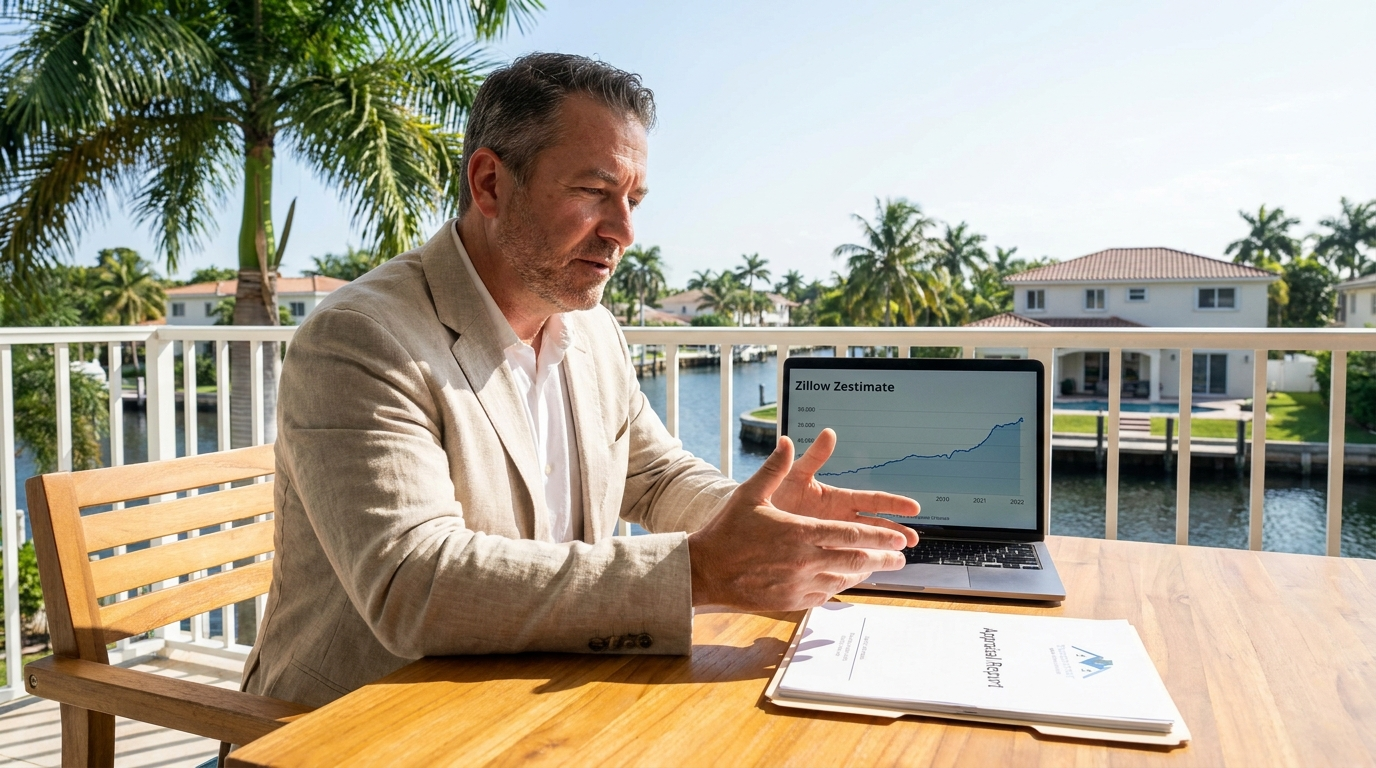
Zillow publishes its own accuracy data. Nationally, the Zestimate's median error rate for on-market homes is approximately 1.9%, meaning half of Zestimates fall within 1.9% of the eventual sale price. For off-market homes, that error rate climbs to about 6.9%.
But these are national medians. South Florida is a high-variance market. Waterfront premiums, wildly different HOA structures, and aging building stock with deferred maintenance all push local error rates higher. A large proportion of condos pushes them higher still. South Florida agents routinely see Zestimates off by 10 to 25 percent in either direction.
Why Zillow struggles in South Florida specifically
Zillow's algorithm depends on comparable sales and public records data. South Florida has several characteristics that confound this approach.
- Water views and waterfront premiums: two nearly identical homes on the same street can differ by $200,000 or more based on water view or canal access alone. The algorithm handles this poorly.
- HOA and condo fee variance: a condo with a $2,500/month HOA fee has a substantially lower effective value than an identical unit with a $700/month fee. Zillow does not factor HOA fees into Zestimates.
- Condition and update gaps: a fully renovated home and a dated original-condition home in the same community may differ by $100,000 or more. Zillow cannot inspect properties.
- Distressed sale contamination: foreclosure and short sale comps can drag Zestimates down in neighborhoods where those sales appear in the dataset.
- Building age and insurance costs: in South Florida's insurance market, a 1970s home needing a new roof and 4-point certification carries very different carrying costs than a 2015-built home. The algorithm has no visibility into that.
When Zillow is useful and when it is not
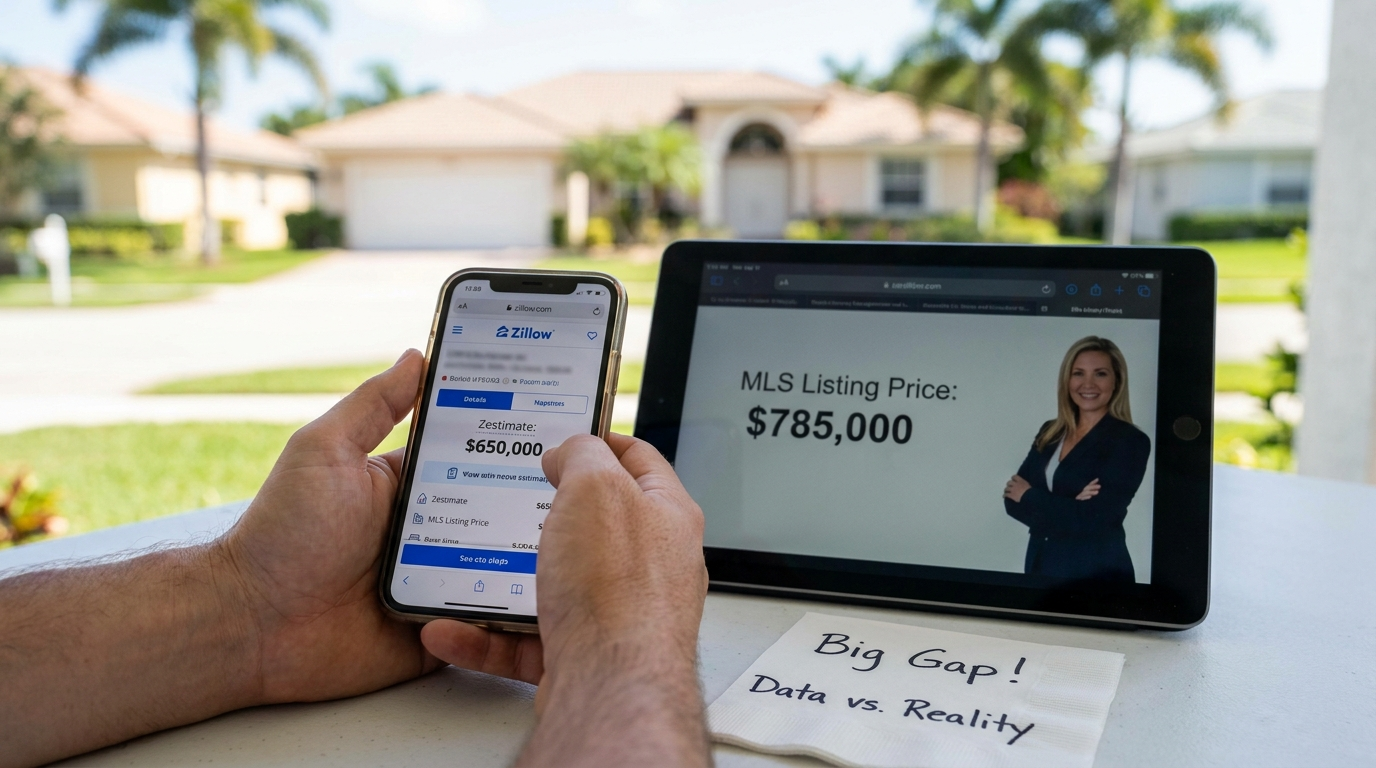
Zillow is genuinely useful for getting a general sense of a neighborhood's price range. If you are comparing Weston to Pembroke Pines, or Delray Beach to Boynton Beach, Zillow gives you a reasonable ballpark. It is also useful for tracking broad market trends over time.
Where it fails is in specific property valuation, which is precisely when the number matters most. When you are deciding what to offer, what to list at, or what a property is worth as collateral, the Zestimate is an unreliable guide that can cost you real money.
How to get an accurate South Florida home value
For an accurate market value in South Florida, three tools actually work.
- A Comparative Market Analysis (CMA) performed by a local agent who knows the neighborhood, adjusts for condition, and can tell a genuine comp from a misleading one. This is free and should be your first call.
- A licensed appraisal, which is required for most mortgage transactions and carries weight for legal, estate, or dispute purposes.
- A Broker Price Opinion (BPO), which is useful in distressed property situations.
We provide free, no-obligation CMAs for any South Florida property. Request your home value estimate from our team, or learn more about our seller services and how we price properties at the right number, not Zillow's number.
What an automated estimate can and cannot see
Automated valuation models work from data they can obtain: recorded sales, tax records, square footage, bed and bath counts, and broad location. That covers a great deal, and on a uniform tract of similar homes built in the same decade, the results can be reasonable.
What the model cannot see is everything that makes two identical-on-paper homes sell $100,000 apart. It does not know that one backs a preserve and the other a road. It does not know that one was renovated last year and the other in 1998. One may have impact windows and a new roof while the other has neither. One may sit in an association facing a structural assessment.
In South Florida those factors are unusually influential, which is precisely why automated estimates struggle here more than in more uniform markets.
The four local factors that break the model most often
- Water. Direct waterfront, canal access with ocean passage, a fixed bridge limiting boat size, and a water view with no access are four different products at four different prices. A model reading only an address rarely distinguishes them.
- Association health. Since milestone inspection and reserve funding requirements changed, two identical condominium units can differ enormously in value based on the building's finances. That information is not in any public dataset the model reads.
- Insurability. Roof age, window type, and flood zone drive what a buyer can afford to carry. A model does not know your roof's age.
- Condition. The single largest variable and the one automated models are blindest to, since they cannot see inside.
Why the error is not random
Automated estimates tend to pull toward the middle of their comparable set. That means a well-renovated home in an average neighbourhood is usually underestimated, and a dated home surrounded by renovated ones is usually overestimated.
This matters because the direction of the error is predictable from your own property. If you have invested in your home, the estimate is likely low. If you have deferred work while neighbours renovated, it is likely high. Owners routinely accept whichever direction flatters them and dispute the other.
How the estimate updates, and why it moves
These figures revise as new data arrives, and a nearby sale can move yours without anything changing at your property. That is why an owner watching an estimate week to week sees movement that feels meaningful and is not. The model is reacting to the neighbourhood, not to the house.
It is also worth knowing that listing a property changes what the model has to work with. Estimates often shift once a home goes on the market and shift again after it sells, which is one reason pre-listing estimates should not be treated as a target.
Using it sensibly rather than dismissing it
An automated estimate is a starting point, and a genuinely useful one for orientation: broadly, is this a $400,000 street or an $800,000 street? That is a real question and the model answers it well.
What it should not be used for is setting a list price, deciding whether an offer is fair, or estimating your equity for a financial decision. Those need actual closed comparables adjusted for the specifics of your property.
What a real valuation involves
A grounded valuation starts with recent closed sales in your own community, not your city, then adjusts for size, condition, view, frontage, and association health. It accounts for what is currently competing with you and how long comparable homes took to sell. Days on market vary widely across the counties we serve, from around 107 in Palm Beach County to roughly 214 in Highlands, and that affects strategy as much as price does.
If you want that for your own property anywhere in the eight counties we serve, we will pull the comparables and explain the adjustments rather than simply handing you a number. It costs nothing and it is a far better basis than any automated figure.
Common questions
How far off can an automated estimate be?
Published error rates are national averages and understate the spread on distinctive properties. Waterfront, renovated, and condominium properties in South Florida are where the largest gaps appear.
Why did my estimate change when I did nothing?
Because a nearby property sold. The model reacts to neighbourhood data, so your figure moves without anything changing at your home.
Should I correct my home facts online?
It can help if square footage or bed and bath counts are genuinely wrong, since those are core inputs. It will not capture condition or view.
Do buyers rely on these estimates?
Some arrive anchored to one, which is worth anticipating as a seller. The counter is evidence: actual closed comparables explaining why your home is priced where it is.
What to do if yours looks wrong
Start by checking the facts the model holds: square footage, bedroom and bathroom counts, lot size, and year built. Those are core inputs and they are wrong often enough to be worth verifying. Correcting a genuine error can move the figure.
What correcting facts will not do is capture condition, view, or association health, so do not expect an accurate result from data entry alone. If the figure matters because you are making a decision, get a real valuation rather than trying to argue the model into agreement.
One last point worth making plainly: an automated estimate is free because it costs nothing to produce. A valuation grounded in closed comparables takes an hour of someone's attention, and for a decision involving hundreds of thousands of dollars, that is a reasonable trade. We do not charge for it either.


