

The 1% Rule in Real Estate: Does It Work in South Florida?
June 9, 2026 · 6 min read · By Onias Derilus, Broker
The 1% rule is a quick screen for rental property deals, but in South Florida's market, it rarely applies to coastal properties. Here's what the rule means, where it works locally, and better alternatives.
The 1% rule in real estate is one of the first metrics most investors learn: if a property's monthly rent equals or exceeds 1% of the purchase price, it deserves deeper analysis as a potential cash-flowing investment. A $200,000 property should rent for at least $2,000/month. A $300,000 property should rent for at least $3,000/month. Simple, memorable, and widely used as a first filter by investors sorting through opportunities.
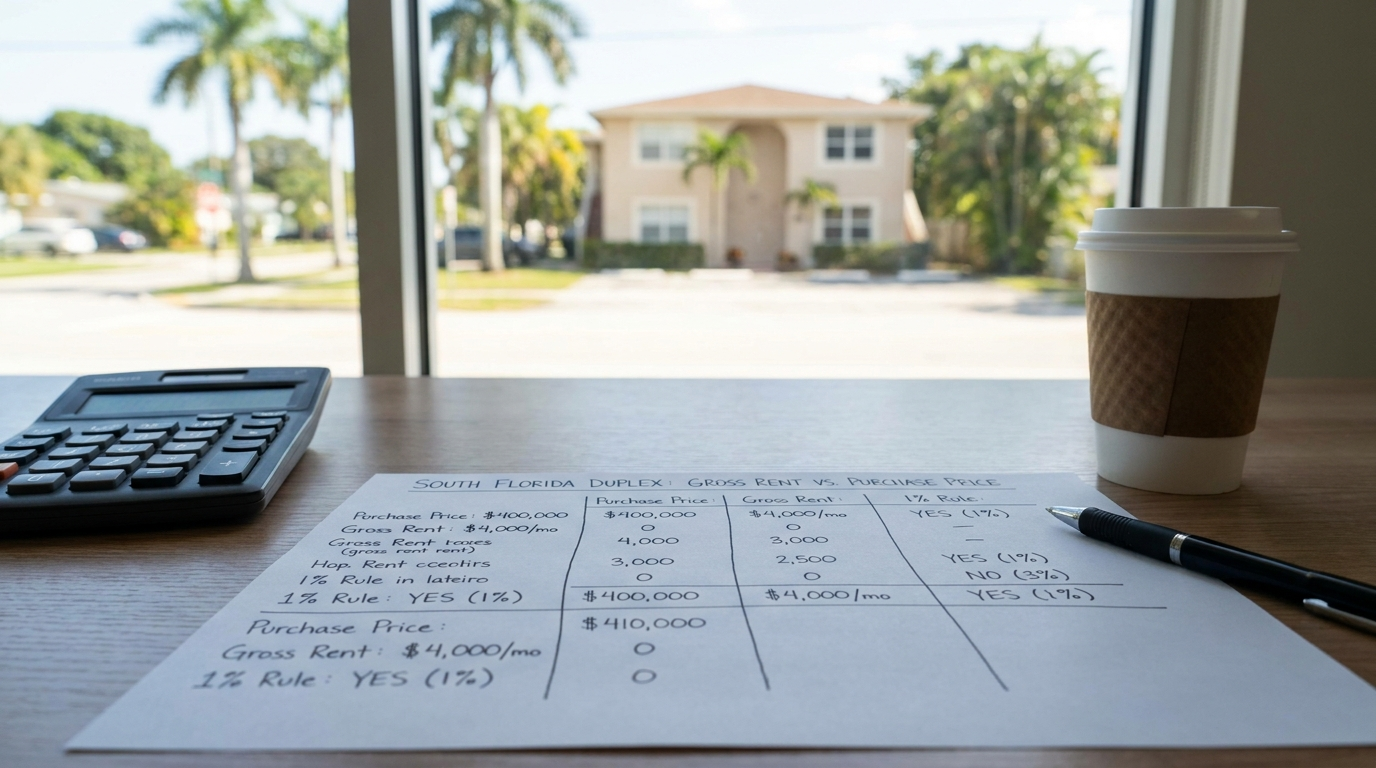
In South Florida's market, where $400,000 homes rent for $2,500/month, the 1% rule is almost universally unachievable on coastal properties. Investors who apply it too rigidly will find themselves unable to buy anything in Miami-Dade, Broward, or coastal Palm Beach County.

What the 1% rule is actually testing
The 1% rule is a proxy for cash flow potential. It exists because in markets where the rule is achievable, properties are more likely to produce positive cash flow after expenses and financing costs. In markets where rents are only 0.4 to 0.6% of purchase price (which describes much of South Florida's coast), cash-on-cash returns from conventional financing are often negative, making the investment a pure appreciation play.
That does not mean South Florida properties are bad investments. It means the investment thesis is different: appreciation, equity build, and tax benefits rather than immediate cash-on-cash return. Both approaches are valid, but you need to be clear on which one you are pursuing before you write an offer.
Where the 1% rule applies in South Florida
The 1% rule is more achievable, though still challenging, in certain South Florida submarkets:
- Inland Broward County (Lauderhill, Lauderdale Lakes, North Lauderdale): Some workforce housing in the $200,000 to $280,000 range rents for $1,800 to $2,200/month, approaching 0.8 to 1.0%.
- Western Palm Beach County (Lake Worth, Greenacres, Belle Glade area): Lower purchase prices relative to rents push the ratio closer to 1%.
- Highlands County: Rural properties and small multifamily in Sebring and Avon Park can approach or exceed the 1% threshold.
- St. Lucie County: Parts of Fort Pierce and inland Port St. Lucie offer better rent-to-price ratios than coastal markets.
Better metrics to use in South Florida
Rather than abandoning quantitative analysis because the 1% rule does not apply, use more comprehensive metrics:
- Cap rate: Net Operating Income divided by Purchase Price. This tells you the property's income yield independent of financing. Learn how to calculate cap rate correctly.
- Cash-on-cash return: Annual cash flow after debt service divided by cash invested. This tells you what your actual dollars are earning.
- Gross rent multiplier (GRM): Purchase price divided by annual gross rent. Lower is generally better. South Florida coastal properties often carry GRMs of 25 to 35x.
The 1% rule is useful for quickly eliminating deals that cannot possibly cash flow. In South Florida, the more useful question is: given my investment thesis (cash flow versus appreciation), does this property's income, expense, and growth profile match my goals? Use our Rental ROI Calculator to run the full numbers on any property you are evaluating.
Looking at investment properties in South Florida? Our agents know the markets where rent-to-price ratios actually work and can help you evaluate deals with full cash flow analysis. Contact us or use the Rental ROI Calculator to run numbers on any property you have in mind.
Frequently asked questions
Does the 1% rule apply to South Florida real estate?
Rarely on the coast. Coastal Miami-Dade, Broward, and Palm Beach County properties typically produce rent-to-price ratios of 0.4 to 0.6%. Inland and rural markets in Highlands County, St. Lucie County, and western Palm Beach County come closer to meeting the threshold.
What is a realistic rent-to-price ratio in South Florida?
For coastal markets, expect 0.4 to 0.6%. Inland workforce housing can reach 0.7 to 0.9%. Coastal luxury properties often fall below 0.4%. These numbers reflect current conditions and shift with both rent and price movements in each submarket.
Should I still use the 1% rule when analyzing properties?
Yes, as a first filter. If a property clearly fails the test, that tells you something. Just do not rule out every South Florida property because of it. Move to cap rate and cash-on-cash analysis once you get past the initial screen.
What is a good cap rate for South Florida investment properties?
Coastal residential properties typically cap at 3 to 5%. Inland markets and small multifamily can reach 6 to 8%. Cap rates above 8% are uncommon and worth scrutinizing for deferred maintenance or other risk factors.
Why the rule breaks in this market specifically
The rule asks whether monthly rent reaches one percent of purchase price. It was built in markets where prices were low relative to rents, and South Florida is the opposite case.
Apply it here and see what it demands. At the Palm Beach County median of about $480,000 it requires $4,800 a month. At Miami-Dade's $599,000 it requires $5,990. At Broward's $390,000 it requires $3,900. Those figures are far above what comparable properties rent for, so the rule rejects essentially the entire coastal market.
A screen that rejects everything is not a useful screen. It is measuring the wrong thing for a market where a large share of the return comes from appreciation and from land scarcity rather than from monthly yield.
Where it is closer to viable
Move inland and the arithmetic improves because prices fall faster than rents. Highlands at about $309,000 and Okeechobee at about $274,900 need roughly $3,090 and $2,749 respectively, which is a much smaller gap to close than on the coast.
The trade is liquidity. Highlands averages around 206 days on market and Okeechobee around 144, against 107 in Palm Beach. Better yield, slower exit. That is the actual decision, and the one percent rule cannot express it because it only looks at one side.
Compute the ratio yourself rather than assuming one
Rather than trusting any published rent to price ratio, derive it for the specific property you are considering. Find what genuinely comparable units nearby are currently renting for, take the monthly figure, divide by the purchase price, and you have the real ratio for that property.
Do that for several properties across two or three counties and you will have a picture of your own market that no general rule provides. It takes an afternoon and it is worth more than any heuristic.
What to use instead
Three measures do the job the one percent rule cannot, and each answers a different question.
- Net operating income. Annual rent minus all operating costs, excluding financing. This is the property's own performance, independent of how you paid for it.
- Cap rate. Net operating income divided by price, which lets you compare properties of different sizes and in different counties on one number.
- Cash on cash return. Annual pre tax cash flow divided by the cash you actually invested. This is the one that tells you what your money is doing.
Then add a break even test. Work out how many months of vacancy the property can absorb before you are funding it from savings. That single number predicts trouble better than any return metric.
The costs a quick ratio always omits
Any rule based on price and rent alone ignores the items that decide Florida outcomes. Property tax resets to your purchase price after you buy rather than continuing at the seller's assessment. Insurance is a major and rising line, particularly near the coast, and it varies by roof age and opening protection rather than by area. Association fees and condominium reserve contributions are increasing under current reserve funding requirements. Vacancy, turnover, management and a real capital reserve for the roof and air conditioning all apply.
Model those explicitly. A property that clears one percent on paper and fails once insurance and reserves are counted is a worse purchase than one that misses the rule and covers its costs comfortably.
Keep it for what it is good at
The rule still has one legitimate use, which is discarding obviously unworkable listings quickly. If a property is nowhere near the ratio and you need current income, you can move on without a full analysis.
Just do not let it be the decision. Use it to shorten the list, then underwrite properly what remains, and let the cap rate and cash on cash figures decide.
More common questions
Should I ignore the rule entirely in South Florida?
Ignore it as a decision rule and keep it as a rough filter. Insisting on it here would exclude the whole coastal market.
Is negative cash flow ever acceptable?
Only with the reserves to fund it indefinitely and a clear reason to expect it to reverse. Relying on appreciation to rescue a property you cannot carry is how forced sales happen.
What cap rate should I expect here?
It varies enough by county, property type and condition that a single figure would mislead. Compute it for several real properties in your target area and compare like with like.


