

The 70 Percent Rule in Real Estate: What It Is and How It Works in South Florida
June 9, 2026 · 6 min read · By Onias Derilus, Broker
The 70 percent rule is the single most important formula in house flipping. It's also the most misunderstood. Here's exactly what it means, how to apply it in South Florida, and when experienced flippers bend it.
The 70 percent rule is the foundation every house flipper builds on. It is a simple formula that gives you the maximum price to pay for a property, and it is designed to keep you profitable even when things go sideways. If you are flipping in Palm Beach, Broward, or Miami-Dade, you need to understand this rule before you make your first offer.
What is the 70 percent rule in real estate?
The 70 percent rule says you should pay no more than 70% of a property's After Repair Value (ARV), minus your estimated repair costs. The formula:
- Maximum Purchase Price = (ARV x 0.70) - Repair Costs
That 30% margin is not pure profit. It covers your profit target, selling costs (typically 6 to 8%), holding costs (financing, taxes, insurance, utilities), and unexpected overruns. Think of it as a safety buffer baked into every deal from the start.
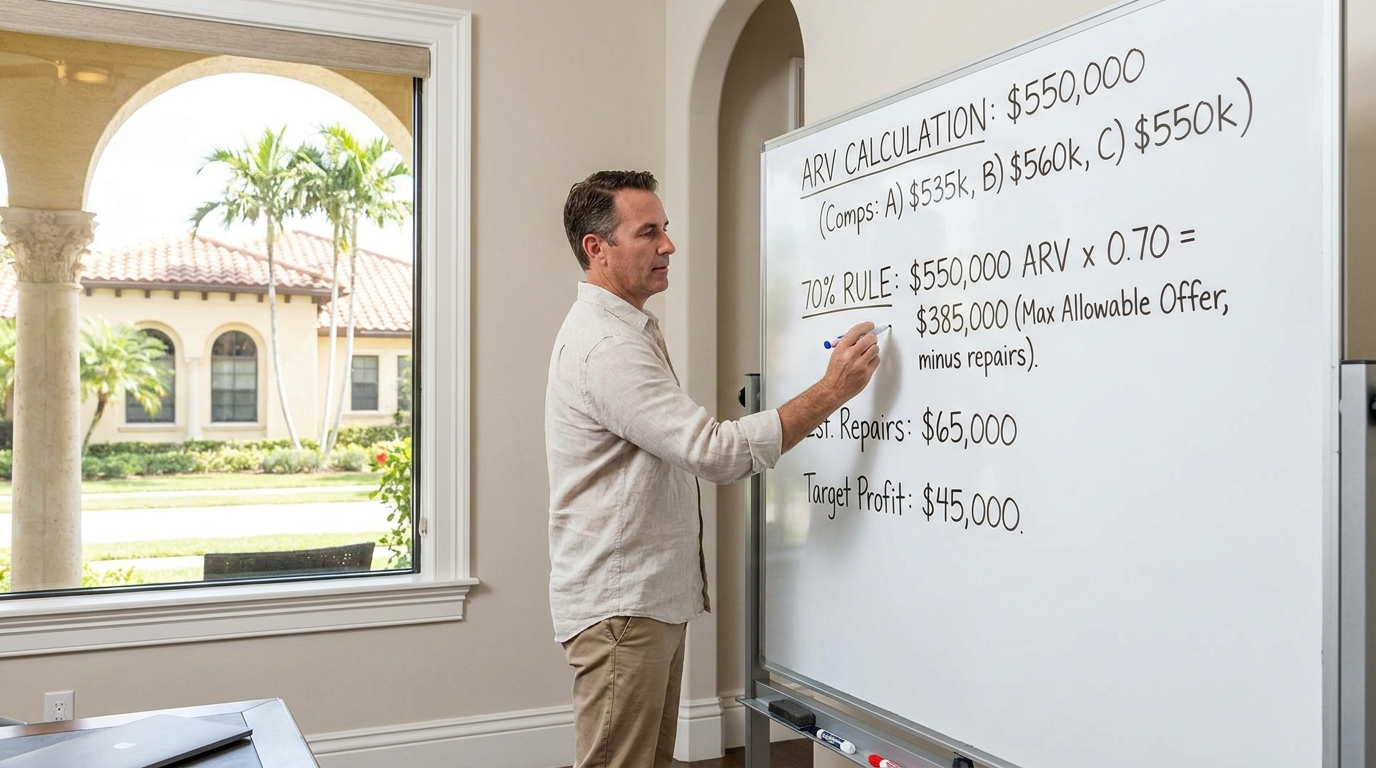
70 percent rule example in South Florida
Here is a real-world scenario in Fort Lauderdale. You find a 3/2 that needs a full kitchen and bath update. Renovated comps in the same neighborhood are selling at $480,000. That is your ARV. Your contractor estimates $75,000 in repairs.
- ARV: $480,000
- 70% of ARV: $336,000
- Minus repairs: $75,000
- Maximum offer: $261,000
If the seller wants $295,000, the deal does not work. You either negotiate down, tighten your rehab scope, or walk away. The 70 percent rule made that call in 30 seconds, before you invested a full day in due diligence.
Why the 70 percent rule exists
The rule accounts for real costs that beginners consistently underestimate:
- Agent commissions, closing costs, and staging typically run 8 to 10% of ARV
- Hard money interest, property taxes, insurance, and utilities add up to $3,000 to $6,000 per month in South Florida
- Almost every rehab project runs over budget. The 70% buffer absorbs that
- After all of the above, a well-executed flip should net 10 to 15% of ARV
When experienced flippers adjust the rule
Treat the 70 percent rule as a starting point, not a law. Experienced South Florida flippers sometimes use an 80% rule in specific situations:
- The rehab is purely cosmetic (paint, flooring, fixtures) with minimal unknowns
- The market is rising fast and the ARV at resale will likely exceed today's comps
- They are buying cash with no financing costs, which eliminates 3 to 5% of typical holding costs
- The property is in a high-velocity submarket like Coconut Grove or Coral Gables where days on market are extremely short
The honest truth: most flippers who stretch past 70% on early deals regret it. Surprises happen. Stick to the rule until you have 10 or more flips of experience in your specific market.
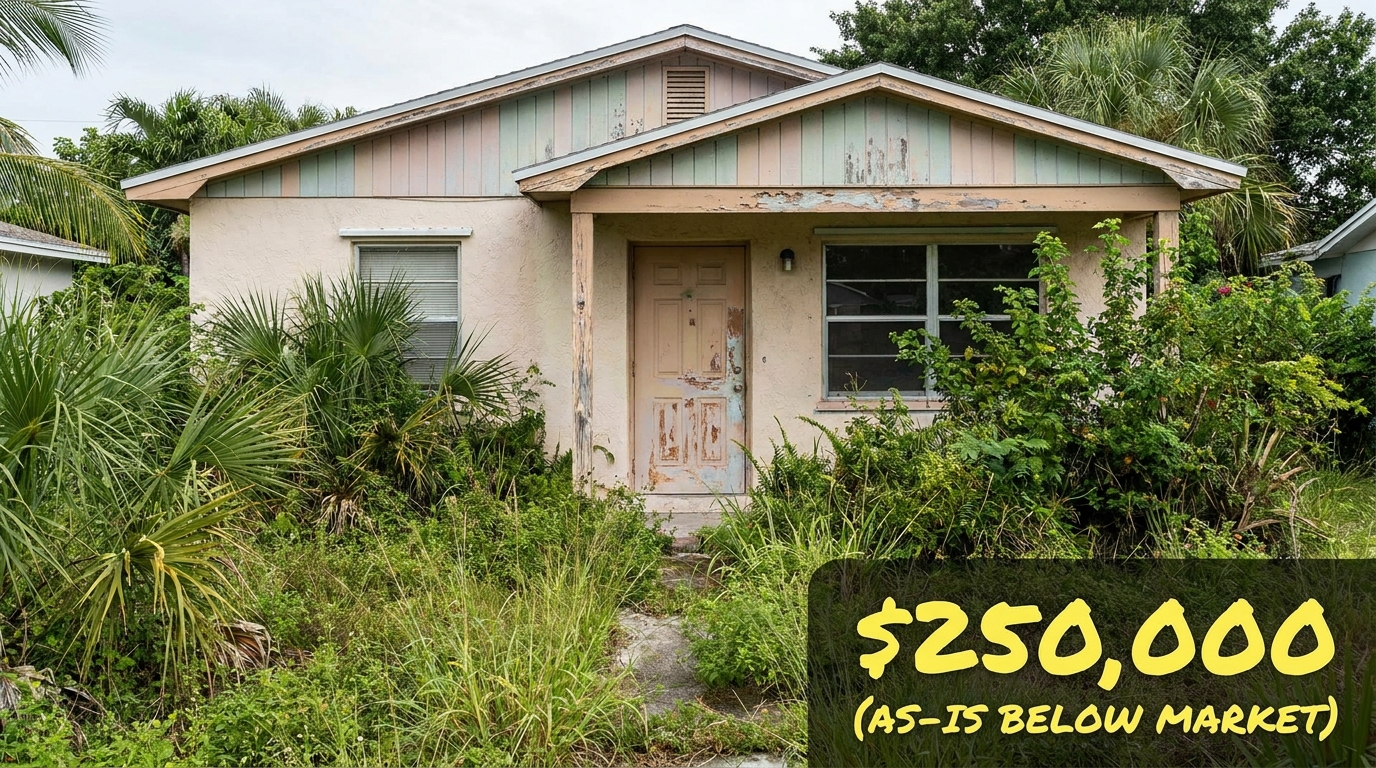
70 percent rule vs. 70 rule calculator: what is the difference?
They are the same concept. "70 percent rule" and "70 rule" both refer to the ARV x 0.70 minus repairs formula. A 70 rule calculator is a digital tool that runs the math instantly across different ARV and repair scenarios. Use our Fix & Flip / BRRRR Calculator to model full deal returns beyond just the acquisition price.
Ready to find South Florida flips that actually pass the 70 percent rule? Tell us your buy box and we will source off-market deals that work. For market data to help you nail your ARV, see Florida Realtors market statistics.
Put the 70 percent rule to work on real deals
Pure Equity sources off-market distressed properties across South Florida. Submit your buy box and we will send you deals that pencil out before you ever make an offer. Already have a property to evaluate? Run the full numbers in our Fix and Flip calculator.
Frequently asked questions
Is the 70 percent rule the same as the 70-30 rule?
Yes. When people say the 70-30 rule in real estate, they mean the same formula: pay no more than 70% of ARV minus repair costs, leaving a 30% margin for expenses and profit.
What if the repair costs are unknown?
Get a contractor to walk the property before you offer. If that is not possible, use a conservative estimate: $30 to $50 per square foot for a moderate rehab, $60 to $80 for a gut renovation. Err on the high side. The 70 percent rule punishes optimistic repair estimates.
Does the 70 percent rule apply to BRRRR deals?
It is a useful starting filter, but BRRRR has a different exit. Instead of selling, you refinance. Your real target is making sure the after-repair value supports a cash-out refi that returns most of your capital. Run the full numbers in a dedicated BRRRR calculator rather than relying on the 70% rule alone.
What counts as ARV?
ARV is what the property will sell for after repairs are complete, based on recent comparable sales of similar renovated homes within half a mile and sold in the last 90 days. Use a licensed appraiser or a realtor with solid local comp access. Guessing ARV is how flippers lose money.
The rule is a lender's constraint wearing a buyer's clothes
The seventy percent figure did not come from an analysis of what makes a flip profitable. It came from how renovation lenders size loans, and understanding that explains both why it exists and when to ignore it.
Short term renovation lenders typically cap what they will advance against a project's after repair value. Seventy percent is a common ceiling, so a borrower working to that number stays inside what the lender will fund. The rule survived because it kept people financeable rather than because it optimised returns.
That reframing has a practical consequence. If you are paying cash, the lender's constraint is not yours, and applying it mechanically means declining deals that work perfectly well on their own arithmetic.
Calibrate your own number instead of inheriting one
The percentage should be an output of your costs, not an input you accept from an article. Work it backwards.
Take a realistic after repair value from closed sales. Subtract everything: renovation, buying costs, financing for your actual holding period, carrying costs, and selling costs including commission, documentary stamps and title where you pay it. Then subtract the profit you require to take the risk.
What remains is your maximum purchase price, and dividing it by the after repair value gives you your percentage. Investors who do this honestly usually land somewhere between sixty five and eighty depending on price point, holding period and cost of capital, and knowing your own number is worth far more than defending someone else's.
Holding period moves the number more than anything else
The rule assumes a project completes and sells within a few months. Where that is untrue, the percentage has to fall, and in parts of our region it is untrue by a wide margin.
Average days on market currently runs about 107 in Palm Beach and St. Lucie, 124 in Broward, 137 in Miami-Dade, 144 in Okeechobee and 206 in Highlands, before adding renovation time and closing. A deal underwritten at seventy percent on a six month assumption is a different deal at eleven months, because interest and carrying costs accrue throughout.
So adjust for your county rather than applying one figure statewide. The slower the exit, the lower the percentage has to be for the same profit.
Where the rule quietly misleads
Two failure modes recur, and both come from treating a screen as an analysis.
The first is repair estimates. The formula subtracts a repair figure, and if that figure is wrong the whole calculation is wrong regardless of the percentage. On an older house, an estimate produced without a contractor walking the property is a guess, and guesses on renovation run low far more often than high.
The second is after repair value. Using active listings rather than closed sales inflates it, and inflating the ARV inflates your maximum bid at exactly the moment discipline matters. Use closings, keep the comparable set tight, and compare against finished condition rather than other distressed sales.
Use it to sort, then underwrite properly
The rule earns its place as a first filter. It lets you discard obviously unworkable listings in seconds without building a model, which is genuinely valuable when you are screening volume.
What it cannot do is decide. Once a property survives the filter, build the costs from the bottom up and look at what profit remains. A deal that clears seventy percent on paper and fails once real carrying costs and a realistic timeline are counted is still a bad deal, and the rule will not tell you that.
More common questions
Does the rule change for BRRRR deals?
Yes, because the exit is a refinance rather than a sale. What constrains you there is what a lender will advance and whether the rent supports the payment, so model those instead.
Should I use a stricter percentage as a beginner?
Generally yes. A lower number buys margin for the estimating errors that first projects reliably produce.
What if I am paying cash?
Then the lender constraint does not apply to you. Underwrite on your own required return and holding cost instead of inheriting a financing ceiling.


