

Can You Make Money Flipping Houses in South Florida? (Honest 2026 Answer)
June 9, 2026 · 7 min read · By Onias Derilus, Broker
Yes, you can make money flipping houses, but the average flip profit is not what YouTube suggests. Here's an honest look at what South Florida flippers actually earn, and what separates winners from money-losers.
Can you make money flipping houses? It is one of the most Googled real estate questions, and almost nobody answers it straight. The truth sits somewhere between "anyone can get rich flipping" and "it is too risky for regular people." Here is what actually happens when you flip a house in the South Florida market.
What flippers actually earn
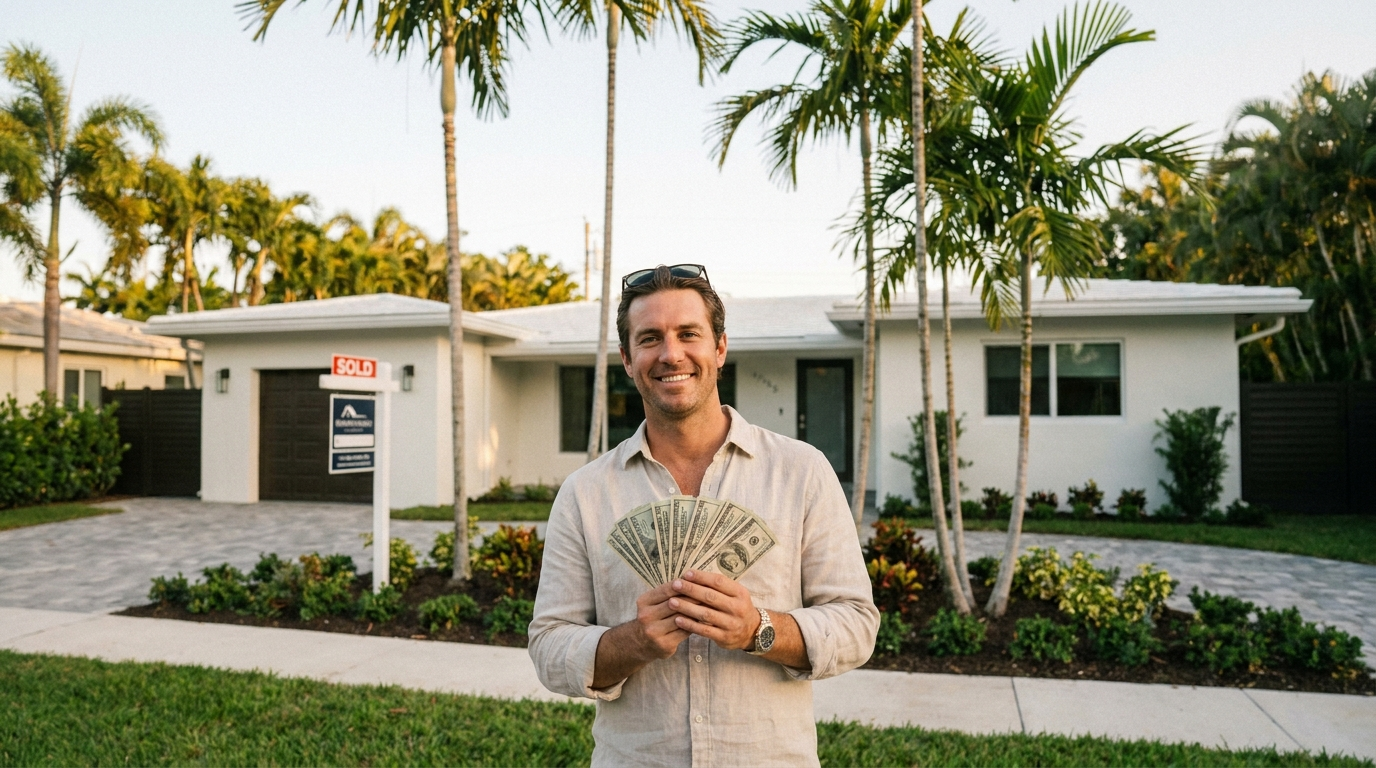
ATTOM Data tracks flip profits every quarter. In recent years, the average gross profit on a flip nationally has run from $55,000 to $75,000. That is gross, before you subtract holding costs, financing, agent commissions, and your own time. Net profit after all of those costs is usually 30 to 50 percent lower.
Down here the math looks different. Higher ARVs mean higher potential gross profits. The flip side is that higher acquisition prices, higher contractor labor costs, and tougher competition all squeeze your net margin. A well-run flip in Palm Beach County might net $40,000 to $80,000. A sloppy one in the same market might net nothing. Some lose $20,000.
The most important truth about flipping profits
You make money on a flip when you buy it, not when you sell it. The market sets your sale price for you. What you actually control is how well you negotiated the purchase and how tightly you held your renovation budget. Flippers who overpay for deals or lowball their repair estimates lose money over and over, no matter what the market is doing.
That is the whole reason the 70 rule calculator exists. It makes you work backward from a profitable exit before you fall in love with a property.
Who actually makes money flipping houses?
The flippers who make money in South Florida year after year tend to share a handful of habits.
- They buy off-market. The best deals never hit Zillow. They come through wholesalers, direct mail, estate attorneys, and agent relationships.
- They have a contractor they trust. Rehab cost is the single biggest swing factor in whether a flip makes money. Flippers with a reliable, fairly priced crew beat the ones who re-bid every job.
- They know their market cold. They can call ARV within 5 percent before pulling a single comp, because they have watched 200 similar homes sell in their target zip codes.
- They move fast. Holding costs (interest, taxes, insurance, utilities) usually run $3,000 to $6,000 a month on a South Florida property. A 4-month flip versus a 7-month flip is a difference of $10,000 or more in your pocket.
How much money do you need to start flipping houses?
In South Florida, a realistic entry-level flip needs $50,000 to $80,000 in cash for the down payment and rehab, assuming you finance the rest with hard money. All-cash flippers who skip financing costs entirely generally tie up $200,000 to $350,000 per project. The capital requirement is real. This is not a zero-down business in 2026.
Can you make money flipping houses as a beginner?
Yes, as long as you go in with your eyes open. Your first flip will take longer and cost more than you planned. Budget a 20 percent contingency on your rehab estimate and add a two-month buffer to your timeline. If the deal still works under those assumptions, you have probably found a viable first project.
Our team has worked with dozens of first-time flippers across Broward, Miami-Dade, and Palm Beach counties. Run the numbers through our Fix & Flip Calculator to stress-test your deal, and reach out if you want a second opinion before you commit. Worth a look too: HUD's 203k rehab loan program, which can work as a financing tool for buyer-flippers.
Frequently asked questions
Can you make money flipping houses in South Florida right now?
Yes, but margins are tighter than the national headlines suggest. Higher acquisition prices and contractor costs eat into the bigger gross profits that high ARVs make possible. The flippers who win buy below market and keep their rehab and holding costs in check.
How much profit should I expect on my first flip?
Plan conservatively. A well-bought entry-level flip in this market might net $40,000 to $80,000, but first-timers often land lower once timeline overruns and surprise repairs hit. If the deal still pencils out after a 20 percent rehab contingency and a two-month buffer, the profit is real.
Is flipping houses worth it compared to renting?
It depends on your goal. Flipping pays you a lump sum once and ties up your capital until you sell. Rentals build wealth slowly through cash flow and appreciation. Many investors flip to raise cash, then redirect the proceeds into buy-and-hold properties.
The honest verdict
Yes, and less often and less easily than the volume of content on the subject implies. It is a real business with real margins and it is not a way to make money quickly with little capital.
The people who do well share a small number of traits. They buy well rather than renovating well, they have enough capital to absorb an overrun without a forced sale, they control the schedule because interest runs regardless, and they treat it as an occupation rather than a side project.
The people who lose money are rarely unlucky. They are usually underfunded, or they bought at a price that left no room for the ordinary things that go wrong.
The five ways a first flip actually fails
- Overpaying at purchase. The margin is set the day you buy. Good finishes cannot rescue a bad entry price, because the exit is fixed by the neighbourhood rather than by your effort.
- Underfunding the renovation. Borrowing the purchase and hoping to fund the work from cash flow is how projects stall half finished, which is the most expensive state for a property to be in.
- Scope creep. Deciding mid project to also do the bathrooms adds cost and, worse, weeks of interest and holding.
- Over improving past the ceiling. Every street has a price buyers will not exceed. Spending beyond it converts your budget into someone else's bargain.
- Ignoring the exit timeline. Palm Beach and St. Lucie average about 107 days on market, Broward 124, Miami-Dade 137, Okeechobee 144 and Highlands 206. Interest accrues across every one of those days.
Gross profit is not your profit
The gap between the two numbers is where most optimism lives. A deal bought at $300,000, renovated for $60,000 and sold at $480,000 shows a gross of $120,000, and that is the figure people repeat.
Then subtract the rest. Buying costs of roughly $6,000, hard money at around 11 percent on $300,000 for six months at about $16,500, holding at roughly $1,400 a month for another $8,400, and selling costs of about $32,235 once commission at 5.5 percent, documentary stamps and the title policy are counted. Net lands near $56,865.
Both numbers are true and only one of them reaches you. Any conversation about flipping profits that does not specify which is being used is not a useful conversation.
What a realistic first year looks like
One project, possibly two. A full cycle from purchase through renovation to funded sale takes close to eight months on a median deal here once marketing and closing are included, so a single pool of capital supports roughly one and a half projects a year.
Expect the first one to teach you that your renovation estimate was low and your timeline optimistic. That is the normal outcome and it is why the first project should be a cosmetic one in a steady neighbourhood, where the cost of learning is small.
Where the tax position bites
Profit from a short hold is generally treated as ordinary income rather than long term capital gain, and if you flip regularly you may be treated as a dealer, which carries its own consequences.
That materially changes the after tax return compared with a buy and hold, and it is a question for an accountant before your first purchase rather than after your first sale. Investors who model gross profit and forget the tax treatment are overstating the result twice over.
The alternative worth weighing
If the goal is building wealth through property rather than running projects, a rental purchase is slower, calmer and considerably more forgiving. It produces income while you hold, pays down debt with someone else's rent, and does not require you to be right about a renovation budget.
Flipping suits people who want the project and can absorb a bad outcome. Choosing the quieter route is not a failure of ambition, and it has made more people money than an underfunded first flip.
More common questions
How much capital do I genuinely need?
The down payment, the entire renovation budget, at least six months of holding costs, and a reserve for an overrun. Missing the last two is the most common reason a first flip fails.
Is it still possible in this market?
Yes, with tighter underwriting than a few years ago. Longer marketing times mean carrying costs matter more, which raises the margin a deal needs at purchase.
Can I flip while working full time?
Possible with a reliable general contractor and a cosmetic scope. Harder than it sounds, since decisions are needed during working hours and delays cost you directly.


