

Drive for Dollars: How It Works and Why It Still Finds Deals in South Florida
June 9, 2026 · 5 min read · By Onias Derilus, Broker
Drive for dollars sounds old-fashioned, but it still works in South Florida's competitive market. Here's how to turn a few hours of neighborhood driving into a consistent off-market deal pipeline.
Drive for dollars is exactly what it sounds like: you drive through target neighborhoods looking for distressed or neglected properties, note the addresses, and then market directly to those owners. It's one of the oldest lead-generation strategies in real estate investing. In South Florida's competitive market, it remains surprisingly effective.
Why drive for dollars still works in 2026
Most investors are fishing in the same pond. Zillow, Realtor.com, wholesaler email lists. Drive for dollars finds properties that aren't in any of those places yet. Think of the house with boarded windows and an overgrown yard, or the estate home sitting vacant after a death. Think of the tired landlord who stopped maintaining their rental three years ago.
These owners haven't listed their property. They may not even be actively thinking about selling. A thoughtful, well-timed direct mail piece sent to an address you found because you were paying attention can be the only offer they ever receive. That's a competitive advantage that no amount of MLS browsing replicates.
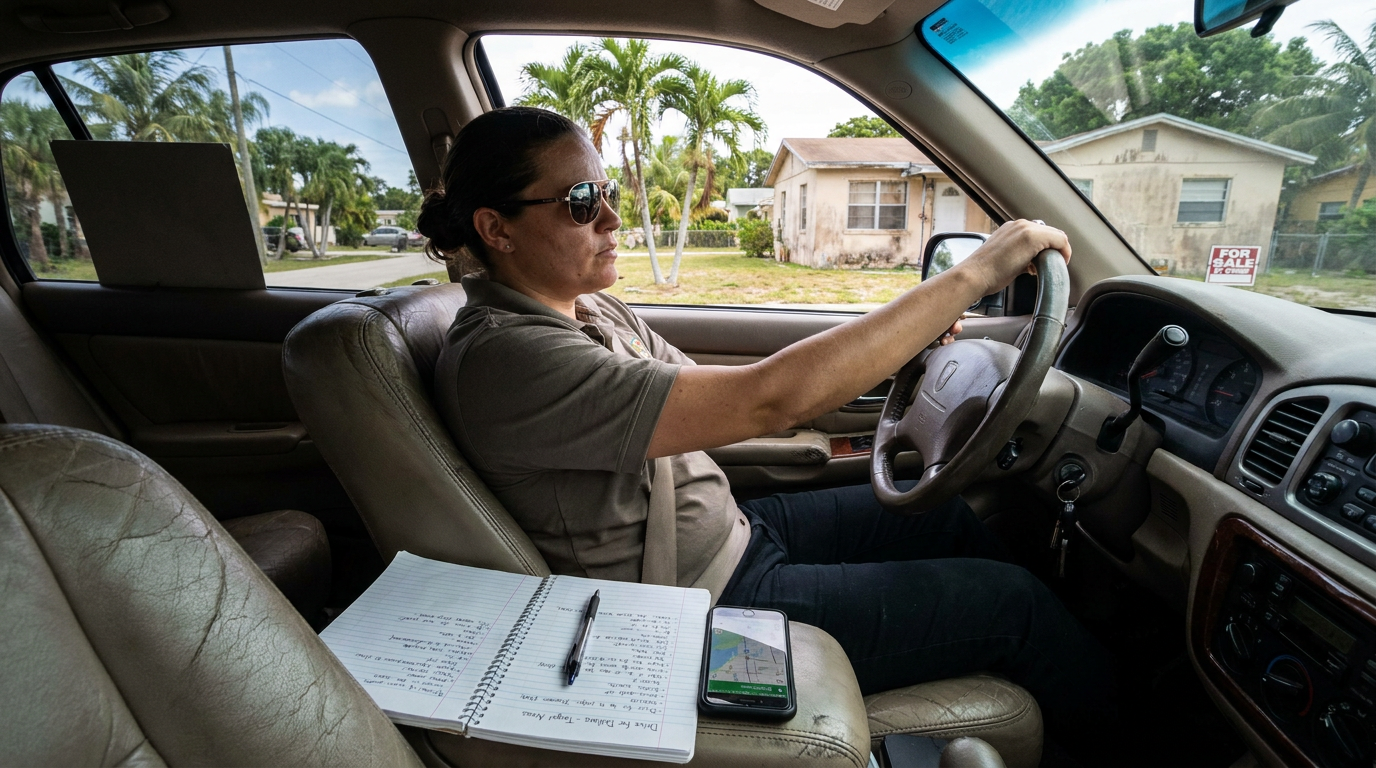
What to look for when driving for dollars
You're looking for signs of distress or neglect. Indicators that the owner may be motivated to sell:
- Overgrown grass or landscaping significantly worse than neighboring properties
- Peeling paint, a damaged roof, or broken windows that haven't been addressed
- Mail piling up, newspapers on the driveway, or other clear signs of vacancy
- Code violation notices posted on the door
- Multiple vehicles parked on the lawn (often signals a stressed occupant)
- A property that looks dramatically different from the well-maintained houses around it
In South Florida specifically, also watch for hurricane damage that was never repaired, properties with tarps still on the roof months after a storm, and homes where flood remediation was clearly incomplete.
How to turn addresses into leads
Once you have a list of addresses, the process is fairly direct:
- Skip trace the owner. Use tools like BatchSkipTracing, PropStream, or ATTOM to find the owner's name, mailing address, and phone number. Many South Florida investment properties are owned by LLCs or out-of-state investors, and skip tracing finds them.
- Send direct mail. A handwritten yellow letter or a professional postcard to the owner's mailing address works well. Keep it simple: "I'm a local investor interested in buying your property at [address]. If you'd ever consider selling, please call me."
- Follow up consistently. Most motivated sellers don't respond to the first letter. A sequence of four to six touches over sixty to ninety days increases response rates considerably.
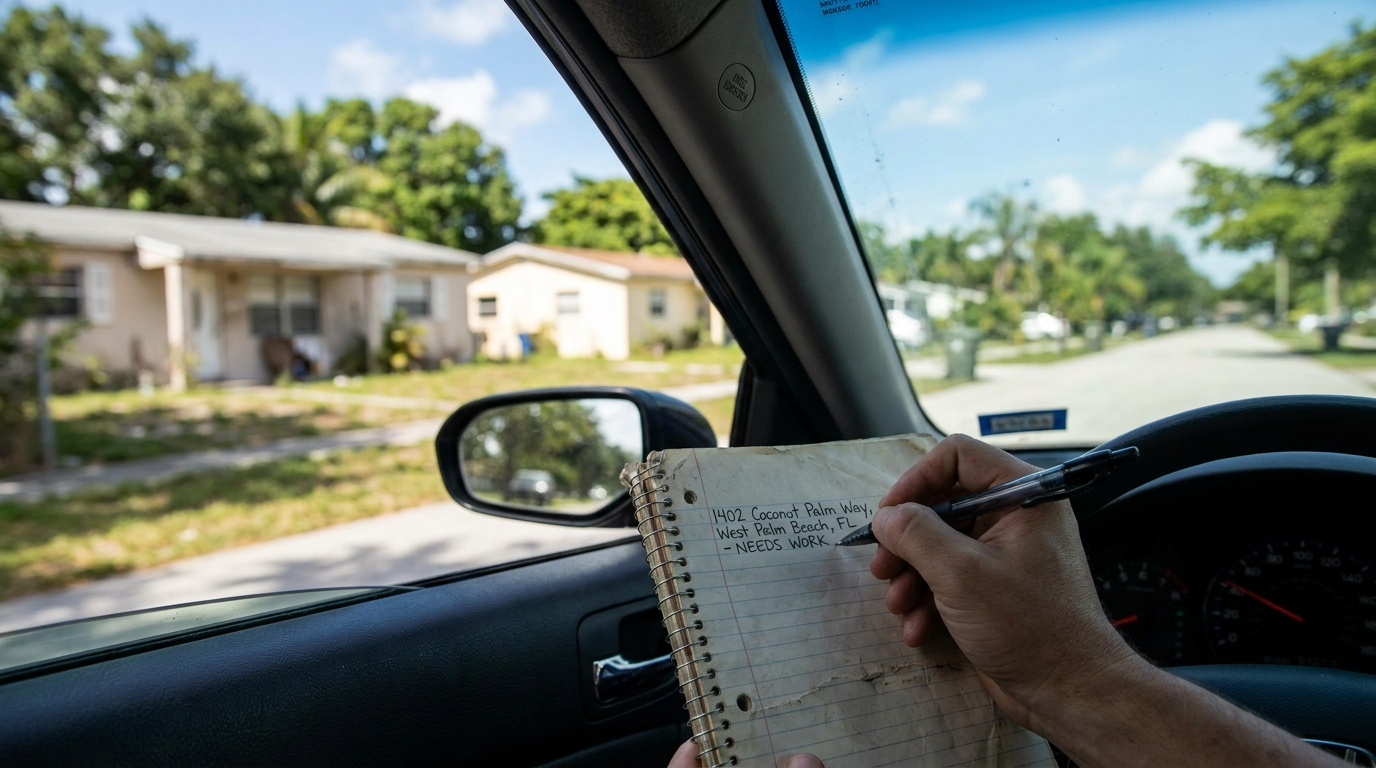
Drive for dollars apps that make it faster
You don't have to write down addresses by hand anymore. Apps like DealMachine, Driving for Dollars by PropStream, and BatchLeads let you drop a pin from your phone. They pull owner information instantly and add it to a direct mail campaign while you're still in your car. These tools have turned a manual process into something scalable.
Once you find a promising drive-for-dollars lead, use our 70 percent rule guide to evaluate whether the deal makes financial sense before you make an offer. And if you need help identifying the right South Florida neighborhoods to target, explore our county area guides for market context. For title and ownership research tools, Florida Realtors and county property appraiser websites are free starting points.
What you are actually looking for
The technique is simple: drive target neighbourhoods and note properties showing signs of distress or absentee ownership, then research and contact the owners. What makes it work is knowing which signals are meaningful.
- Deferred maintenance that suggests an owner unable or unwilling to spend: aged roof, peeling paint, damaged fascia.
- Overgrown landscaping, particularly obvious in South Florida where growth is fast and neglect shows within weeks.
- Accumulated mail or notices, or code enforcement postings.
- Boarded or covered windows outside storm season.
- Vehicles that never move, or an absence of any sign of occupancy.
What you are inferring is not that someone wants to sell, but that circumstances may have changed. That is a hypothesis to check, not a conclusion.
Why it still works when data is abundant
Every investor has access to the same lists. Nobody has access to what a street looks like today. Condition is the variable least well captured in any dataset, and it is precisely the variable that determines whether a property is a candidate.
Driving also surfaces properties that are not on any list at all, because the owner has not yet reached the stage that generates a public record. Reaching someone before that point is the entire advantage.
Doing the research afterwards
Property appraiser records give you ownership, mailing address, assessed value, and sale history. A mailing address different from the property address indicates absentee ownership, which is one of the strongest signals available. Tax collector records show delinquency. Clerk records show liens, judgments, and probate filings.
Probate deserves particular attention. An inherited property with heirs elsewhere is a common situation behind a neglected house, and those owners frequently do want to sell but have not started because the process feels daunting.
Making contact without becoming a nuisance
These are people, often in difficult circumstances, and the approach matters ethically and practically.
Identify yourself and your interest plainly. Never imply any official capacity. Respect no-contact requests and honour do-not-call obligations, which apply to this activity as much as any other. Keep the volume of contact reasonable, because repeated pressure on someone in distress is both unpleasant and legally risky.
Be honest about their options too. An owner with equity is usually better served by an open-market sale than by a discounted quick close, and saying so builds the reputation that produces referrals later. Investors who conceal that fact get one deal and a story that follows them.
South Florida specifics
Distress presents differently here. Rapid vegetation growth makes neglect visible quickly. Storm damage, particularly older roofs and unrepaired soffit, is a recurring signal. Association-governed communities are often the wrong hunting ground, since rules force maintenance and mask the signals you are looking for.
Insurance is worth remembering as motivation. Owners with aged roofs are increasingly finding coverage expensive or unavailable, and that pressure alone is prompting sales that would not otherwise happen.
Common questions
Is this legal?
Driving public streets and researching public records is legal. Entering private property without permission is not, and contact is subject to the same do-not-call and solicitation rules as any other outreach.
How many properties before a deal?
The ratios are unforgiving, which is why consistency matters more than any single outing. Treat it as a habit rather than a campaign.
Should I use a mail campaign instead?
Many investors combine both. Driving identifies the properties; mail, calls, or door knocks make the contact. The advantage is in the identification.
Can you help me evaluate what I find?
Yes. We can pull ownership, sale history, and comparable closings for any property in the eight counties we serve, which is the fastest way to tell whether a candidate is worth pursuing.
Running it as a repeatable system
The people who get results treat this as a routine rather than an occasional activity. Pick specific streets rather than wandering, cover them on a schedule, and record what you find consistently: address, the signal you observed, the date, and the follow-up status.
Repetition is what surfaces change. A house that looked fine three months ago and now has an overgrown yard and accumulating mail tells you something a single pass never could. That change over time is the real signal, and it is only visible to someone covering the same ground repeatedly.
Knowing when to stop pursuing one
Not every distressed-looking property is a deal, and pursuing the wrong ones consumes the time that should go into finding the right ones. If the numbers do not work at a price the owner would plausibly accept, move on. If the owner has said no, move on. If the title is a probate tangle with heirs who cannot agree, understand that timeline before investing months in it.
Discipline about walking away is what separates this from an expensive hobby, and it is the habit newer investors develop last.
Pairing it with the data you already have
The technique works best combined with public records rather than instead of them. Pull the delinquent tax list, code enforcement filings, and probate records for your target area, then drive those addresses specifically. That way you are confirming a documented signal with your own eyes rather than guessing from appearance alone, which is a far better use of the same hours.
If you would like a second opinion on a property you have spotted, send us the address and we will pull the ownership, sale history, and comparable closings before you invest any more time in it.


