

How Much Do Real Estate Wholesalers Make in South Florida? (2026 Reality Check)
June 9, 2026 · 6 min read · By Onias Derilus, Broker
Real estate wholesaling income ranges from zero to $300,000+ per year depending on volume and market. Here's what South Florida wholesalers actually earn, and what it takes to get there.
How much do real estate wholesalers make? It is one of the most searched questions in real estate investing, and one that almost nobody answers honestly. The YouTube version shows people collecting $20,000 checks with no money down. The skeptic's version says it doesn't work at all. The real picture is more complicated: wholesaling can generate serious income, but it is a real business that requires real effort, real marketing spend, and real skill.
How real estate wholesalers get paid
A wholesaler earns an assignment fee: the difference between the price they contracted with the seller and the price they charge the end buyer. If you lock a property under contract at $190,000 and sell the contract to a flipper for $210,000, your assignment fee is $20,000.
You never own the property. You don't need a license to wholesale in Florida, though you must be careful about marketing properties you don't own. Florida law has specific requirements on that point. The model is capital-light compared to buying and holding, but it is far from passive.
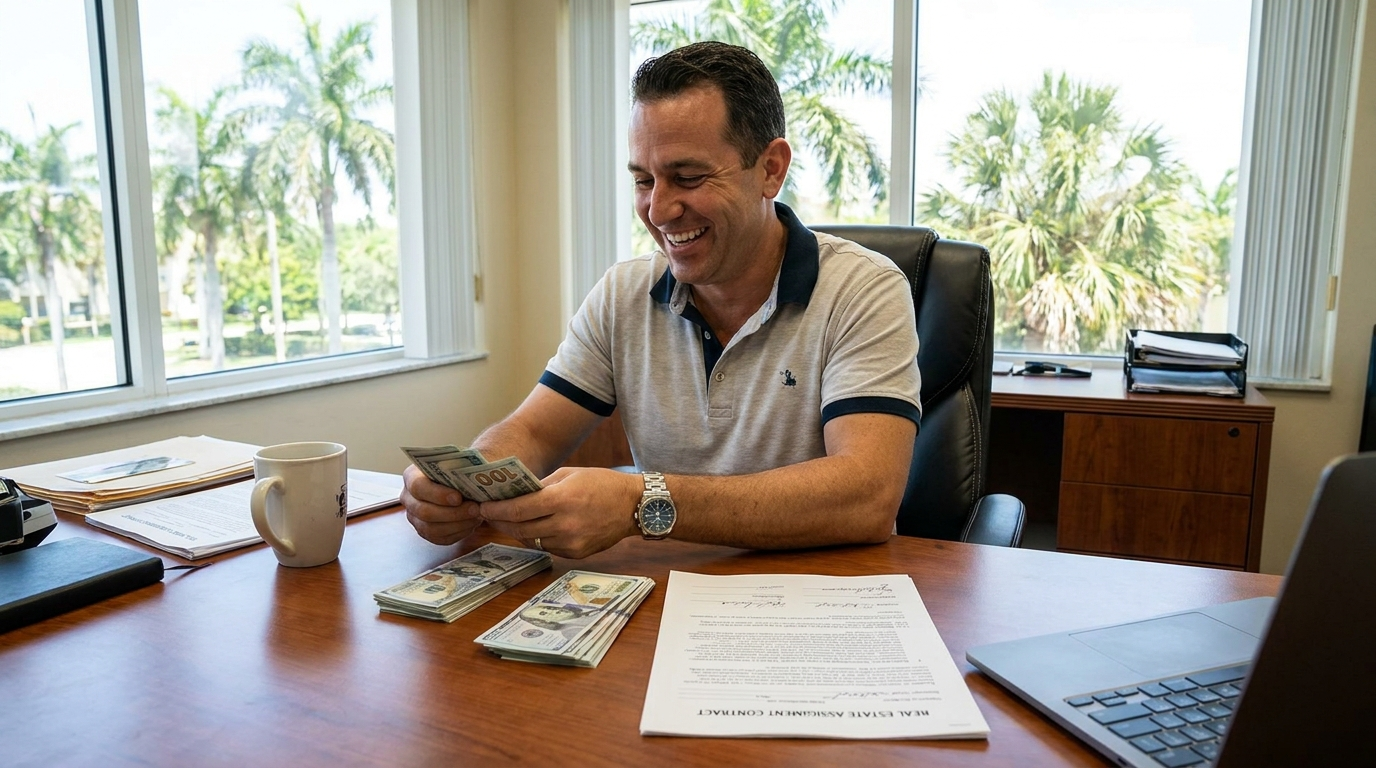
What the typical South Florida wholesale deal looks like
In South Florida's market, assignment fees typically range from $8,000 to $25,000 per deal. Higher-priced properties in Palm Beach or Miami-Dade can support larger fees, but buyers there are also more sophisticated and will push back on inflated margins. A realistic South Florida deal breakdown looks like this:
- Seller contract price: $230,000
- ARV (renovated value): $380,000
- Buyer's max offer (70% rule): $266,000 minus $55,000 repairs = $211,000
- Wholesaler assignment fee: $211,000 minus $230,000 = deal doesn't work. Contract price is too high.
This is the core challenge: finding sellers willing to accept prices low enough to leave room for both a profitable flip and a wholesale fee. That is why motivated seller sourcing, not buyer relationships, is the hard part of wholesaling.
Income ranges: what wholesalers actually earn
Here is an honest range based on experience and volume:
- Beginner (0 to 2 deals per year): $0 to $30,000. Most beginners do one deal in their first year, if they do one at all. The learning curve is steep and marketing costs are real.
- Part-time active (3 to 6 deals per year): $30,000 to $90,000. A serious part-timer who invests in marketing and has a buyers list can close several deals annually.
- Full-time professional (10 or more deals per year): $100,000 to $300,000 and up. Full-time wholesalers in South Florida with an established marketing system, a CRM, and a buyer network can close one to two deals per month.
The real cost of wholesaling: marketing spend
Most wholesaling income projections ignore the cost of finding deals. In South Florida's competitive market, common lead generation costs include:
- Direct mail: $3,000 to $8,000 per month for a meaningful campaign
- Pay-per-click (Google Ads for motivated sellers): $2,000 to $5,000 per month
- Cold calling, texting software, and skip tracing: $500 to $1,500 per month
- Driving for dollars apps: $100 to $300 per month
A wholesaler spending $5,000 per month on marketing who closes one deal at a $15,000 assignment fee nets $10,000 for that month. That is a solid return, but it took a real marketing investment to get there.
If you are an investor looking to buy wholesale deals rather than source them, our team can connect you with vetted South Florida wholesalers and help you evaluate deals before you commit. Set up your buyer criteria here or use our 70 percent rule guide to screen deals quickly. For Florida wholesaling legal requirements, review the Florida Realtors legal resources.
How the model actually works
A wholesaler puts a property under contract, then assigns that contract to an end buyer for a fee rather than closing on it themselves. The income is the assignment fee, the difference between the contracted price and what the buyer pays for the contract.
So wholesaling income is not a salary or a commission. It is transaction-by-transaction, entirely dependent on finding motivated sellers and having buyers ready, and there is no floor beneath it.
The legal question that comes first
Florida regulates real estate brokerage, and marketing a property you do not own can cross into unlicensed brokerage activity. The distinction wholesalers rely on is that they are assigning their own equitable interest in a contract rather than marketing someone else's property, and how that plays out depends on exactly what you do and how you advertise it.
This is genuinely a legal question rather than a business one, and it is worth paying a Florida real estate attorney for an hour before building anything. Anyone teaching wholesaling as a get-started-today activity without addressing licensure is leaving out the part that carries risk.
What determines the fee
- The spread you negotiated. All of it comes from buying below what an investor will pay, which means the seller's motivation and your negotiation do the work.
- The buyer's own maths. Investors price from after-repair value minus renovation, holding, and selling costs, then subtract their required margin. Your fee has to fit inside what is left.
- Property type and price point. Higher-value properties can support larger fees, and they also attract fewer cash buyers.
- How well you know the exit. A wholesaler without a real buyer list is guessing, and guessed deals fall through.
Why South Florida is harder than the courses suggest
The strategy needs a wide spread between distressed and market pricing, and this market is well covered. Investors here are numerous and sophisticated, which compresses the spread. Median list prices run from about $265,000 in Okeechobee to $599,000 in Miami-Dade, and higher price points mean higher risk per deal rather than automatically larger fees.
Insurance and association costs also complicate the buyer's arithmetic in ways that reduce what they can pay. A condominium with a pending assessment or a house with an aged roof is worth materially less to a flipper here than the same property elsewhere, and that comes straight out of the fee available to you.
The costs and the failure rate nobody advertises
Marketing to find motivated sellers costs money continuously, whether it is direct mail, driving, or paid leads. Deposits are at risk if you cannot assign. Deals collapse routinely, and the work on a collapsed deal is unpaid.
Most people who try wholesaling stop within a year, and it is usually because the marketing cost of finding one workable deal exceeded what they expected and the fee on that deal did not cover the search for it.
If you are a seller being approached by a wholesaler
Understand what is happening: the person offering to buy your house may intend to assign the contract to someone else at a higher price, and that spread is money that would otherwise have been yours.
That is not automatically a bad deal. Speed and certainty have genuine value if you need them. But it is worth knowing what your property would fetch on the open market before accepting a discounted cash offer, particularly since the taxes and costs simply come out of proceeds at closing in a normal sale. We will tell you that number for free, in the eight counties we serve, whether or not you list with us.
Common questions
Do I need a licence to wholesale in Florida?
It depends on what exactly you are doing and how you advertise, and the line is not obvious. Speak to a Florida real estate attorney before you start rather than after a complaint.
What is a typical assignment fee?
There is no typical figure. It is whatever spread the deal supports after the end buyer's own numbers are satisfied, and it varies enormously by property and market.
How long until the first deal?
Longer than most expect. Finding genuinely motivated sellers takes sustained marketing, and the first fee often arrives after months of unpaid effort.
Is it better to wholesale or get licensed?
Different businesses. A licence lets you represent clients and earn commissions with clearer legal footing; wholesaling is deal-by-deal with more risk and no client relationship. Many people who start with wholesaling end up licensed.
What a realistic first year looks like
Marketing spend from month one with no income against it. A pipeline of conversations, most of which lead nowhere because the seller is not actually motivated or the numbers do not support a spread. Some deals under contract that collapse before assignment. And, if it goes well, a handful of completed assignments across the year.
Net that against the marketing, the software, the deposits at risk, and the time, and the honest first-year figure for most people is small or negative. That is not an argument against trying, but it is the number to plan around rather than the headline fees quoted in courses.
The buyer list is the actual business
Wholesalers who last are the ones with real, funded, repeat buyers who will close quickly. Everything else, the marketing and the negotiation, only converts to income if someone is standing ready at the other end.
That is also why the strategy is harder for a newcomer here than the training suggests: established wholesalers already have those relationships, and cash buyers have no reason to work with someone who has not delivered before. Building the buyer side first, before the seller side, is the less obvious and more durable order.


