

How Much Does It Cost to Sell a House in South Florida? (2026 Breakdown)
June 9, 2026 · 6 min read · By Onias Derilus, Broker
Selling a house in South Florida costs more than most sellers expect. Agent commissions, closing costs, repairs, and carrying costs can add up to 8,10% of your sale price. Here's the full breakdown.
How much does it cost to sell a house? It is one of the most important questions a South Florida homeowner can ask, and most sellers underestimate the answer. Total selling costs typically run 7 to 10 percent of the sale price, meaning a seller netting $400,000 from a $450,000 sale may actually spend $40,000 to $45,000 getting there. Here is every line item, broken down.
Real estate agent commission
Agent commission is the largest selling cost for most South Florida sellers. Traditionally structured as a percentage of the sale price, total agent fees typically run 4 to 6 percent in the current market, split between the listing agent and the buyer's agent. Following the 2024 NAR settlement, commission structures have become more variable. Buyers may now negotiate their agent's fee directly, and sellers negotiate the listing agent's fee separately.
On a $500,000 South Florida home, total agent commissions might range from $20,000 (4%) to $30,000 (6%) depending on what you negotiate and what the buyer's agent is offered. This remains the biggest line item by far.
Florida documentary stamp tax (doc stamps)
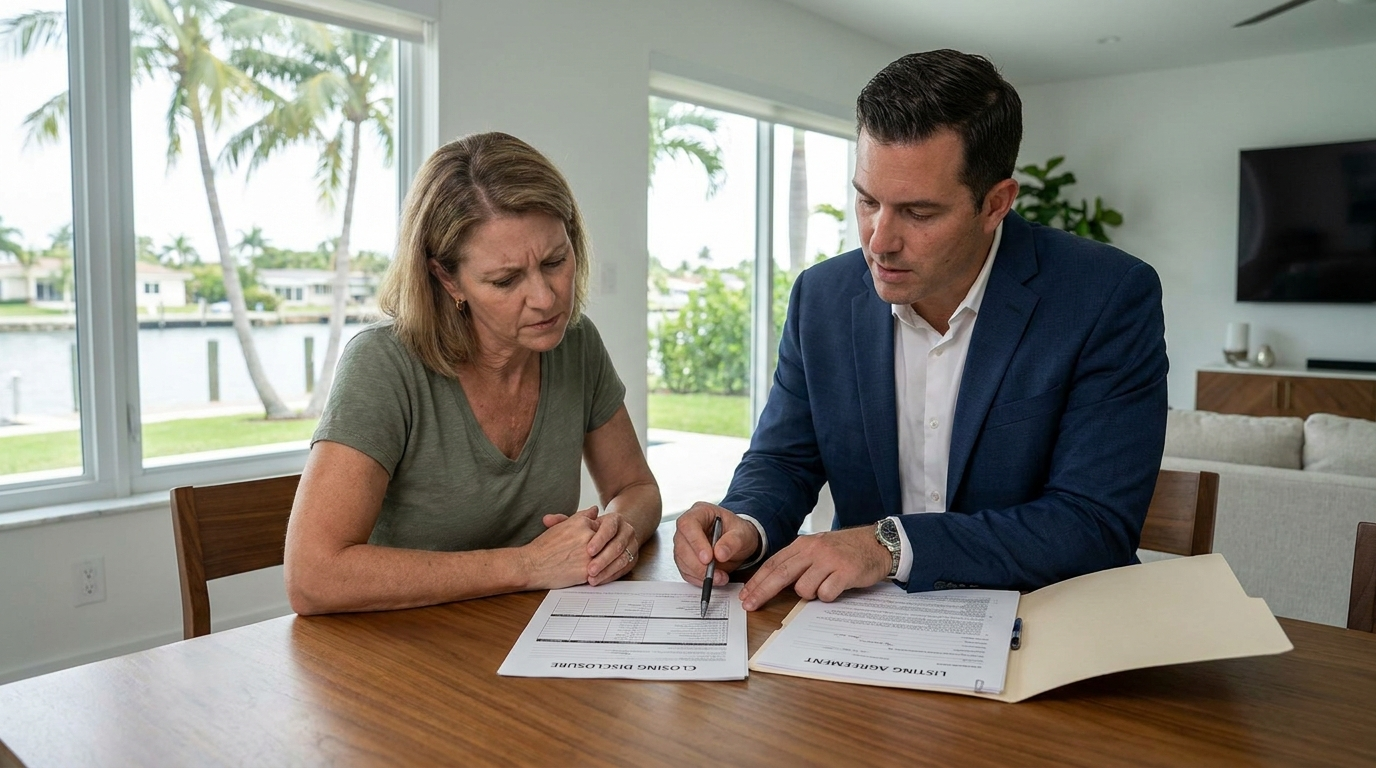
Florida charges documentary stamp taxes on all real estate transfers. The rate is $0.70 per $100 of the sale price, paid by the seller in most Florida counties. On a $500,000 sale, that comes to $3,500. In Miami-Dade County, the rate is $0.60 per $100 on the deed plus a surtax, which typically results in a similar total.
This is a cost many sellers forget to budget for until they see the closing disclosure.
Title insurance and closing fees
In most South Florida counties, the seller pays for the owner's title insurance policy. That is a Florida tradition, though it is negotiable. Title insurance premiums are regulated by the state and based on the sale price. On a $500,000 sale, expect $2,500 to $3,500 for the owner's policy. Add settlement fees, title search, and document preparation, and total title and closing costs for the seller typically run $3,500 to $5,500.
Pre-sale repairs and preparation
Most South Florida sellers spend $3,000 to $15,000 preparing their home for market, depending on its condition. Common pre-sale costs include:
- Deep cleaning and staging: $500 to $3,000
- Interior/exterior painting: $2,000 to $8,000
- Landscaping and curb appeal: $500 to $2,500
- HVAC service and minor repairs: $300 to $1,500
- Roof inspection and minor repairs: $500 to $3,000
Sellers who invest in preparation typically net more than the cost of those improvements. But it is still a real upfront expense before a single dollar comes in.
Prorated property taxes and HOA fees
At closing, sellers pay their prorated share of property taxes through the closing date. In Palm Beach and Broward counties, where tax bills can run $6,000 to $18,000 or more annually, a mid-year closing means the seller may credit the buyer $3,000 to $9,000 in prorated taxes. HOA fees, if applicable, are also prorated.
The full cost summary for a $500,000 South Florida sale
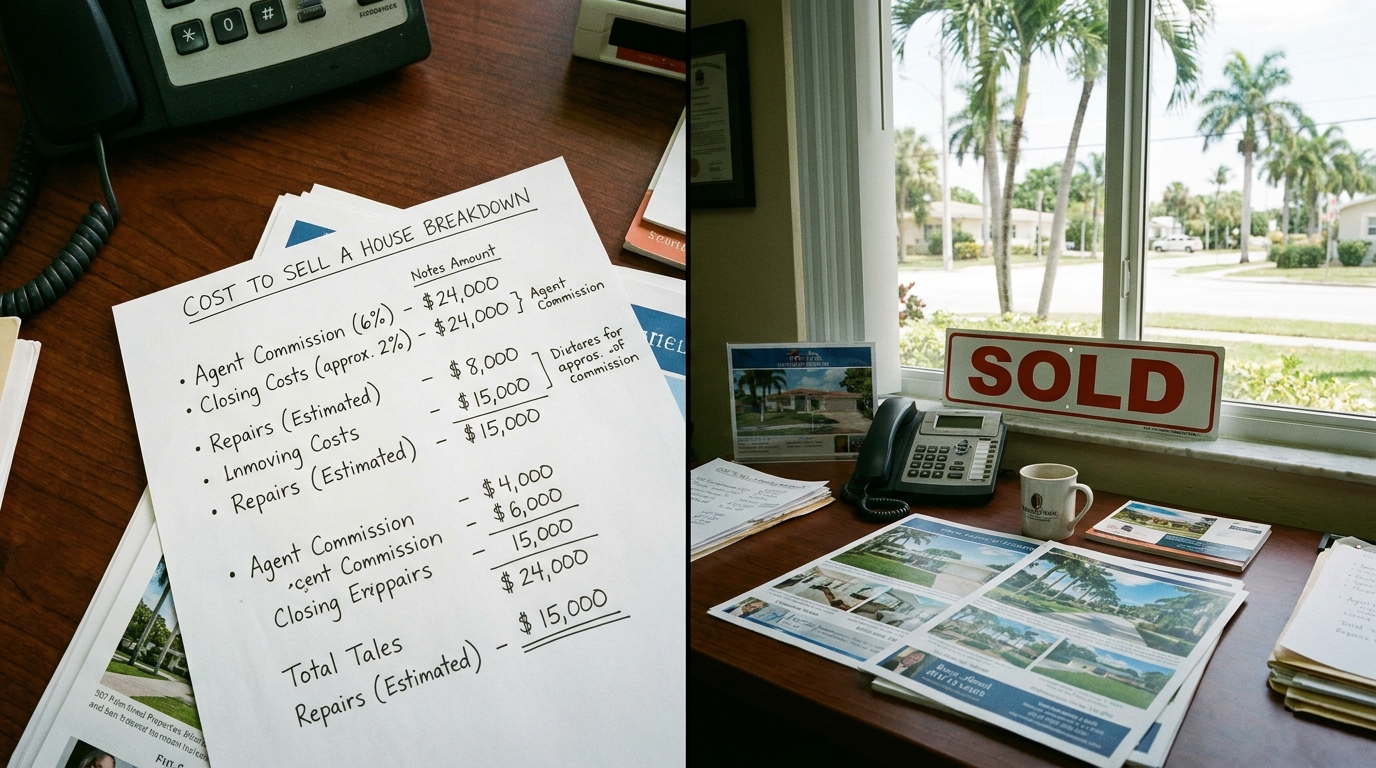
- Agent commissions (5%): $25,000
- Documentary stamp tax: $3,500
- Title insurance and closing fees: $4,500
- Pre-sale preparation: $6,000
- Prorated property taxes and HOA: $3,500
- Total estimated seller costs: approximately $42,500 (8.5%)
- Estimated net proceeds: approximately $457,500
These figures vary based on your specific property, negotiations, and timing. Our team provides a detailed net proceeds estimate before you list, so you know exactly what you will walk away with before you commit. Request a free seller analysis here or talk to an agent. For more on documentary stamp taxes, see the Florida Department of Revenue guide.
Ready to know your real number?
Get a personalized net proceeds estimate before you list. Our agents walk through every cost line by line so there are no surprises at closing. Start with a free seller analysis or contact us directly.
Frequently asked questions
What is the biggest cost when selling a house in South Florida?
Agent commissions are the largest single cost for most sellers, typically running 4 to 6 percent of the sale price. Documentary stamp taxes and title insurance are the next largest items.
Do sellers pay closing costs in Florida?
Yes. Florida sellers pay documentary stamp taxes on the deed, owner's title insurance in most counties, prorated property taxes, and their share of any settlement fees. Buyers cover their own closing costs separately.
Can I negotiate who pays for title insurance in Florida?
Yes. While the seller traditionally pays for the owner's title insurance policy in most Florida counties, this is negotiable. In some transactions, buyers cover it, particularly when they are bringing a lot to the table in other concessions.
How do pre-sale repairs affect my net proceeds?
Strategic repairs and preparation often generate more in sale price than they cost, but not always. An agent familiar with your local market can tell you which improvements buyers in your area actually value and which ones are unlikely to move the needle.
What happens to my mortgage at closing?
Your outstanding mortgage balance is paid off at closing from the sale proceeds before you receive anything. Make sure your lender provides a payoff statement close to your closing date, since interest accrues daily.
The money you spend before anyone makes an offer
Closing costs are deducted from proceeds, so they are painless in the sense that you never write a cheque. Pre market spending is different: it comes out of your pocket, weeks before any buyer exists, and it is the part sellers underestimate.
- Cleaning and decluttering. The highest return per dollar in the entire process, and largely your own time.
- Paint and small repairs. Visible defects get read as deferred maintenance across the whole house, which costs more than the repair.
- Landscaping. The first photograph and the first impression, and in Florida it can be neglected quickly.
- Photography. Not optional. Most buyers decide whether to visit from the images alone.
- Staging or partial staging. Worth it in an empty house, where bare rooms photograph poorly and show every flaw.
- Pre listing inspection. Optional, and it lets you handle problems on your timetable rather than under contract.
None of this is recovered if you decide not to sell, which is the argument for getting a realistic net figure before spending anything.
Build the net sheet before you commit
The only number that matters is what reaches your account. Work it in order: sale price, minus mortgage payoff, minus commission, minus documentary stamps, minus title work where you pay it, minus prorated taxes, minus association estoppel, minus agreed repair credits, minus payoff interest through the actual payoff date.
That last item catches people out. Your lender charges interest to the day the payoff is received, not the day you sign, so the figure on your statement is not the figure at closing.
Do this exercise before listing rather than at closing. It occasionally changes the decision entirely, particularly for anyone who bought recently and may have less equity than they assume once costs are counted.
Repair credits are a real cost that nobody budgets
Almost every transaction produces a post inspection negotiation, and whatever you concede reduces your proceeds exactly as a price reduction would.
Budget for it rather than being surprised. A credit is usually preferable to doing the work yourself under time pressure, because a buyer will typically accept a credit worth less than the repair would cost you to arrange in a hurry.
The costs of the sale not happening
Carrying costs run for as long as the house is on the market, and in slower parts of the region that is the largest hidden expense.
Average days on market currently runs about 107 in Palm Beach and St. Lucie, 109 in Martin, 119 in Indian River, 124 in Broward, 137 in Miami-Dade, 144 in Okeechobee and 206 in Highlands, and closing adds another month or more after an accepted offer.
So mortgage interest, taxes, insurance, utilities and maintenance continue throughout. On a home carrying $3,000 a month, three extra months of marketing is $9,000, which is frequently larger than the price reduction that would have avoided it. That is the real argument for pricing correctly on day one rather than testing a higher number.
Where sellers genuinely save money
Commission is negotiable and it is the largest single line, so it is the right conversation to have, in the open, before signing anything. Ask precisely what marketing and service is included at whatever rate is proposed.
Beyond that, the savings are in avoiding waste. Do not renovate a kitchen to sell. Do not test an aspirational price for a month and burn your best exposure. Do not skip photography to save a few hundred dollars on the thing that generates every showing. Those three decisions cost sellers more than any closing line item.
More common questions
What is the single largest cost?
Commission, by a wide margin, followed by documentary stamps on the deed. Everything else is comparatively small.
Do I pay anything if the house does not sell?
Your pre market spending is gone, and nearly every other cost is triggered by closing. That is why the net sheet belongs before the preparation.
Can I bring less to closing than I owe?
If the payoff exceeds the proceeds you must fund the difference, so check this early rather than at the closing table. It is the one scenario where selling requires money rather than producing it.


