

How to Ask for Highest and Best Offer in South Florida (Seller's Guide)
June 9, 2026 · 5 min read · By Onias Derilus, Broker
When multiple buyers compete for your South Florida home, asking for highest and best offers is the move that maximizes your sale price. Here's exactly how to do it, and the common mistakes that leave money on the table.
When your South Florida listing attracts multiple offers, knowing how to ask for highest and best from all buyers is typically the right move. It levels the playing field, applies competitive pressure, and often results in a higher final sale price than accepting the first strong offer. The process has to be handled correctly, though. Done poorly, you can accidentally reduce competition rather than intensify it.
What "highest and best" actually means
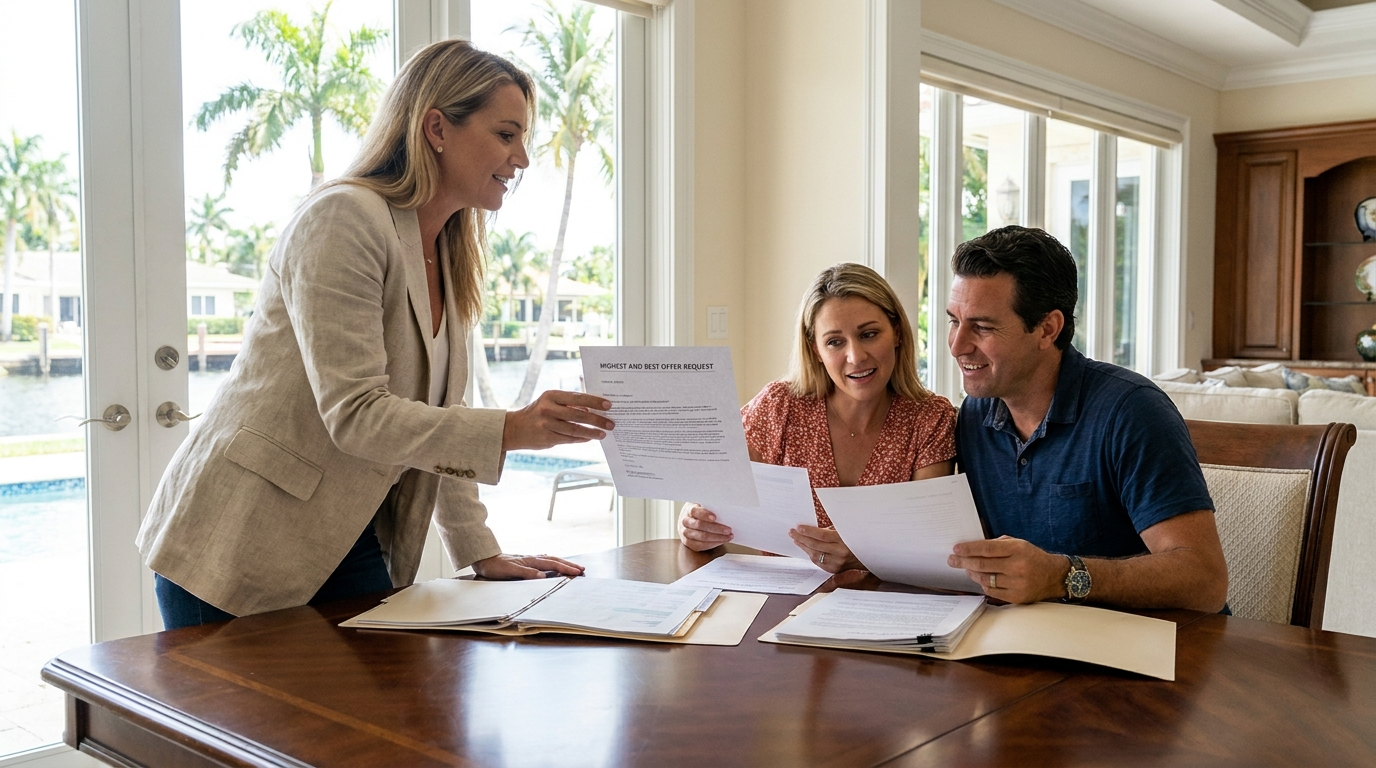
When a seller requests highest and best, they're asking all interested buyers to submit their strongest possible offer by a specific deadline: price, terms, and any modifications they want to make. The seller then reviews all offers simultaneously and selects the one that best meets their needs. That might be the highest price, the best terms, the strongest financing, the fastest closing, or some combination of all of these.
Requesting highest and best is not an auction. Buyers don't know what others are offering. They're making a blind best offer, knowing this is likely their last opportunity to compete.
When to request highest and best
The right time to call for highest and best is when you have genuine competition: multiple offers, or strong buyer interest suggesting more offers will arrive within 24 to 48 hours. Common triggers in South Florida:
- Two or more offers received within the first 48 to 72 hours of listing
- One offer received with clear signals that others are coming (multiple showing requests, active agent inquiries)
- A first offer that's good but below your target, and you believe enough competition exists to drive it higher
What you should not do: call for highest and best when you only have one buyer. Buyers usually know when they're the only party at the table. If you request highest and best with one offer and that buyer walks, you've lost your only lead.
How to word the highest and best request
Your agent communicates the request to all buyer's agents whose clients have submitted or expressed interest. A clear, professional request covers four things:
- The deadline: a specific date and time (typically 24 to 48 hours from the request, often 5 pm or 8 pm to give buyers time to consult their agents)
- What to include: offer price, all terms, proof of funds or pre-approval letter, and any escalation clause parameters if you're accepting them
- A statement that you will review all offers after the deadline and make a decision, with no further rounds of negotiation
- Confirmation that all parties will be notified once a selection is made
The language should be firm and clear. A vague or casual request signals that you're not serious, which reduces buyer urgency.
Evaluating highest and best offers: price isn't everything
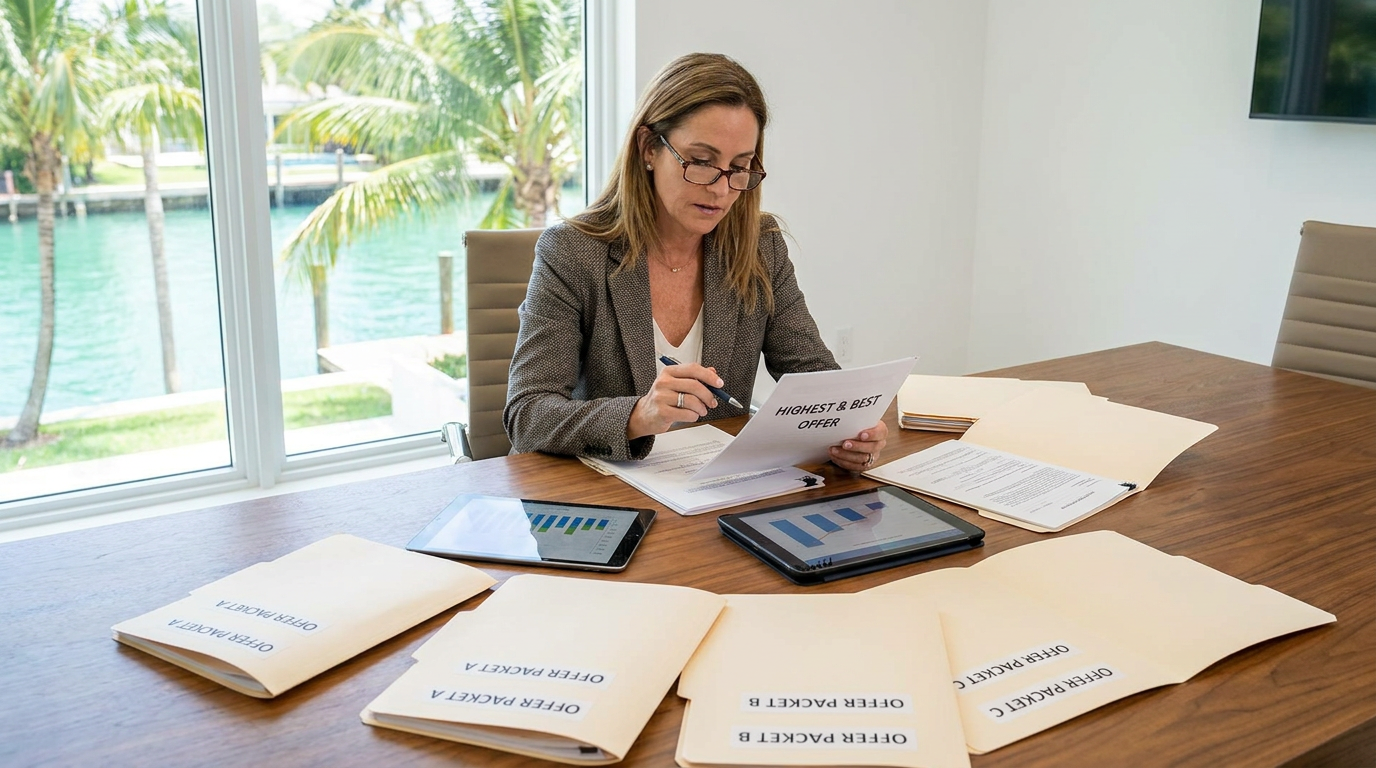
When the offers come in, resist the temptation to automatically accept the highest price. In South Florida's market, several other factors often matter just as much:
- Financing strength: Cash offers are more certain than financed ones. A financed offer $10,000 higher than a cash offer may net you less if the financing falls through and you lose two weeks of marketing time.
- Contingencies: Fewer contingencies (or shorter contingency periods) reduce your risk. A buyer waiving the inspection contingency on a well-maintained property is real value, not just a number on a page.
- Closing timeline: Your ideal closing date matters. A buyer who can close in 21 days may be worth more to you than one who needs 45.
- Earnest money: A larger deposit signals buyer commitment and gives you protection if the buyer defaults.
What to do after highest and best
Once you've selected an offer, execute the contract promptly and notify all other buyers that the property is under contract. Speed matters. Your selected buyer should be in contract within hours of your decision, not days. Delays after a highest and best selection give buyers time to second-guess and walk away.
Handling a multiple-offer situation correctly takes experience and strategy. Our listing agents have worked through dozens of competitive South Florida situations and know how to run this process in a way that maximizes what sellers walk away with. Request a listing consultation here or reach out to our team to discuss your specific situation.
Selling in South Florida? Pure Equity works with sellers across Palm Beach, Broward, and Miami-Dade counties. We price competitively, market aggressively, and know how to run a multiple-offer process to get you the best possible outcome. Start with a free home valuation or contact us directly.
Frequently asked questions
Do I have to accept the highest offer after a highest and best request?
No. As the seller, you can accept any offer or reject all of them. The highest and best process is a request for buyers to submit their strongest offers. The final decision is yours, and you can weigh price against terms, financing, and timeline however you choose.
Can I negotiate after receiving highest and best offers?
Technically, yes. Practically, it's risky. If you told buyers this was their final opportunity and then come back to negotiate, you can lose credibility and buyers may walk. It's better to set the right expectations upfront. If you plan to counter, don't frame the request as a final round.
How much time should I give buyers to respond?
Most agents recommend 24 to 48 hours. Less than 24 hours can feel arbitrary and may cause buyers to disengage. More than 48 hours lets urgency fade. A Monday evening deadline for offers received Friday morning is a common approach in South Florida.
What if only one buyer submits in the highest and best round?
You can still accept, counter, or reject that offer. If other buyers declined to improve their offers, that tells you something about where the market sees the property's value. A good agent will help you decide whether to accept what's on the table or return the property to active status.
Is a highest and best request legally binding?
No. Neither the seller nor the buyers are bound by the process itself. Buyers submit offers voluntarily. The seller is only bound once both parties sign a contract. The highest and best request is simply a structured method for gathering competitive offers.
Running one has a cost, and sellers rarely price it
The request is usually presented as free upside. It is not, and understanding the downside is what stops sellers calling for it when they should not.
Some buyers will not participate. A buyer who has already offered near their limit may read the request as a signal they are being used to bid against themselves, and withdraw rather than raise. That is a genuine risk when you have two offers, because losing one leaves you negotiating against a single buyer who now knows the other is gone.
The request also pauses momentum. Everything stops while you wait, and if the round produces nothing better you have lost days and revealed that you were hoping for more.
So the honest test is whether you have enough genuine competition that losing one participant does not matter. With four offers, run it. With two, negotiate directly instead.
Evaluate on certainty, not on the top number
The highest price is not the best offer, and in Florida several terms matter more than a modest price difference.
- Financing strength. A full underwritten approval is very different from a pre qualification. Ask which you are looking at.
- Inspection period length. A shorter period is less time for a buyer to change their mind, and in this state it also compresses their insurance investigation.
- Appraisal terms. Whether the buyer will cover a shortfall matters enormously if your accepted price is at the top of the comparable set.
- Deposit size and whether any of it goes hard. Money at risk is the clearest evidence of commitment.
- Closing date flexibility. Frequently worth real money if you are coordinating a purchase of your own.
A cash offer slightly below the top, with a short inspection period and a substantial deposit, is often the better outcome than a financed offer at a higher number with a long inspection period and a thin deposit.
Be straight about what you are doing
How the request is communicated affects both the response and your credibility.
Tell every buyer the same thing at the same time: that multiple offers have been received, that all parties are invited to submit their best terms by a stated deadline, and what you will be weighing. Give a deadline that is short enough to maintain urgency and long enough for a buyer to consult their lender, which usually means a day or two rather than hours.
Say plainly whether you will negotiate afterwards or accept as submitted. Buyers behave differently depending on the answer, and telling them one thing and doing another damages the transaction you are trying to protect.
What you owe, and what you do not
You are not obliged to accept the highest offer, or any offer. You may accept, counter, or continue negotiating, unless you have said otherwise.
Two cautions. If you told buyers this was a final round and then reopen negotiations, expect participants to disengage, since you have shown the process was not what you described. And be consistent in how you treat every buyer, both because it produces better outcomes and because fair housing obligations apply to how offers are handled.
If the round underperforms
Sometimes buyers hold their positions or one withdraws. That is information rather than a failure.
It generally means the property is priced at or above what this buyer pool will pay, which is worth knowing now rather than after four more weeks. Go back to the strongest terms on the table and negotiate directly rather than treating the round as a lost cause.
More common questions
How long should buyers get?
Long enough to speak to their lender, generally a day or two. Too short excludes financed buyers, too long dissipates urgency.
Can I negotiate after the round?
Generally yes unless you said otherwise. Saying it was final and then reopening costs you credibility with the buyers you still need.
What if only one buyer responds?
Negotiate with them directly. It tells you the competition was thinner than it appeared, which is useful before you set expectations further.


