

How to Buy Your First Home in South Florida: A Step-by-Step Guide
June 9, 2026 · 9 min read · By Onias Derilus, Broker
Buying your first home in South Florida is one of the most significant financial decisions you'll make. Here's a clear, honest walkthrough of every step from pre-approval to closing.
Buying your first home in South Florida is exciting and genuinely complex. Done right, it is one of the most powerful wealth-building decisions you will ever make. The process has more steps, more stakeholders, and more potential pitfalls than most first-time buyers expect. This guide walks you through every stage of how to buy your first home in Palm Beach, Broward, or Miami-Dade county, from the first financial check to the moment you receive your keys.
Step 1: Check your financial position
Before you look at a single listing, do an honest financial assessment. Lenders will evaluate three things: your credit score, your debt-to-income ratio (DTI), and your assets. A minimum credit score of 620 is typically needed for conventional loans. FHA loans allow as low as 580 (with 3.5% down) or 500 (with 10% down). Your DTI, meaning all monthly debt payments divided by gross monthly income, should generally be below 43 to 45 percent.
Know what you can afford before you start looking. A pre-approval (not just a pre-qualification) from a lender gives you a specific purchase price ceiling based on actual documentation review. In South Florida's competitive market, you need a pre-approval letter before making any offer. Sellers will not take you seriously without one.
Step 2: Choose your down payment strategy
South Florida first-time buyers have several down payment options:
- Conventional loan: 5 to 20 percent down. With 20 percent you eliminate private mortgage insurance (PMI). With less, PMI adds to your monthly cost.
- FHA loan: 3.5 percent down with a 580 or higher credit score. Best for buyers with limited savings and strong income. FHA loans on condos require the building to be FHA-approved.
- VA loan: Zero down for eligible veterans and active duty. No PMI. One of the best financial products available if you qualify.
- USDA loan: Zero down in eligible rural areas of South Florida, primarily in Highlands, Martin, and St. Lucie counties.
- Down payment assistance programs: Florida Housing Finance Corporation offers several DPA programs for first-time buyers. Palm Beach, Broward, and Miami-Dade counties also have local programs worth exploring.
Step 3: Find the right agent
As a buyer in Florida, you do not pay your agent's commission. The seller typically covers it, which means you have access to professional representation at no direct cost to you. Use it. A good buyer's agent in South Florida will help you identify neighborhoods that match your criteria, alert you to listings before they go public, guide you through the offer and negotiation process, and represent your interests through inspection, appraisal, and closing.
Interview at least two agents. Ask about their experience with first-time buyers, their communication style, and their specific knowledge of the neighborhoods you are targeting.
Step 4: Search, make offers, and negotiate
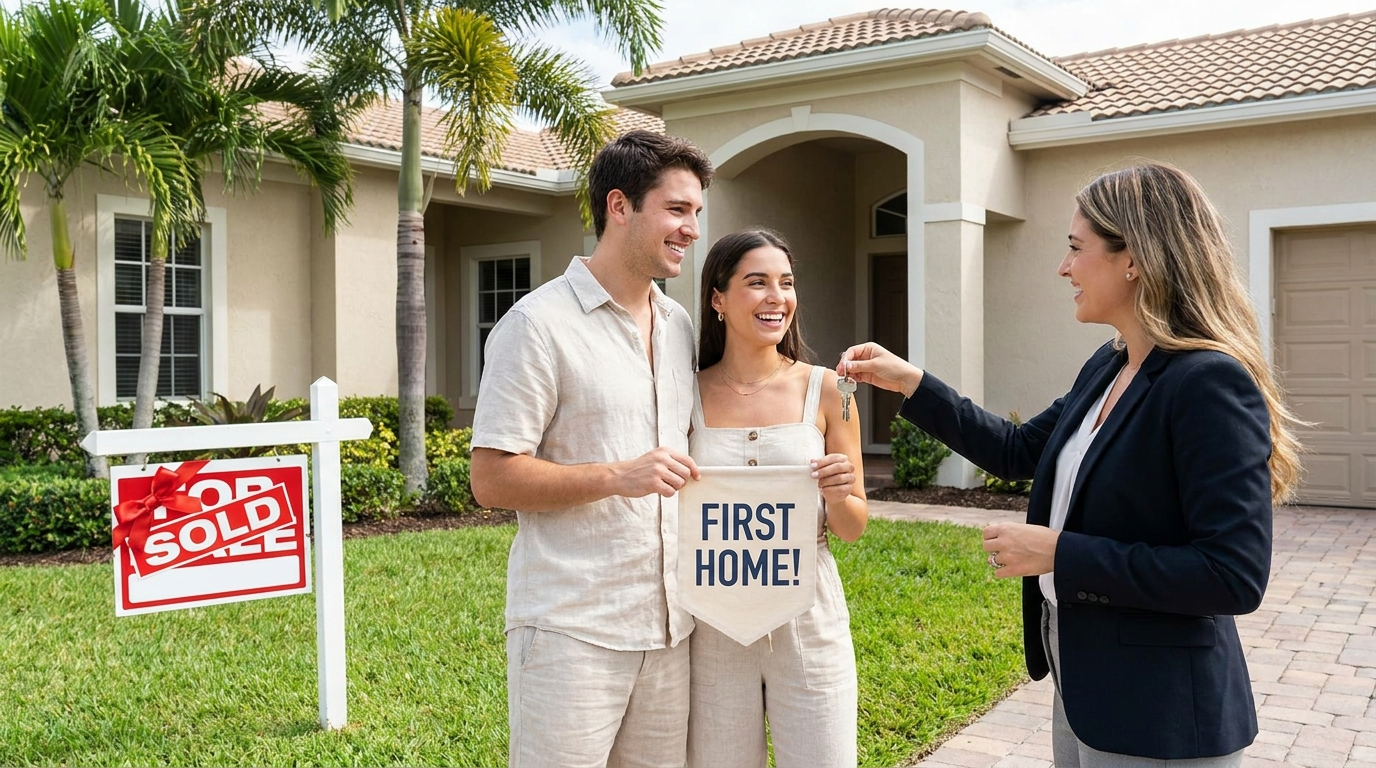
With your pre-approval letter in hand and an agent by your side, start your search. In South Florida's current market, properties that are well-priced and in good condition still move quickly. Be prepared to act within 24 to 48 hours on homes you want. Your agent will help you craft a competitive offer, not just on price but on terms like earnest money deposit, contingencies, and closing timeline.
Do not skip the earnest money discussion with your agent. Understanding your deposit and contingency structure matters before you sign anything.
Step 5: Inspection, appraisal, and due diligence
After your offer is accepted, the clock starts on your due diligence period. In South Florida, this typically includes:
- General home inspection: 2 to 4 hours, $300 to $600. Essential regardless of the home's age or apparent condition.
- Wind mitigation inspection: required for insurance discounts. Evaluates your roof straps, windows, and construction for hurricane resistance.
- 4-Point inspection: required by most Florida insurance companies for homes 25 or more years old. Covers roof, electrical, plumbing, and HVAC.
- Appraisal: ordered by your lender to confirm the property value supports your loan amount.
Step 6: Clear to close and closing day
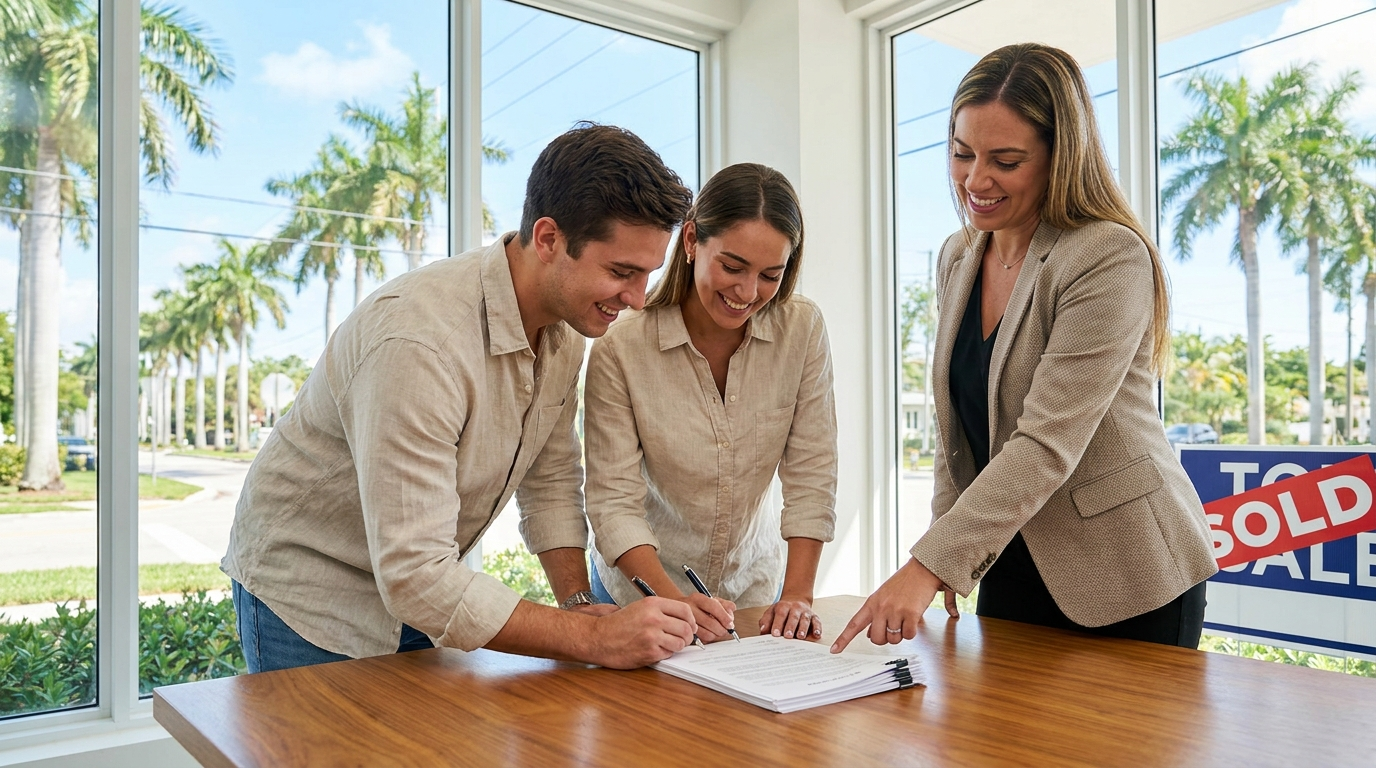
Once your loan is approved, inspections are resolved, and title is clear, you will receive a "clear to close" from your lender. Your closing disclosure will outline every cost: loan fees, title costs, prepaid items, and property tax prorations. Review it carefully. On closing day, you will sign approximately 100 pages of documents and wire your closing funds. Verify the wire instructions directly with your title company before sending anything. Wire fraud is a real risk and it is not recoverable. After that, you walk out with your keys.
Ready to start your first home search in South Florida? Talk to our team at Pure Equity. We specialize in guiding first-time buyers through this process across Palm Beach, Broward, Miami-Dade, and our full six-county service area.
Ready to buy your first home in South Florida?
Our agents work with first-time buyers across Palm Beach, Broward, and Miami-Dade counties. Contact us to get started or use our mortgage calculators to run the numbers before your first lender call.
Frequently asked questions
How much money do I need to buy my first home in South Florida?
Plan on at least 3.5 percent of the purchase price for an FHA loan down payment, plus 2 to 5 percent of the loan amount in closing costs. On a $400,000 home, that puts your out-of-pocket figure around $22,000 to $34,000 before any assistance programs. Down payment assistance through Florida Housing or county programs can reduce that significantly for eligible buyers.
How long does the home buying process take?
From the time you start seriously searching to closing, most first-time buyers take two to four months. The search itself varies depending on the market and how quickly you can make decisions. Once you are under contract, closing typically takes 30 to 45 days for financed purchases.
Do I need a real estate agent to buy a home in Florida?
You are not legally required to use one, but there is almost no reason not to. The seller pays the buyer's agent commission in most transactions. You get professional representation, negotiation help, access to MLS data, and guidance through paperwork at no cost to you.
What credit score do I need to buy a home?
Most conventional lenders want 620 or higher. FHA loans go down to 580 with a 3.5 percent down payment, or 500 with 10 percent down. VA loans have no official minimum, though lenders typically set their own floor around 580 to 620. A higher score gives you better interest rates, which adds up to real money over a 30-year loan.
Is South Florida a good place to buy a first home?
South Florida has strong long-term appreciation history, a diverse economy, and no state income tax. The trade-offs are real: property insurance costs have risen sharply in recent years, HOA fees are common, and inventory in desirable areas can move fast. Going in with accurate expectations and a lender pre-approval puts you in a much better position than most first-time buyers.
You are negotiating more than the price
First time buyers arrive thinking the negotiation is a number. Experienced buyers know it is a package, and several of the other terms are worth more than a small price movement.
- Closing date. Frequently worth real money to a seller who is coordinating a purchase of their own, and it costs you nothing if your timing is flexible.
- Inspection period length. A shorter one strengthens your offer and gives you less time, so ask for what you actually need rather than the maximum.
- Deposit size. A larger deposit signals commitment without raising the price. Understand what it puts at risk before you use it as leverage.
- What conveys. Appliances, window coverings, mounted televisions and outdoor furniture are all negotiable and are frequently given away because nobody asked.
- Closing costs. A seller contribution can help more than a price reduction for a buyer who is short on cash rather than on payment capacity.
- Repairs versus credit. A credit at closing is usually cleaner than a seller repair, because you control who does the work and to what standard.
Work out which of these matter to you before you write, so you are trading deliberately rather than conceding under time pressure.
Read the seller's position before you write
How much room you have is knowable, and it is mostly in the listing history rather than in anything anyone says.
Days on market is the first signal. A property that has sat well past what is normal for its area has a seller who has already been disappointed, which is a very different negotiation from a new listing with several showings booked. Ask your agent what normal looks like for that specific community, since the figure varies enormously between them.
Price reductions are the second. A listing that has been reduced once or twice is telling you the original price was wrong and that the seller now knows it.
Then ask why they are selling and when they need to be out. You will not always get an honest answer and you will often get a useful one. A seller who has already bought elsewhere is carrying two properties, and that is worth more to you than any argument about comparable sales.
What to do when you lose one
Most first time buyers lose at least one property, and how you handle it determines how long the search takes.
Ask what it sold for and on what terms. That is the most valuable feedback available, and it tells you whether you were beaten on price, on certainty, or on something you could have offered without spending more.
Do not respond by raising your ceiling. The most common error after a loss is stretching, and a buyer who overpays out of frustration lives with that decision for years. If you were beaten on terms rather than price, fix the terms.
And ask your agent to keep an eye on it. Deals fall apart regularly, most often on financing, insurance or inspection, and a buyer who is ready when that happens frequently gets the property at their original number.
Treat the contract as a calendar
Once you are under contract, most of what can go wrong is procedural, and it is all avoidable with one habit.
Take every date out of the contract and put it in one place: inspection period end, financing deadline, any association document review period, the appraisal, the walkthrough and closing. Each of those is an obligation with a consequence rather than a suggestion.
Contingencies expire on their dates. If you let an inspection period lapse without terminating or extending in writing, that protection is gone even if you were still investigating. Deliver every notice in the form and by the method the contract requires, and get any extension in writing rather than by agreement in conversation.
Then front load the work. Order the inspection immediately rather than in the last few days, and start the insurance and association questions in the first week, because those are the ones with the longest lead time and the ones most likely to change your decision.
More common questions
What else can I negotiate besides price?
Closing date, inspection length, deposit size, what conveys, a closing cost contribution, and repairs versus a credit. Several are worth more than a small price movement.
How do I tell if a seller will negotiate?
Days on market compared with what is normal for that community, and the price reduction history. Both are in the listing record.
What should I do after losing a bidding situation?
Find out what it sold for and on what terms, fix the terms rather than raising your ceiling, and ask your agent to watch it in case the deal falls through.


