

Loans for Rental Property: Financing Options for South Florida Investors
June 9, 2026 · 8 min read · By Onias Derilus, Broker
Financing a rental property in South Florida is different from getting a home mortgage. Here are the best loan options for investors, and how to choose the right one for your strategy.
Financing a rental property in South Florida works differently than financing a primary home. Lenders treat investment properties as higher risk, so they apply stricter qualifying standards, require larger down payments, and offer different loan products altogether. Knowing your options for loans for rental property is the foundation of building a portfolio that pencils out. Below is a plain breakdown of the financing landscape for South Florida investors in 2026.
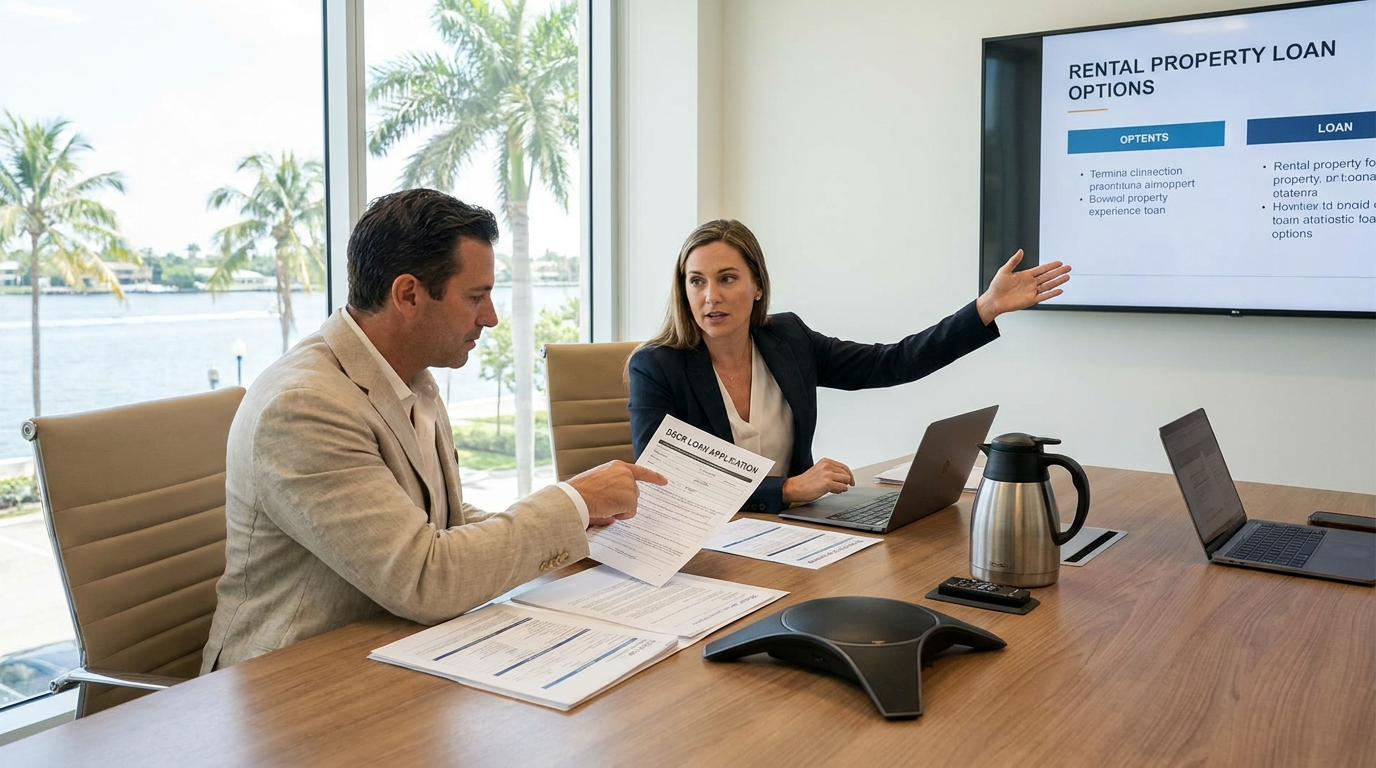
Conventional investment property loans
Conventional loans backed by Fannie Mae or Freddie Mac are the most straightforward option for investors with strong credit and documented W-2 income. The main terms to know:
- Down payment: minimum 15% to 20% for single-family rentals; 25% for 2-to-4 unit properties
- Credit score: minimum 620, though better rates come at 740 or above
- Rate premium: investment property rates typically run 0.5% to 0.875% above primary residence rates
- Rental income treatment: lenders will credit 75% of market rent toward your debt-to-income ratio
- Property cap: Fannie/Freddie conventional loans top out at 10 financed properties per borrower
For most South Florida investors purchasing their first one to four investment properties, conventional financing is a reasonable starting point, assuming the W-2 income and debt profile support it.
DSCR loans (Debt Service Coverage Ratio)
DSCR loans are built specifically for real estate investors and have grown into one of the most used rental property financing tools in South Florida. The key difference from conventional: the loan qualifies on the property's income, not the borrower's personal income.
The DSCR ratio is calculated as Gross Rental Income divided by Monthly Debt Service (PITI). A ratio of 1.0 means the rent exactly covers the mortgage payment. Most lenders require a minimum ratio between 1.0 and 1.25.
Typical DSCR loan terms:
- Down payment: 20% to 25% is standard
- Interest rates: higher than conventional, running roughly 7.5% to 9% in the current market
- Income documentation: no W-2s, tax returns, or DTI calculations required
- Best fit: self-employed investors, high earners with complex tax returns, or anyone who has reached the 10-property cap on conventional financing
Portfolio loans
Portfolio lenders (community banks, credit unions, and some private lenders) keep their loans on their own books rather than selling them to Fannie or Freddie. That gives them room to write loan terms that fall outside conventional guidelines.
Portfolio loans come up when a property does not conform to standard requirements, such as an unusual structure, older condition, or rural location, or when the borrower's situation falls outside what conventional underwriting accepts. South Florida has several community banks with active portfolio rental programs. Terms vary considerably from lender to lender, and the relationship with the bank matters more than it does in the secondary market.
Hard money and bridge loans
Hard money loans are short-term, asset-based products from private lenders. They close fast, often in 5 to 10 days, require minimal documentation, and underwrite primarily on property value rather than borrower income. The trade-off is cost: rates of 10% to 14% plus one to three origination points are typical.
Hard money is the tool for BRRRR investors, fix-and-flip operators, or anyone buying at foreclosure auction where conventional financing is not available. Once the property is stabilized and leased, the hard money loan gets refinanced into a conventional or DSCR long-term product.
Choosing the right loan for your strategy
The right loan depends on your income profile, property type, and how far along you are in building your portfolio:
- Strong W-2 income, buying your first one to three properties: conventional investment loan
- Self-employed or complex income, buying for long-term hold: DSCR loan
- Buying a distressed property to rehab: hard money or bridge loan, then refinance into DSCR
- Non-conforming property or situation that falls outside Fannie/Freddie guidelines: portfolio lender
- Scaling past 10 properties: DSCR, portfolio, or commercial loans
Use our Rental ROI Calculator to model cash flow under different financing scenarios. To get lender referrals we trust in the South Florida market, reach out to our team directly.
Ready to run the numbers on a rental property?
Our Rental ROI Calculator and DSCR Loan Calculator can help you stress-test any deal before you talk to a lender. When you're ready to move, contact our team for lender referrals and current inventory across South Florida.
Frequently asked questions
What credit score do I need for a rental property loan?
For conventional investment loans, the minimum is 620. Rates improve meaningfully at 740 and above. DSCR lenders vary, but most want at least a 660 to 680 credit score. Hard money lenders often have no minimum because they underwrite primarily on the asset.
How much do I need down for a rental property?
Single-family rentals financed conventionally require at least 15% down, though 20% gets you better terms. Two-to-four unit properties require 25%. DSCR loans typically require 20% to 25% down regardless of unit count.
Can I use rental income to qualify for the loan?
With a conventional loan, lenders will count 75% of projected or actual market rent toward your debt-to-income calculation. With a DSCR loan, the rental income is the primary qualifying factor and your personal income is not used at all.
What is a DSCR loan and how does it work?
A DSCR loan qualifies you based on the property's cash flow rather than your personal income. The lender calculates your debt service coverage ratio by dividing the gross monthly rent by the total monthly mortgage payment (principal, interest, taxes, and insurance). A ratio at or above 1.0 to 1.25 generally meets the threshold. No W-2s or tax returns are required.
What interest rate should I expect on a rental property loan in 2026?
In the current market, conventional investment property loans run roughly 0.5% to 0.875% above primary residence rates. DSCR loans are typically in the 7.5% to 9% range depending on the lender, property type, and your credit profile. Hard money loans run 10% to 14% plus points, but are short-term by design.
How many rental properties can I finance with conventional loans?
Fannie Mae and Freddie Mac allow up to 10 financed properties per borrower. Once you reach that cap, DSCR loans, portfolio loans, and commercial financing become the paths forward.
The lender is underwriting the property, not only you
Most guidance on investment lending covers borrower qualification and stops there. In Florida a large share of these loans fail on the property rather than on the borrower, and usually late.
Insurability. The lender requires coverage. If the property cannot be insured, or the premium is high enough to break the numbers, the loan does not close regardless of how strong you are. On an income property this bites twice, because the premium is also an operating expense that reduces the coverage ratio the lender is calculating.
The association, on a condominium or townhouse. Lenders assess the building as well as the unit: reserve levels, the proportion of units rented, litigation, delinquency and any structural inspection findings. A building that fails those tests is difficult to finance for you and equally difficult for whoever buys it from you.
Condition. An appraisal that flags required repairs can make a property ineligible for the loan you applied for, which on an investment purchase frequently means renegotiating or walking.
Ask about all three in the first week rather than the last. An insurance quote and a set of association documents cost you a few days and they are the two things most likely to end the transaction.
Qualifying and closing are separate hurdles
Investors are often surprised that an approval is not the finish line, because an income property brings conditions a primary residence does not.
The appraisal may include a rent schedule, and if the appraiser's market rent comes in below your assumption, the debt coverage the lender calculates changes with it. Ask early what rent figure the lender will use and where it comes from.
Reserve requirements are common on investment loans, meaning cash held after closing rather than spent on it. Ask how many months, and whether the requirement rises with the number of financed properties you already hold.
Cash out refinancing usually carries a seasoning requirement, so the value you created through renovation may not be available immediately. If your plan depends on recycling capital quickly, that timing is the whole plan and it belongs in the first conversation with the lender rather than the last.
Ask the questions that actually differ between lenders
Rates move and vary, so comparing them alone tells you little. These are the terms that decide whether a lender fits your strategy.
- Prepayment penalties. Common on investment products and a serious constraint if you intend to refinance or sell within a few years.
- Whether they lend to an entity, and on what terms, if you hold property in a company.
- How many financed properties they allow, and what changes as you add more.
- Whether they will lend on the property type you are targeting, since appetite differs sharply between a house, a small multi family building and a condominium.
- How they treat existing rental income, and what documentation they need for it.
- Whether the loan is kept or sold, which affects flexibility when something unusual arises.
Ask those six of any lender before discussing price. They will separate the lenders who can do your deal from the ones who cannot far faster than a rate sheet.
Build the relationship before you need it
The investors who move quickly are not the ones who shop hardest on each deal. They are the ones who set up their financing before they had a property in mind.
Talk to a lender before you are under contract, so you know your ceiling, your terms and your conditions in advance. Then a good property becomes a decision rather than a scramble, and you can make an offer with a short financing period because you already know it will clear.
Keep more than one relationship. Different lenders suit different deals, and a portfolio lender who will consider a property a conventional programme rejects is worth knowing before the day you need one.
And keep your documentation current. Investors who can produce tax returns, statements, a schedule of properties and a personal financial statement within a day close faster and negotiate from a stronger position than those who assemble it over three weeks.
More common questions
What kills investment loans in Florida most often?
Insurance and, on attached housing, the association's finances. Both are property questions rather than borrower questions and both surface late if you let them.
Is an approval enough to make an offer confidently?
Only if the property side is also checked. Ask about the appraisal rent schedule, reserve requirements and any seasoning rule before you rely on the timeline.
What should I ask a lender first?
Prepayment penalties, entity lending, property count limits, eligible property types, and how they treat existing rental income. Those decide fit; the rate decides price.


