

What Does NNN Mean in Real Estate? A South Florida Guide to Triple Net Leases
June 9, 2026 · 7 min read · By Onias Derilus, Broker
NNN stands for triple net, a lease structure where the tenant pays property taxes, insurance, and maintenance costs in addition to rent. Here's how NNN leases work and why investors love them.
If you've explored commercial real estate investing in South Florida or seen listings for restaurants, retail stores, and office buildings, you've almost certainly come across NNN, also called a triple net lease. It's one of the most common lease structures in commercial real estate. Understanding what NNN means is essential for any investor evaluating commercial property opportunities across Palm Beach, Broward, and Miami-Dade counties.

What NNN (triple net) actually means
In a standard gross lease, the landlord pays most operating expenses (property taxes, insurance, maintenance) and the tenant pays a flat rent. In a triple net (NNN) lease, the tenant pays those three costs on top of base rent. The "three nets" are:
- Property taxes: The tenant is responsible for paying the property's real estate taxes.
- Property insurance: The tenant pays for building insurance. The landlord may retain specific coverage depending on the lease.
- Maintenance and repairs: The tenant handles routine maintenance, repairs, and often capital expenditures for the building.
The result: the landlord receives a relatively clean check each month with most operating expenses shifted to the tenant. This is why NNN leases are sometimes called "mailbox money" investments. The management burden on the landlord drops significantly.
Types of net leases: N, NN, and NNN
Net leases come in several forms, and the distinctions matter when you're evaluating a deal:
- Single net (N): Tenant pays property taxes. Landlord pays insurance and maintenance.
- Double net (NN): Tenant pays taxes and insurance. Landlord keeps responsibility for structural repairs.
- Triple net (NNN): Tenant pays taxes, insurance, and maintenance. The landlord's exposure is generally limited to structural or capital items, depending on specific lease language.
- Absolute NNN: The most landlord-favorable structure available. The tenant is responsible for all costs including structural repairs, roof replacement, and HVAC. This structure is common with national credit tenants like fast food chains and pharmacies.
NNN properties as investments in South Florida
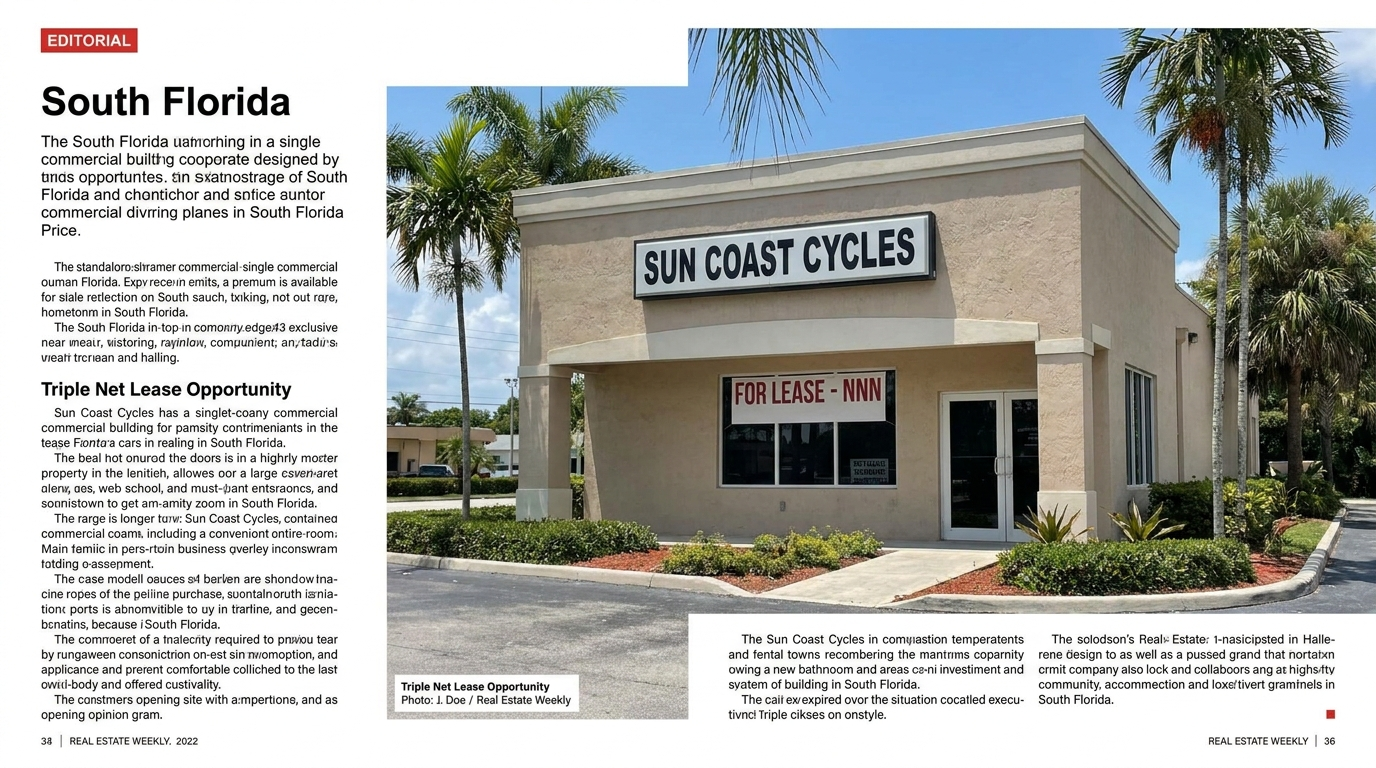
South Florida has an active NNN investment market. Standalone retail buildings occupied by national tenants (pharmacies, fast food, convenience stores, dollar stores) are particularly common, and they attract investors for a few clear reasons.
- Passive income: With a credit tenant on a long-term lease, management demands are minimal.
- Predictable cash flow: Multi-year leases with rent escalations give investors clear income visibility.
- Credit tenant security: A McDonald's or Walgreens on a 15-year NNN lease carries a very different risk profile than a local restaurant.
There are real tradeoffs. NNN properties in South Florida typically trade at cap rates of 4 to 6 percent for credit tenants. They're priced for stability, not yield. As interest rates have risen, some NNN investors have ended up in negative leverage situations where the cap rate falls below the cost of financing.
What to watch out for
Not all NNN leases are created equal. Here are the issues that matter most when evaluating a specific deal:
- Tenant credit quality: A strong lease with a weak tenant is a problem waiting to happen. Know who is on the other side of your lease and what their financial picture looks like.
- Lease expiration and renewal options: A property with three years left on the lease and no renewal options carries real re-leasing risk that should be priced into what you pay.
- The actual lease language around "net": The allocation of expenses is defined by the specific lease document, not the label. Always have an attorney review it rather than assuming "NNN" means a standard structure.
- Building condition and capital needs: Even with a solid NNN lease, roof replacements and major structural work can eventually revert to the landlord. Factor deferred capital needs into your underwriting.
Interested in commercial real estate investment in South Florida? Our team works with both residential and commercial investors across all eight counties. Contact Pure Equity to discuss your commercial investment strategy or to request analysis on specific NNN opportunities in your target market.
Ready to invest in South Florida commercial real estate?
Whether you're evaluating your first NNN property or adding to an existing portfolio, our team can help you analyze deals and identify opportunities. Get in touch or browse our commercial land listings to see what's available across South Florida.
Frequently asked questions
Is a NNN lease good for landlords?
Generally yes, especially when the tenant is a creditworthy national brand on a long-term lease. The landlord collects rent with minimal management responsibility. The downside is that NNN properties tend to trade at lower cap rates, so you give up some yield in exchange for that simplicity.
Who pays property taxes in a NNN lease?
The tenant pays property taxes directly, along with property insurance and most maintenance costs. This is the core feature that distinguishes a triple net lease from a gross lease.
What is the difference between NNN and gross lease?
In a gross lease, the landlord bundles operating expenses into the rent and handles taxes, insurance, and maintenance. In a NNN lease, the tenant pays those expenses separately. The base rent on a NNN property is lower, but the tenant's total occupancy cost ends up similar to a gross lease once you add the operating expenses back in.
What does "absolute NNN" mean?
An absolute NNN lease goes further than a standard triple net. The tenant is responsible for all costs with no exceptions, including structural repairs, roof replacement, and parking lot maintenance. National credit tenants often agree to absolute NNN terms in exchange for favorable base rent rates.
Are NNN properties a good investment in South Florida?
They can be, but the market is competitive. Cap rates for credit-tenant NNN properties in South Florida typically run in the 4 to 6 percent range, which leaves little margin for error if you're financing the purchase. They work best for investors who prioritize income stability over maximum return. Rising interest rates have compressed returns further, so underwriting needs to be careful right now.
See it as a spectrum rather than four labels
The letters describe positions on one continuous question: how much of the building's operating cost sits with the tenant. Once you see it that way the terminology stops being confusing.
At one end, a gross or full service lease means the tenant pays rent and the landlord pays operating costs out of it. At the other, an absolute net lease means the tenant pays rent plus essentially everything, including structure and roof.
Between them sit the graduated forms. A single net lease adds property taxes to the tenant's side. A double net adds insurance. A triple net adds common area maintenance, so the tenant covers taxes, insurance and maintenance on top of base rent. Modified gross sits wherever the parties negotiated, which is why it is common and why it must be read rather than assumed.
The label is a starting point, not a definition. Two leases both described as triple net can allocate differently, and the schedule of who pays what is the document that governs.
The question that actually matters is the roof and the structure
For a tenant this is the single largest financial exposure hiding in the label, and it is where triple net and absolute net diverge sharply.
Under many triple net leases the landlord retains responsibility for the roof, structure and sometimes major systems, while the tenant covers taxes, insurance and routine maintenance. Under an absolute net lease those capital items can fall to the tenant.
A roof replacement or a structural repair on a commercial building is a large number. Discovering mid lease that it is yours is the kind of surprise that damages a small business. Find the clause, read it, and if it is ambiguous have it clarified in writing before signing.
CAM reconciliation is where the real cost lives
Tenants budget the base rent and the estimated additional charges, then get surprised annually, because those estimates are trued up.
Through the year you typically pay an estimate of common area maintenance, taxes and insurance. After year end the landlord reconciles actual costs against what you paid and bills or credits the difference. A year with an unexpected insurance increase, which in Florida is entirely plausible, produces a reconciliation invoice you did not plan for.
Three protections are worth negotiating. A cap on annual increases in controllable expenses. The right to audit the reconciliation and see the underlying invoices. And exclusions for items that should not be operating expenses at all, such as capital improvements, leasing commissions or the landlord's own financing costs.
For investors, the credit matters more than the building
Net leased property is frequently sold on the strength of the income stream, and that stream is only as good as the tenant behind it.
Ask who the tenant actually is, since a lease guaranteed by a national parent company is a different asset from one signed by a single location franchisee. Ask how many years remain, since a lease with three years left is a very different proposition from one with fifteen. Ask what the renewal options are and at what rent, because options sit with the tenant rather than with you.
Then ask what happens if they leave. What you actually own, once the current lease ends, is the building's usefulness to another tenant. Its location and configuration matter for the same reason. A highly specialised building in a weak location is hard to re-let, regardless of how good the current income looks.
Where this fits in our market
Net leased retail and small commercial buildings appear throughout the region's arterial corridors, and the same Florida cost pressures that affect residential apply here.
Insurance in particular deserves attention. In a triple net structure, rising premiums pass through to the tenant. That raises their total occupancy cost and can affect their willingness to renew. A landlord reading only the base rent is missing that pressure.
Property tax is the other one. A sale resets assessed value, so an investor buying a net leased property should model the reassessed tax rather than the seller's current bill, exactly as a residential buyer should.
More common questions
Who pays property taxes under NNN?
The tenant, along with insurance and common area maintenance. Confirm in the lease rather than assuming from the label.
What is absolute NNN?
A structure where essentially everything sits with the tenant, commonly including roof and structure. That is the main difference from a standard triple net.
Is NNN better for a landlord?
It transfers cost volatility to the tenant, which is why it is popular. It does not transfer the risk of the tenant leaving, which remains yours.


