

How to Find Reliable House Flip Contractors in South Florida
June 9, 2026 · 6 min read · By Onias Derilus, Broker
Bad contractors kill flip profits, and good ones are hard to find in South Florida's competitive construction market. Here's how experienced flippers source, vet, and manage the contractors who make or break their deals.
Ask any experienced South Florida flipper what their biggest operational challenge is and you will hear the same answer: finding reliable contractors. A bad contractor who starts strong, then disappears or overbids or uses substandard materials can turn a profitable flip into a loss. Knowing how to find, vet, and manage house flip contractors is one of the core skills that separates investors who make money from those who do not.
Where to find house flip contractors in South Florida
The best house flip contractors rarely advertise on Angi or HomeAdvisor. Most are fully booked with repeat business from investors who guard their contact information. Here is where to actually find them:
- Local REIAs: South Florida Real Estate Investor Associations in Palm Beach, Broward, and Miami-Dade hold monthly meetings where investors regularly share contractor referrals. This is the single best source for the region.
- Other investors: Ask every investor you know who they use for their flips. A contractor who has completed 20 successful flips for other investors is a known quantity. That referral network is the foundation of the local contractor ecosystem.
- Your real estate agent: Agents who work extensively with investors often know who does the work on completed flips and how that work holds up at resale.
- Active job sites: Drive neighborhoods where flips are underway and talk to the crews. If the work looks good, ask for the contractor's card.
- Permit pull records: Search your county building department's records for contractors who regularly pull permits for renovation work in your target neighborhoods. Consistent permit pulling is a strong signal of compliant, inspectable work.

How to vet a contractor before you hire them
Never hire a contractor based on price alone. The cheapest bid almost always produces the most expensive outcome. Run through these checks before anyone signs anything:
- License verification: Confirm the contractor's license is active and in good standing at myfloridalicense.com. Florida requires general contractors to be licensed. Unlicensed work creates permit and liability problems that can kill a deal.
- Insurance verification: Require a certificate of insurance showing general liability and workers' compensation. If a worker is injured on your property and the contractor carries no workers' comp, you may be on the hook.
- Investor references only: Ask specifically for references from real estate investors, not homeowners. Investor jobs run on tighter timelines and harder-nosed expectations. That is the relevant track record.
- Walk a completed project: Tour a recent flip they finished before you commit. Look at the quality of finishes, the workmanship, and how the details were handled.
- DBPR and BBB records: Search for open complaints or disciplinary actions. A pattern of complaints tells you something a phone reference will not.
Contract and payment structure: protecting yourself
How you structure the contract and payment schedule matters as much as who you hire. These are the practices South Florida flippers rely on:
- Detailed scope of work: Specify every line item, including materials, brands, quantities, and finishes. Vague scopes produce disputes and change orders.
- Draw schedule tied to milestones: Do not pay large amounts upfront. Structure payments as work is completed and inspected: 10 to 15 percent upfront for materials, then draws at defined completion milestones, with 10 percent held until final walkthrough and punch list sign-off.
- Change orders in writing: All scope changes must be documented, signed by both parties, and agreed to before work begins. Verbal change orders are money handed away.
- Timeline with a penalty clause: Specify a completion date with a daily penalty for delays, typically $100 to $250 per day. It concentrates minds.
Managing contractors during the flip
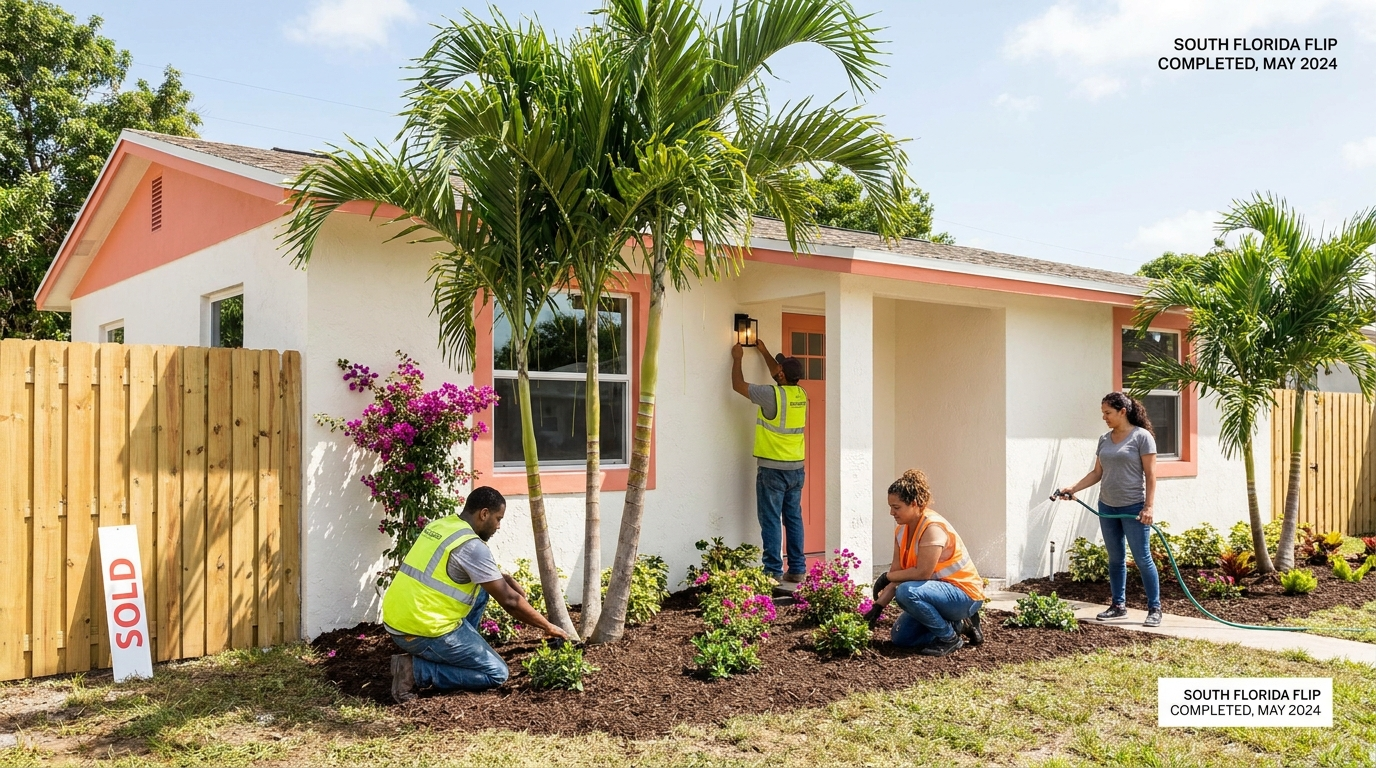
Even the best contractors need active oversight. Check the job site every two to three days. Review all work before releasing draws. Build a punch list throughout the project rather than discovering everything at the end. Take photos at every stage. They document progress and protect you if a dispute comes up.
Investors who consistently deliver profitable South Florida flips treat contractor management as an active, ongoing part of their job, not something to hand off and forget. Use our Fix & Flip Calculator to model your renovation budget and expected profit before you start. Ready to find flip deals in South Florida? Connect with our investor team. Also see our complete guide to getting started flipping houses.
Florida construction lien law is the risk nobody mentions
This is the part that turns a manageable renovation into a genuine problem, and most first time flippers have never heard of it until it happens.
Under Florida's construction lien law, subcontractors and material suppliers who work on your property can record a lien against it. That holds even when you have already paid your general contractor in full. If the general contractor took your money and did not pay them, the lien is still against your property and your title.
You may receive a document called a notice to owner from parties you never hired. It is not a bill and it is not an accusation. It is a formal notification that someone is working on your property and preserving lien rights, and it tells you exactly who must be accounted for before you release further payment.
The procedure, deadlines and forms are technical and unforgiving. This section describes the shape of the risk rather than the rules, and anyone flipping in Florida should have a construction attorney explain the current requirements once. That conversation is cheap relative to a lien on a property you are trying to sell.
Release payment against waivers, not against progress
The practical defence is simple and it is a discipline rather than a document.
Ask for lien waivers from every party who has been paid, at every payment stage, before releasing the next one. Track the notices to owner you receive and reconcile them against the waivers you hold. Where the sums are significant, joint cheques payable to the contractor and the supplier together are a straightforward way to ensure the money reaches the person who could otherwise lien you.
Never pay substantially ahead of completed work. A deposit to secure a start is normal; funding the whole job in advance removes every piece of leverage you have and is how abandoned projects begin.
Verify the licence yourself
Florida licenses construction trades at state and county level, and verification is free through the Department of Business and Professional Regulation. Do it yourself rather than accepting a photograph of a card.
Confirm the licence is current, that it covers the category of work you need, and that the name on it matches the entity you are contracting with. Then confirm insurance directly with the insurer rather than from a certificate the contractor hands you, and check workers compensation coverage, since an uninsured injury on your property is your exposure.
Permits are your problem, not just theirs
Unpermitted work is a liability that attaches to the property and surfaces when you sell. A buyer's inspector or the county record will reveal it, and closing can stall while it is resolved.
Establish before work starts who is pulling permits and make sure it is the contractor rather than you as owner builder, because that designation shifts responsibility onto you. Keep the permit and inspection record with the project file, since it becomes part of the sales package and answers a question buyers reliably ask.
Write the contract so it can be enforced
A quote is not a contract. What you want is a written agreement with a defined scope, in enough detail that a dispute has an answer. It needs a fixed price or a clear basis for variation. It needs a payment schedule tied to completed and inspected milestones, plus a start date and a completion date. Materials should be specified by make and model rather than by adjective.
Vague scope is the most common cause of overrun. Where the document says quality fixtures rather than naming them, you will pay twice: once in the argument and once in the change order.
Managing the schedule is your actual job
Interest and holding costs run whether or not anyone is on site, so an idle week is a direct cost to you and to nobody else. That misalignment is why supervision matters.
Visit regularly and at unannounced times. Keep decisions ahead of the trades, since a crew waiting on your tile selection is a crew working somewhere else next week. And resolve problems immediately rather than at the end, because a defect discovered at handover is far harder to get fixed than one raised the day it appeared.
More common questions
Can I use an unlicensed contractor to save money?
It exposes you on permits, insurance and enforcement, and it complicates resale where work required a permit. The saving is rarely worth it.
What is a reasonable deposit?
Enough to secure materials and a start, not the majority of the job. Structure the rest against completed milestones.
Do I need a contract for small jobs?
Yes, in writing. Scope disputes on small jobs are just as awkward and the document takes minutes.


