

What Is ARV in Real Estate? (And How to Calculate It in South Florida)
June 9, 2026 · 6 min read · By Onias Derilus, Broker
ARV, after-repair value, is the single most important number in house flipping. Get it right and you protect your profit. Get it wrong and you lose money. Here's how to calculate it correctly in South Florida.
ARV stands for after-repair value. It is the estimated market value of a property once it has been fully renovated. What is arv, exactly? It is the foundational number in every fix-and-flip deal, every BRRRR calculation, and every hard money lending decision. In South Florida's market, knowing how to calculate ARV accurately is what separates a profitable flip from a costly mistake.
Why ARV matters so much
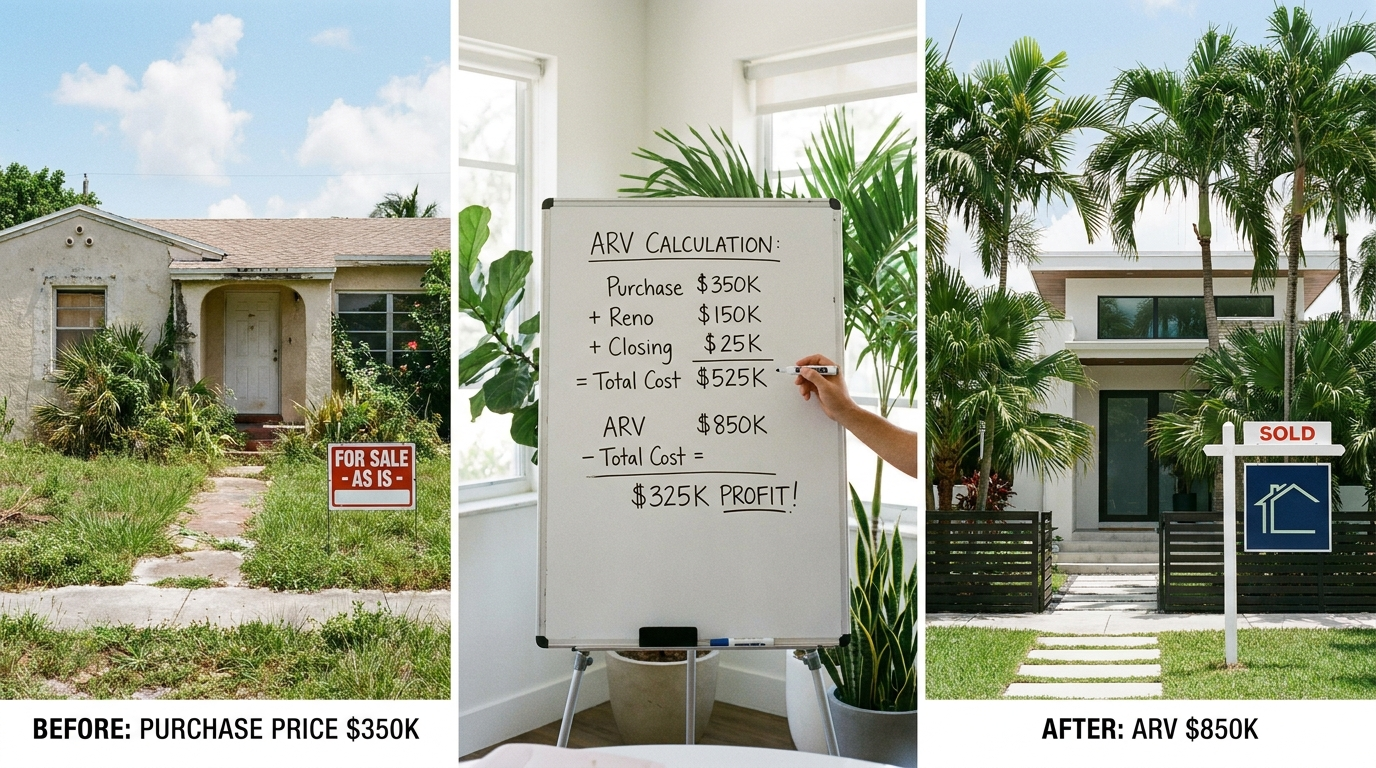
ARV drives every other number in a flip deal. The 70% rule (the primary formula for determining maximum purchase price) is built directly on ARV:
Maximum Purchase Price = (ARV x 0.70) - Estimated Repair Costs
If your ARV is off by 10%, your maximum purchase price shifts by 7%, and your entire profit margin can evaporate. A flip that looks like a $40,000 profit at one ARV might look like a $10,000 loss at a more accurate one. Experienced investors spend more time on ARV analysis than on any other part of deal evaluation for exactly that reason.

How to calculate ARV in South Florida
ARV is determined by analyzing comparable sales (comps): recently sold properties in the same neighborhood that resemble what your subject property will look like after renovation. Here is how to do it correctly:
- Define your search area tightly. In South Florida's patchwork of neighborhoods, the right comps are often within 0.25 to 0.5 miles of the subject property. A comp two miles away in a different neighborhood is usually meaningless.
- Match the condition. You are estimating value after renovation, so your comps should be fully updated, move-in-ready properties. Distressed comps have no place in an ARV calculation for a renovated home.
- Match the key features. Bed count, bath count, square footage (plus or minus 15%), garage or no garage, pool or no pool, lot size. Each difference requires an adjustment.
- Use recent sales. In South Florida's market, pull sales from the last 3 to 4 months. Older comps in an appreciating market understate ARV; in a softening market, they overstate it.
- Pull multiple comps. One comp is not enough. Find at least 3 to 5 comparable sales and bracket your estimate with a low, mid, and high scenario.
Common ARV mistakes South Florida investors make
- Using Zillow's Zestimate as ARV. Zestimate is an algorithm-generated estimate, not a professional valuation. It routinely misses by 5 to 15% in South Florida's heterogeneous neighborhoods. Never use it as your ARV.
- Using active listings instead of sold comps. List prices are asking prices. Sold prices are what the market actually paid. ARV must be grounded in what properties closed for.
- Ignoring condition adjustments. A fully renovated comp in the same neighborhood may have granite countertops, new flooring, and updated bathrooms. If your planned renovation is more modest, your ARV should be adjusted downward accordingly.
- Expecting renovations to add more value than they cost. In South Florida, some renovations add close to dollar-for-dollar value (kitchen, baths, curb appeal). Others return less than their cost (pools, additions in certain price ranges). Know what the local market rewards before you budget.
Getting ARV right in South Florida's market
South Florida's neighborhoods are highly localized. Values can change street by street in some markets. A property two blocks off a major road may command $30,000 more than an identical property on it. Gated vs. non-gated matters in certain price ranges. School district boundaries matter in family-oriented markets. These nuances require local expertise to navigate correctly.
Our team pulls comp analyses for investor clients as part of deal evaluation support. Use our Fix & Flip Calculator with your ARV and repair estimates to see the full profit projection on any deal. If you want help pulling comps on a South Florida property you are considering, reach out here. Also see our complete flip guide for beginners.
If someone just used this formula on you
Plenty of people meet the term ARV for the first time because an investor has made them an offer. If that is you, the formula is worth seeing in full, because it explains exactly where the number came from.
The common version is the seventy percent rule. An investor takes the after repair value, multiplies it by 0.7, then subtracts the estimated repair cost. On a house with an after repair value of $480,000 and $60,000 of work, that is $336,000 minus $60,000, so an offer around $276,000.
That thirty percent is not profit. It has to cover the purchase costs, the financing, the months of holding, the selling costs and the risk of being wrong about the repairs. But it does mean the offer in front of you is built to leave room, and the room is the point.
So the useful question for an owner is not whether the offer is fair. It is whether your house genuinely needs the repairs being assumed, and whether an ordinary sale would net you more even after commission and time. Frequently it does, and the gap is large.
Deriving after repair value properly
The number is only as good as the comparable sales behind it. Use closed sales rather than active listings, because a listing tells you what somebody hoped for and a closing tells you what a buyer paid.
Keep the comparables tight. Same neighbourhood, similar square footage, similar lot, and ideally within the last three to six months. Then adjust for real differences such as an extra bathroom, a garage, a pool or waterfront access.
Most importantly, the comparables must be homes in finished condition, because that is what you are producing. Comparing against other distressed sales gives you the value of an unfinished house, which is the mistake that quietly ruins a deal.
Where the seventy percent rule breaks
The rule was built for moderately priced markets, and it distorts at both ends of ours. On a $180,000 house in Highlands or Okeechobee, thirty percent is $54,000, which barely covers fixed costs that do not shrink with the price.
At the other end it overcorrects. On a $1,200,000 Palm Beach Gardens property, thirty percent is $360,000, which is far more margin than the deal needs and will lose you every competitive bid.
Treat the rule as a screening shortcut rather than an underwriting method. Real underwriting builds the actual costs from the bottom up and asks what profit remains, which is a different exercise and a more honest one.
How lenders and appraisers see it
Your ARV is an opinion. The appraiser's is the one that decides whether your buyer's loan closes.
Appraisers work from the same closed sales you should be using, and they are conservative about improvements that do not add measurable square footage. A high specification kitchen in a modest neighbourhood rarely returns what it cost, because the appraisal is anchored to the street rather than to your invoices.
Renovation lenders take a similar view when they underwrite a project. Being able to defend your ARV with specific closed sales, rather than with enthusiasm about the finish level, is what gets a deal financed.
The ceiling nobody wants to hear about
Every neighbourhood has a price point above which buyers stop paying, regardless of what you spent. Over improving past that ceiling converts your budget into someone else's bargain.
Find the ceiling before you plan the work. Look at the highest closed sales in the immediate area over the past year, then set your target below that rather than at it. Aiming to be the most expensive house on the street is a strategy that relies on finding an unusual buyer.
Condominiums need a different sanity check
ARV on a condominium is not just a function of the finishes, because the building sets a ceiling the unit cannot escape. Two identical renovated units in different buildings can be worth very different amounts.
Check the monthly fee, the reserve position and any pending special assessment before you commit to a number. Buyers qualify on the total monthly payment, so a high fee compresses what anyone can offer regardless of how good the kitchen looks. In older Florida buildings the reserve funding now required by law is the single biggest swing factor.
More common questions
Is ARV the same as market value?
No. Market value is what the property is worth as it stands today. ARV is what it should be worth once specified work is finished, which makes it a forecast rather than a measurement.
Who decides the repair estimate in that formula?
Usually the investor making the offer, which is worth knowing. Get an independent contractor quote before accepting a number that was produced by the person buying from you.
Can I calculate ARV myself?
You can get close using recent closed sales in your immediate area. An agent can pull the full comparable set and the adjustments, which is where the accuracy lives.
Would an ordinary sale net me more than a cash offer?
Often, and it is a question worth answering with numbers rather than assumptions. We will run both figures side by side on any property in the eight counties we serve.


