

How to Flip Houses With No Money in South Florida (What Actually Works)
June 9, 2026 · 6 min read · By Onias Derilus, Broker
Flipping houses with no money of your own is possible, but it requires one of three things: a lender's capital, a partner's capital, or a strategy that doesn't require buying the property at all. Here's what actually works in South Florida.
Can you learn how to flip houses with no money? The honest answer: not quite. You can flip houses with very little of your own money by using other people's capital strategically. South Florida investors use several proven approaches to get into deals without deploying large amounts of personal capital. Here is what actually works, and what is mostly wishful thinking.
Hard money lending: the most common path
Hard money lenders are private lending companies that specialize in short-term, asset-based loans for real estate investors. They lend based primarily on the property's value, not your credit score or income, and they can fund in days rather than weeks.
In South Florida, hard money lenders typically offer:
- 65 to 75% of ARV (after-repair value) financed
- 12 to 18% interest rates, significantly higher than conventional
- 2 to 4 origination points (2 to 4% of the loan amount)
- 6 to 12 month loan terms
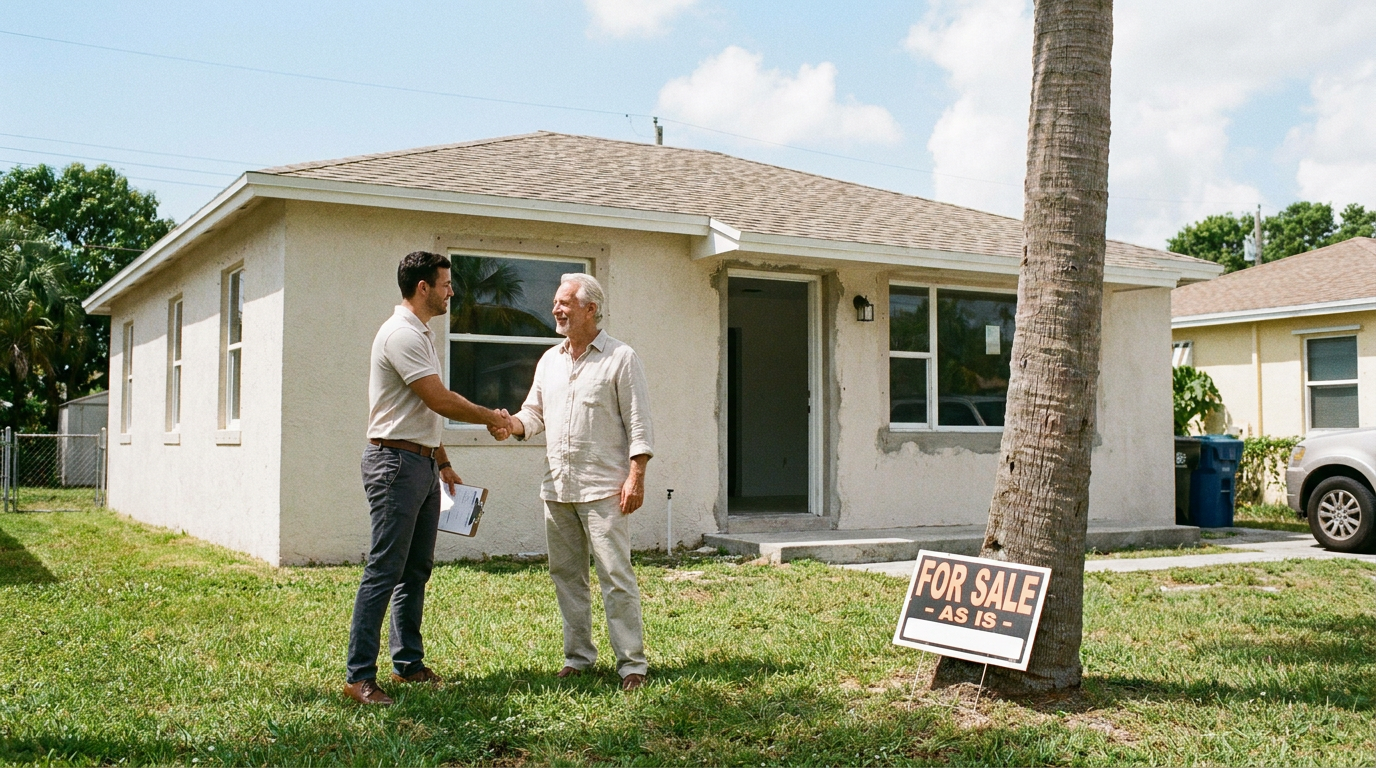
You still need cash at closing. That is typically 20 to 30% of the purchase price plus closing costs, but far less than buying conventionally. On a $250,000 South Florida purchase, that might mean $55,000 to $75,000 of your own money. Hard money does enable deals that conventional financing cannot touch, particularly distressed properties that will not appraise for conventional loans.
Private money: friends, family, and investors
Private money is capital from individuals, not institutional lenders, who want to earn a fixed return on a secured real estate investment. A private lender might be a family member, a colleague, or a local real estate investor who prefers lending to owning. Terms are fully negotiable. Typical private money rates in South Florida run 8 to 12% with varying equity arrangements.
Finding private money requires relationship building. Attend local Real Estate Investor Association (REIA) meetings. Network with established investors who may want to put passive capital to work. Demonstrate your deal competency with a solid track record or a detailed pro forma analysis.
Joint ventures and equity partnerships
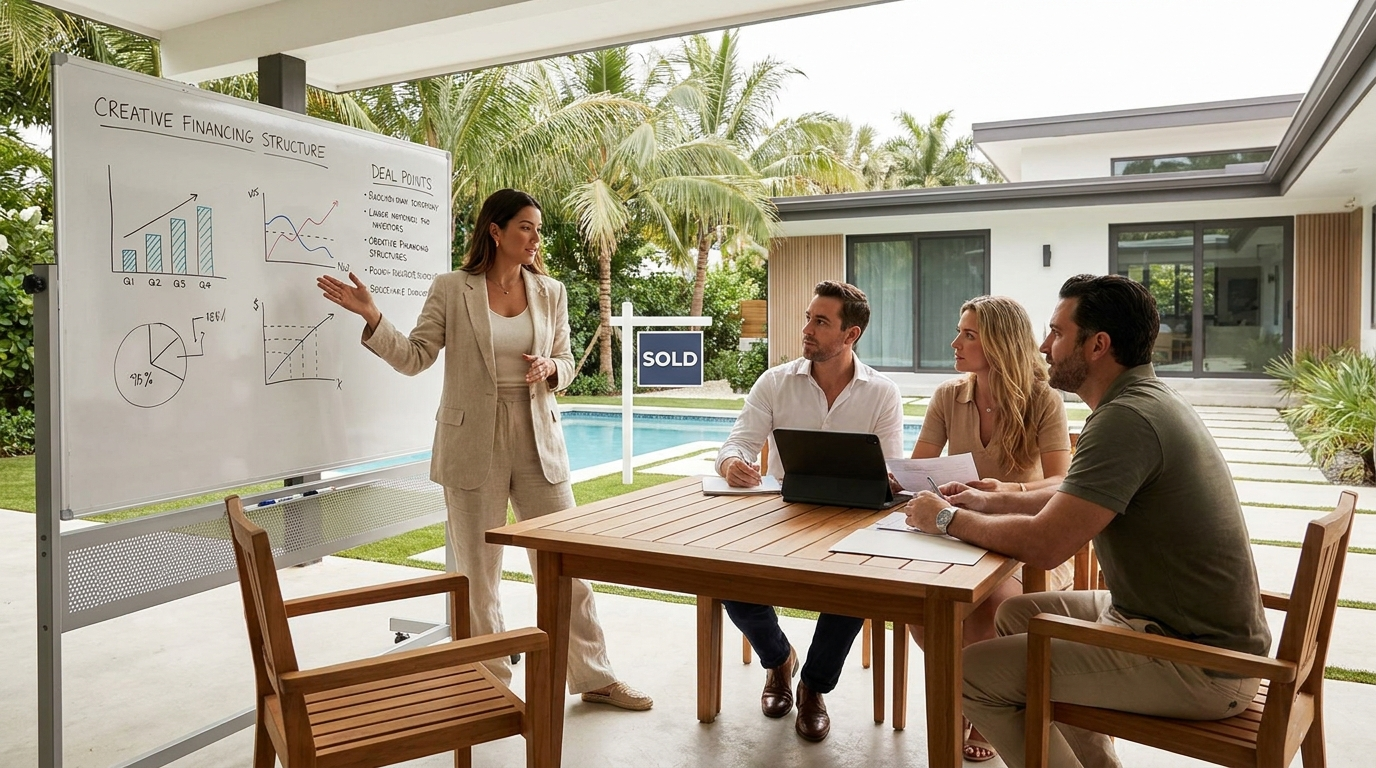
The "no money" model that most closely lives up to its name involves finding a money partner and contributing your deal-sourcing, project management, or sweat equity in exchange for a profit split. Common structures include:
- 50/50 split: partner brings all capital, you find and manage the deal
- 70/30 or 60/40: weighted toward the capital provider for riskier deals
- Preferred return plus split: the capital partner gets a 10 to 12% preferred return on invested capital first, then profits split
To attract money partners, you need to demonstrate credibility through your knowledge, your team (contractor, agent, and lender relationships), or a track record of successful deals. Your first joint venture is the hardest to structure. After one successful project, future partners are much easier to find.
Wholesaling as the entry point with zero capital
Wholesaling is the closest thing to truly no-money real estate. You put a distressed property under contract and sell that contract to a buyer without ever owning it. No mortgage, no renovation, no ownership risk. Assignment fees in South Florida typically run $8,000 to $25,000 per deal.
Wholesaling is not flipping in the traditional sense, but it is a legitimate path for investors with zero capital to generate cash they can then deploy into actual flips. Many successful South Florida flippers started as wholesalers and transitioned once they had accumulated enough capital.
The honest truth about "no money" flipping
Every "no money" strategy requires something: a lender's capital (with associated costs), a partner's capital (with shared profits), or a strategy that bypasses ownership entirely like wholesaling. None of them are truly free. What they do is lower the capital barrier significantly. Instead of needing $100,000 or more in cash, you need credibility, a good deal, and the right relationships.
Use our Fix & Flip Calculator to model any deal you are considering, including hard money carrying costs. If you need help finding investor-friendly properties in South Florida or connecting with financing sources, reach out to our team. Also review our complete flip guide for new investors.
Frequently asked questions
Can you flip a house with no money down?
Not in the traditional sense. Every strategy that lets you flip without large personal capital still involves someone's money: a hard money lender, a private individual, or an equity partner. What changes is whose capital is at risk and how you compensate them for it.
What credit score do you need for hard money loans in South Florida?
Hard money lenders focus on the property's value and your exit strategy, not your credit score. Many will lend to investors with scores in the 600s. Some have no minimum credit requirement at all. Your ability to demonstrate a viable deal matters far more than your credit history.
How do I find private money lenders for flipping?
Start at local REIA meetings. Florida has active investor associations in Palm Beach County, Broward, and Miami-Dade. Introduce yourself, share what types of deals you are targeting, and listen. Many private lenders are former or current investors who prefer earning a fixed return to managing properties themselves.
Is wholesaling legal in Florida?
Yes. Florida law allows contract assignment, but as of 2023 wholesalers marketing properties they do not own must hold a real estate license or operate under specific disclosure rules. If you plan to wholesale in Florida, review the current statute or speak with a real estate attorney before marketing your first deal.
What is a realistic profit target for a first flip?
Most experienced South Florida flippers target a minimum of $30,000 net profit per deal after all costs, including acquisition, renovation, holding, and selling costs. First-timers often underestimate renovation costs and carrying charges. Budget conservatively, add a 15 to 20% contingency to your rehab estimate, and run the numbers through a calculator before you make an offer.
Read the phrase precisely, because it is doing a lot of work
No money in this context almost always means no money of your own for the purchase and renovation. It does not mean no money at all, and confusing the two is how first projects fail.
Even with a lender funding the purchase and the renovation, you will generally need cash for several items. Those are origination costs and points, an appraisal and inspections, and closing costs. Add insurance including vacant property cover, plus utilities and taxes during the project. Keep a reserve for the overrun ordinary projects produce.
So the honest framing is that these strategies reduce the largest barrier while leaving a real capital requirement behind. Anyone presenting them as requiring nothing is selling something, usually education.
What a hard money lender is actually underwriting
Understanding this explains why the strategies work at all and where they stop working.
These lenders underwrite the deal more than the borrower. They lend against the property's value and the strength of the project, which is why a borrower with limited capital can still get funded on a good enough purchase.
What they generally will not do is fund the whole thing. Expect them to advance a percentage of purchase and a percentage of renovation, with the gap left to you, and expect renovation money to arrive in draws against completed and inspected work rather than upfront. That draw structure is the specific reason you need working capital even on a fully financed project: you pay the contractor, then get reimbursed.
Ask about the advance rate, the draw process and how quickly draws are funded before you rely on any of it.
Partnering is the honest route, and it should be documented
For someone genuinely without capital, the realistic path is not a financing trick. It is bringing something other than money to a deal.
That usually means finding the property, managing the renovation, or handling the sale, while a partner funds it. It is a real business arrangement rather than a shortcut, and doing your first deal as the junior partner in someone else's is the fastest way to learn what you do not know at somebody else's risk.
Document it properly. Who contributes what, who decides what, how profit splits, what happens if the project runs over budget and who funds that, and what happens if one party wants out. Verbal partnerships between friends are where relationships and money are lost simultaneously.
Wholesaling as an entry, with the legal position stated
Assigning a contract you hold to another buyer for a fee is a common entry point because it requires little capital, and it needs care in Florida.
Assigning a contract you genuinely hold is generally lawful. Marketing property you do not own can cross into unlicensed brokerage activity, which Florida regulates, and the line depends on what is actually being advertised and to whom. That is a legal question rather than one to resolve from an article, so take advice from a Florida real estate attorney before building a business on it.
Treated as education rather than as a career, it teaches deal analysis and negotiation quickly, which transfers directly to flipping with your own capital later.
Why undercapitalised flips fail
The failure mode is specific and worth naming, because it is not usually the market.
Something ordinary goes wrong: the renovation runs thirty percent over, a permit takes three extra weeks, the sale takes longer than the county average. With no reserve, work stops. A half finished house is the most expensive possible state, since it cannot be sold at full value, cannot be rented, and continues accruing interest.
At that point the exits are all bad, which is how a project with a reasonable margin at purchase ends in a loss. The reserve is not a nicety; it is the thing that lets an ordinary problem stay ordinary.
More common questions
Can I really flip with nothing?
Realistically no. Financing reduces the largest barrier while closing costs, carrying costs and a reserve remain. Partnering is the honest route for someone with no capital.
Why do I need cash if renovation is financed?
Because draws reimburse completed work. You pay the contractor first and get repaid afterwards, so working capital is required throughout.
Is wholesaling a good first step?
As education it teaches analysis and negotiation cheaply. Get legal advice on the Florida position before treating it as a business.


