

How Many Houses Can You Flip in a Year in South Florida? (2026 Reality Check)
June 9, 2026 · 6 min read · By Onias Derilus, Broker
How many houses can you flip in a year? One is a start. Ten is a full-time business. Twenty-plus is a scaled operation. Here's what each level requires in South Florida's market, and how to get to the next one.
How many houses can you flip in a year? It is one of the first questions aspiring South Florida investors ask, and the answer varies enormously based on your capital, your systems, your team, and your experience level. Here is an honest breakdown of what different flip volumes actually look like in practice.
The math of flipping volume: what limits you
The number of houses you can flip in a year comes down to a few constraints working against you at the same time.
- Capital ties up your cash on every active flip. Each project absorbs acquisition costs, renovation funds, and carrying costs. Until a flip sells and that capital comes back, you cannot redeploy it. With $200,000 available and four-month average hold times, you can realistically run two or three simultaneous flips and close six to nine per year.
- Contractor capacity is the next wall. Most South Florida flippers find that managing more than three or four concurrent renovations without a dedicated project manager creates quality problems and blown timelines.
- Deal flow is the hardest constraint at any volume level. Consistent lead generation (marketing spend, agent relationships, wholesale networks) takes time and money to build.
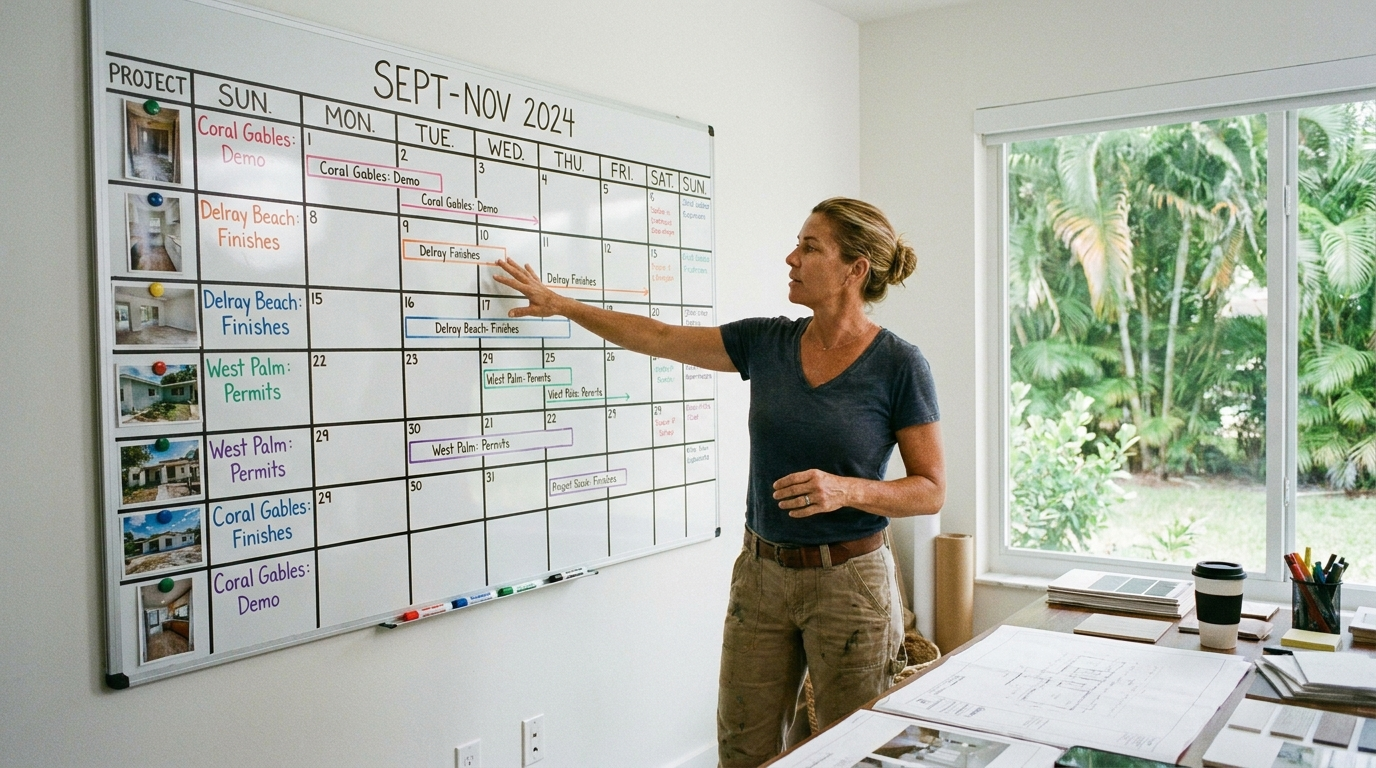
What different flip volumes look like in South Florida
1 to 3 flips per year (beginner/part-time). This is where most investors start. One flip at a time, personally managing the renovation, learning the market. Capital requirement: $80,000 to $150,000 per flip (purchase plus renovation plus carrying). Annual profit potential: $50,000 to $150,000 before taxes. Time commitment: 10 to 20 hours per week.
4 to 8 flips per year (active investor). You are running one or two concurrent flips with a reliable contractor and starting to systematize: consistent draw schedules, standardized finishes, growing agent relationships. Capital requirement: $300,000 to $600,000 total deployed. Annual profit potential: $150,000 to $350,000. Time commitment: 25 to 40 hours per week.
10 to 20 flips per year (professional operator). This is a full-time business. Multiple concurrent projects, a dedicated project manager, established wholesale relationships and a real marketing budget, lender relationships for portfolio financing. Capital requirement: $1M or more deployed at any time. Annual profit potential: $400,000 to $1M or more. Time commitment: a full-time team.
20-plus flips per year (scaled operation). Rare. Requires institutional-quality systems, multiple contractor teams, dedicated acquisitions staff, and usually investor capital beyond personal funds. The top South Florida flippers at this volume are running $5M to $20M-plus annual businesses.
South Florida-specific constraints
South Florida has a few factors that affect flip volume more than most markets.
- Permit timelines. County building departments in Palm Beach, Broward, and Miami-Dade can run four to twelve weeks for permit approval on larger renovation scopes. That extends hold times compared to markets with faster permitting.
- Insurance complexity. Renovation insurance (vacant property, builder's risk) is more expensive and harder to obtain in South Florida. Budget for it and get it in place before closing.
- Contractor availability. South Florida's construction labor market is tight. Experienced renovation contractors who execute investor flips on tight timelines are in demand and often booked weeks out.
How to increase your flip volume
The path to higher volume is sequential. Master one flip before trying to run two. Master two before trying three. Each step up requires solving the next binding constraint, which is usually capital (solved by reinvesting profits or bringing in investor capital), contractor capacity (solved by building a second crew), or deal flow (solved by increasing marketing spend or expanding referral relationships).
Use our Fix & Flip Calculator to model deals at any scale. Our team helps South Florida investors find deals across all six counties and evaluate whether a property's numbers work before committing. Connect with us to discuss your flip strategy, and see our contractor guide for building the team that makes volume possible.
Capital cycles are the real limit
Most people assume the constraint is finding deals. In practice it is how fast your money comes back, because the same dollars cannot be in two houses at once.
Work out your cycle time honestly. Acquisition and closing takes perhaps three to six weeks, renovation on a typical cosmetic project runs eight to twelve weeks, and then the property has to sell. Palm Beach County currently averages about 107 days on market, and closing after an accepted offer adds another thirty to forty five days.
Add it up and a smooth median deal runs close to eight months from start to cash in hand. One pool of capital therefore supports roughly one and a half projects a year, not four.
Where the counties differ
Marketing time varies more than anything else in this calculation. Palm Beach and St. Lucie average about 107 days, Broward 124, Miami-Dade 137, Okeechobee 144 and Highlands 206.
That Highlands figure is roughly three extra months of interest, tax, insurance and utilities on every single project. Cheap entry prices inland genuinely exist, and so does the carrying cost that eats them. Model the market you are actually buying in rather than a national average.
Running projects in parallel
Throughput improves by overlapping rather than by rushing. While one house is on the market, another can be under renovation and a third under contract, so capital and crews are never idle.
This requires more capital, not less, and it requires the discipline to keep buying when you already have money committed. It also multiplies your exposure if the market turns, since three unsold houses cost three times as much to carry as one.
The constraints that are not money
- Permits and inspections. Timelines vary by municipality and are outside your control. Anything structural, electrical or plumbing adds review time, and a failed inspection restarts a queue.
- Contractor capacity. A good crew is the genuine bottleneck. Trying to run four simultaneous projects with a crew that can handle two produces four slow projects rather than four fast ones.
- Your own attention. Flipping is project management. Beyond a certain count you are no longer supervising, and that is exactly when overruns appear.
- Insurance and financing limits. Lenders cap concurrent exposure to a single borrower, so your third and fourth simultaneous loan may simply be unavailable.
What different volumes actually require
One or two a year is achievable for an individual with a single pool of capital and a day job. This is where nearly everyone starts and where many sensibly stay.
Four to six a year generally means multiple capital sources, a dedicated crew or two reliable general contractors, and someone treating this as their main occupation. Ten or more is a business with staff, systems and a pipeline, not a person doing projects.
Be honest about which of these you are building, because the middle is the uncomfortable place. Enough volume to need systems and not enough to justify them is where most people burn out.
Improving throughput without adding risk
Shorten the marketing phase by pricing to the comparable set on day one rather than testing a high number for a month. Every week of testing costs interest and holding, and a stale listing sells for less anyway.
Standardise the renovation specification so material choices are not remade on every project. Line up the next acquisition before the current one lists, and keep a relationship with more than one lender so a slow approval does not stall a cycle.
Measure your own cycle rather than guessing
The numbers above are averages, and yours will differ. Track four dates on every project: the day you closed, the day work started, the day it listed and the day it funded.
After two projects you will know your real acquisition lag, your real renovation duration and your real marketing time. That is the only reliable basis for planning volume, and it is nearly always slower than the plan you made before you started.
Track cost overruns the same way. If your renovations consistently run twenty percent over quote, that is not bad luck, it is your estimating baseline, and the fix is to underwrite the next deal at the higher figure rather than hoping for a better contractor.
More common questions
Can I flip a house in three months?
Occasionally, with a light cosmetic project and a fast sale. Do not build a plan on it, because the median outcome in our counties is considerably longer.
Is it better to do more deals or better deals?
Better deals, almost always. Volume multiplies whatever your per deal margin is, and multiplying a thin margin by four just multiplies the risk.
How much capital does two a year need?
Enough for the down payment, the full renovation budget and at least six months of holding on one project at a time, plus a reserve for an overrun. Underfunding the reserve is what turns a slow deal into a forced sale.


