

How Many Rental Properties to Make $10,000 a Month in South Florida
June 9, 2026 · 7 min read · By Onias Derilus, Broker
$10,000 a month in passive rental income is a real goal, but how many properties does it actually take in South Florida? The answer depends on your strategy, financing structure, and market. Here's the math.
How many rental properties to make $10,000 a month is one of the first questions serious investors ask when they start building toward financial independence. The honest answer: it depends on your net cash flow per property, your financing structure, and which South Florida market you're buying in. Here's how the actual numbers work.
The key metric: cash flow per door
The number of properties you need is set by your net cash flow per property. Net cash flow is what's left after subtracting mortgage payments, property taxes, insurance, maintenance reserves, property management fees, and vacancy from your rental income.
In South Florida's current market, realistic cash flow by strategy looks like this:
- Leveraged single-family rental (25% down, conventional financing): $200 to $600/month net in most Palm Beach/Broward submarkets, higher in inland markets like Port St. Lucie or Sebring.
- Leveraged small multifamily (2 to 4 units): $400 to $900/month net total, depending on rents and financing.
- All-cash single-family rental: $800 to $1,500/month net (no mortgage payment, but significantly more capital deployed).
- Short-term rental (Airbnb/VRBO): $1,500 to $4,000+/month net in high-demand coastal areas, with more management intensity and higher insurance costs.
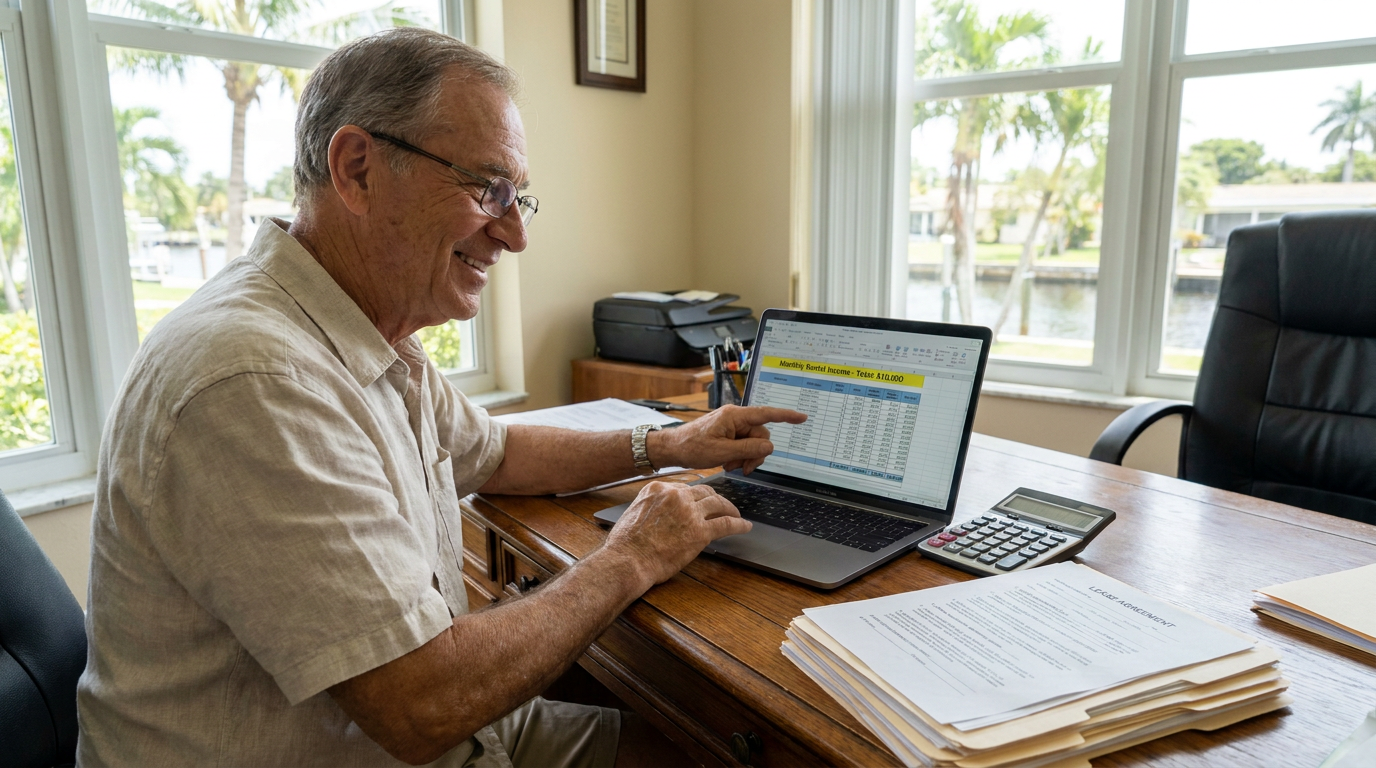
How many properties to make $10k/month: the math
Using realistic South Florida cash flow figures:
- At $500/month net per property: 20 properties needed.
- At $700/month net per property: roughly 15 properties needed.
- At $1,000/month net per property: 10 properties needed.
- At $2,000/month net (STR or all-cash): 5 properties needed.
Most investors using leveraged long-term rental strategies realistically need 15 to 20 properties to hit $10,000/month net. That's a meaningful portfolio, but it's achievable over 8 to 12 years with disciplined reinvestment of equity and cash flow.
A realistic South Florida example
Take a 3/2 in Port St. Lucie priced at $285,000. You put 25% down ($71,250). After a 7% interest rate mortgage, taxes, insurance, and a 10% management fee, you net approximately $520/month. You'd need 20 similar properties to reach $10,400/month.
Compare that to the all-cash route on the same property: buy it outright for $285,000. Net cash flow climbs to approximately $1,350/month with no mortgage payment. You'd need only 8 properties, but you'd have $2.28 million deployed versus roughly $1.4 million in down payments for the leveraged approach.
Leverage accelerates portfolio growth. All-cash maximizes cash flow per property. Most successful investors use a combination: buy leveraged, refinance as equity grows, and pay off select properties to increase cash flow as they close in on their income target.
How to reach $10k/month faster
Investors who hit this goal on the shorter timeline follow a consistent pattern:
- Buy in appreciation markets first. South Florida coastal markets may have tighter initial cash flow, but equity growth lets you pull out capital for the next purchase faster.
- Use the BRRRR strategy. Buy, Rehab, Rent, Refinance, Repeat recycles your capital into the next deal. See our BRRRR calculator guide for the numbers.
- Reinvest cash flow for the first five years. Every dollar that goes back into the portfolio compounds. Investors who pocket early cash flow reach $10k/month years behind those who reinvest it.
- Target markets with landlord-friendly laws. Florida's eviction process and no-rent-control environment protect your cash flow. See our guide to landlord-friendly states.
Use our Rental Property ROI Calculator to model cash flow on specific properties before you buy. Explore investment opportunities across our service area counties in South Florida. Each county offers a different cash flow vs. appreciation profile. For additional research, see Florida Realtors investor resources.
Ready to build your South Florida rental portfolio?
Pure Equity works with investors across Palm Beach, Broward, St. Lucie, and surrounding counties. We can help you identify cash-flow-positive properties, analyze deals, and structure your acquisitions. Contact us or browse available properties to get started.
Frequently asked questions
How many rental properties does it take to make $10,000 a month?
With leveraged long-term rentals in South Florida averaging $400 to $600/month net cash flow, most investors need 17 to 25 properties. All-cash purchases or short-term rentals can reduce that number to 5 to 12, depending on location and property type.
What's more important: number of properties or cash flow per property?
Cash flow per property matters more. Ten properties generating $1,000/month each hits your goal. Twenty generating $500/month gets you there too, but with twice the management overhead, twice the financing complexity, and twice the vacancy risk. When you can buy a property with higher per-door cash flow, that's nearly always the better path.
Is $10,000/month from rentals realistic in South Florida?
Yes, though it typically takes 8 to 15 years to build the portfolio unless you're starting with substantial capital. Investors who begin with 2 to 3 properties and systematically reinvest equity into additional purchases reach this level. The math works. The timeline is the harder part.
Which South Florida counties are best for rental cash flow?
St. Lucie, Okeechobee, and Highlands counties generally offer better initial cash flow than coastal markets in Palm Beach or Broward. Coastal markets tend to appreciate faster, giving you more equity to pull forward for the next acquisition. Your strategy should determine which county you prioritize first.
Should I use leverage or pay cash for rental properties?
Both have a place in a portfolio. Leverage lets you control more properties with the same capital, which grows your portfolio faster early on. Paying off properties increases per-door cash flow and makes your income more stable long-term. Many investors leverage heavily in their first decade, then pay down mortgages selectively as they near retirement.
Work it backwards from your own numbers
The honest answer is that no fixed property count exists, because the figure depends entirely on cash flow per property, and that varies enormously by county, price point and financing.
The arithmetic is simple and it has to use your figures rather than published ones. Take a specific property you could actually buy. Work out its monthly net after every cost, then divide $10,000 by that number.
The reason people find this discouraging is not the division. It is that the honest net is far lower than the number they had in mind, because most projections omit half the costs.
The costs that turn a good number into a real one
A realistic monthly net starts with rent and subtracts all of the following. Leave any of them out and the answer is wrong in a predictable direction.
- Mortgage principal and interest, if financed.
- Property tax based on your purchase price, not the seller's capped assessment, since a rental gets no homestead protection.
- Insurance quoted on the specific address as a landlord policy, which differs from an owner occupant one.
- Association fees and any district assessment.
- Vacancy, as an annual allowance rather than an assumption of none.
- Management at roughly eight to twelve percent, whether or not you intend to use it, because a property that only works when you self manage is a job.
- Maintenance and a capital reserve for the roof and air conditioning, which have finite lives and will need replacing.
The last two are the ones most often omitted. Together they often separate a property that clears a few hundred a month from one that clears almost nothing.
Cash flow per door beats door count, and it is not close
Two portfolios reaching the same total behave completely differently, and the smaller one is usually the better business.
Every property adds tenants, turnover, maintenance, insurance renewals, tax reporting and management. Reaching a target with a smaller number of stronger properties means less of all of that for the same income, and fewer things that can go wrong simultaneously.
It also means less exposure. A vacancy in a four property portfolio removes a quarter of the gross rather than a twentieth, so higher per property cash flow has to be weighed against that concentration. The point is that door count is the wrong target, not that more doors is always worse.
The leverage fork changes the whole answer
This is the decision that most affects how many properties you need, and it is a genuine trade rather than a right answer.
Paying cash produces far higher cash flow per property, because there is no debt service, so you need fewer properties. It also ties up your capital, so you acquire more slowly and own less total property.
Financing produces lower cash flow per property and lets the same capital control more properties, which builds equity through loan paydown and amplifies appreciation. It also amplifies losses, adds a fixed obligation that continues through vacancies, and demands larger reserves.
Neither is correct in the abstract. What decides it is whether you want income now with less risk, or a larger asset base over time with more.
Where the region actually supports this
Cash flow generally improves inland and appreciation and liquidity improve toward the coast, and the county figures make the trade explicit.
Median asking prices run about $599,000 in Miami-Dade, $480,000 in Palm Beach, $410,000 in St. Lucie, $390,000 in Broward, $309,000 in Highlands and $274,900 in Okeechobee. Rents do not vary by anything like that ratio, which is why per property cash flow tends to improve as you move away from the coast.
The offsetting cost is your exit. Highlands averages about 206 days on market against 107 in Palm Beach, so an inland portfolio takes roughly twice as long to liquidate. That matters more than it sounds when you eventually want the capital back.
More common questions
Is $10,000 a month realistic here?
Achievable, and it generally takes either substantial capital or many years of compounding. Anyone presenting it as quick is omitting the costs above.
Should I buy cash or finance?
Cash for income now with lower risk, financing for a larger asset base with higher risk and larger reserve requirements. Model both on a real property before deciding.
What is the most common projection error?
Omitting the capital reserve and management. Together they frequently consume most of what looked like the profit.


